O P I N I O N / E Y E W I T N E S S R E P O R T
by Dovid Katz

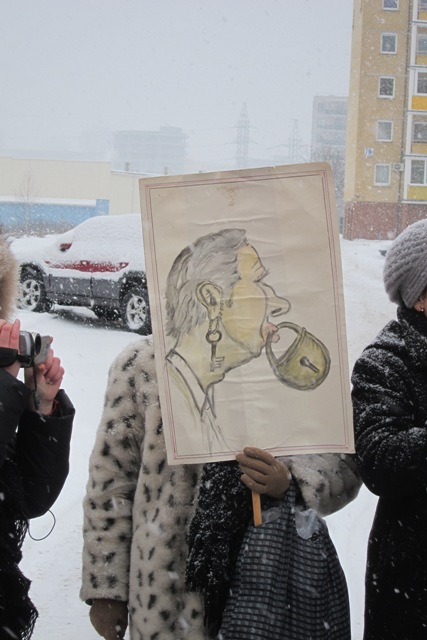
One of the placards carried by pro-Paleckis demonstrators outside the Vilnius courthouse

One of the placards carried by pro-Paleckis demonstrators outside the Vilnius courthouse

◊
Algirdas Paleckis’s critique of legal neo-Nazi parades, legalized swastikas and military personnel participating in Nazi activities — at the November 2011 conference on tolerance in Vilnius: video; translation; report.
Andrius Navickas, a religious studies expert and editor-in-chief of the Bernardinai.lt website, published a rather strange editorial at the end of 2011 taken from a speech he gave over Lithuanian Radio.
Petras Stankeras appeared on the pages of DefendingHistory.com in late November 2010, after publishing on 14 November 2010 in the mainstream Lithuanian weekly magazine Veidas an article in which he called the Holocaust “a myth”, described Ribbentrop’s hanging as a lamentable case of “victor’s justice” (also praising the Nazi foreign minister for conducting himself heroically), and called the Nuremberg Trials “a farce”. A full translation of the article is available here. A subsequent comment piece appeared in this journal early this year.
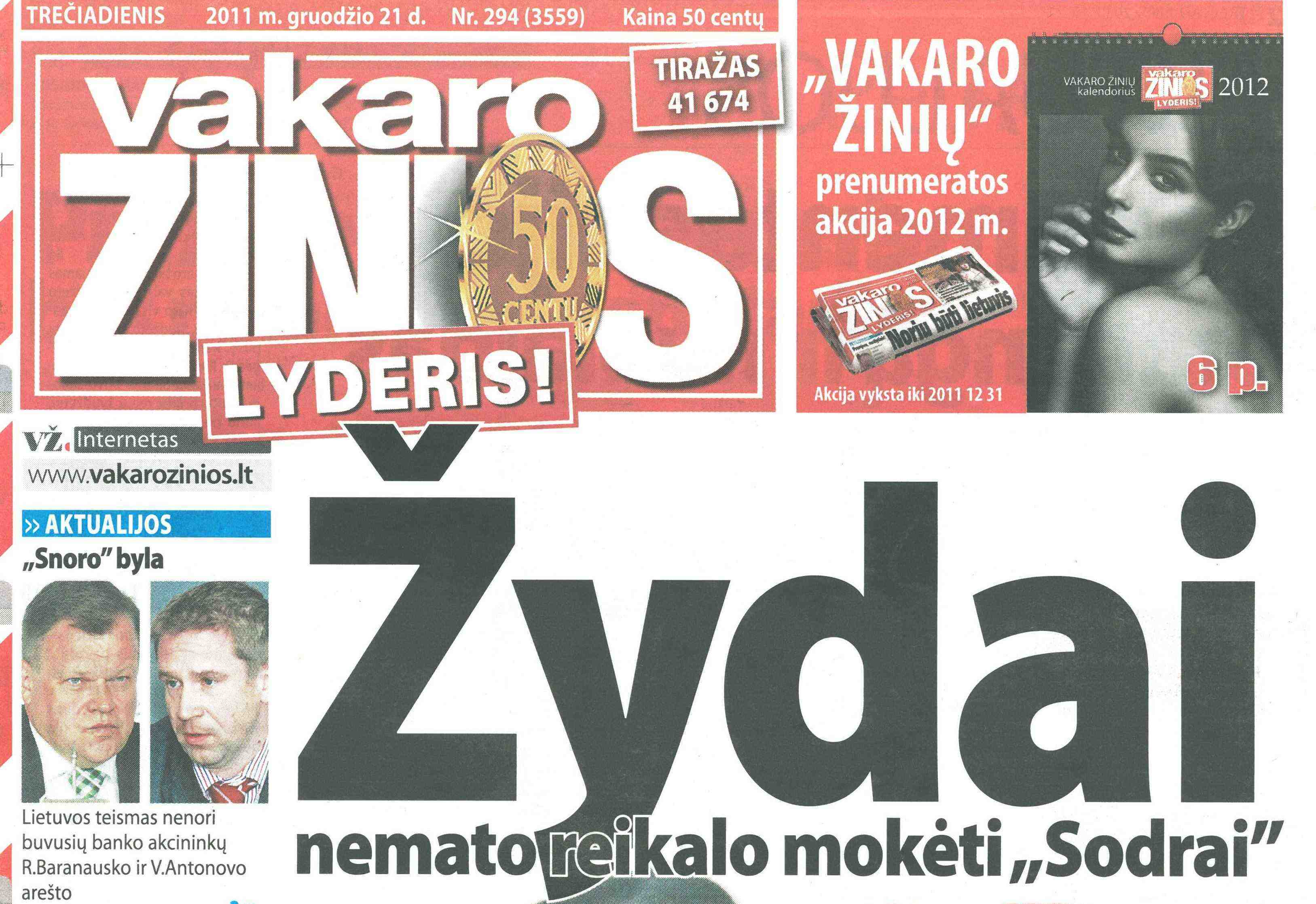
European and North American human rights activists may have thought that Vakaro žinios (‘The Evening News’) could not outdo its past antisemitic sensations, but today’s full front page with a huge banner headline ‘THE JEWS’ may herald a new low in the series of 1930s grade dissemination of hate against Lithuania’s tiny and shrinking Jewish minority. Around 95% of the country’s Jewish population was killed during the Holocaust.
The front page article (PDF here; English translation here) continues on to pages 3 and 5. The outrage caps a December of mainstream publication antisemitic articles. This is the first to ‘feature’ Chabad rabbi Sholom Ber Krinsky. Earlier in the month, long articles appeared targeting Dr. Shimon Alperovich, elected head of the Jewish Community of Lithuania, first in Lithuania’s most prestigious newspaper, Lietuvos rytas (report), and then in the same Vakaro žinios (report).

Expanding on his earlier antisemitic-spirited article — ‘Jews in the Service of Hitler‘ — Česlovas Iškauskas has now published ‘Jews in Service to the Bolsheviks’ on Delfi.lt, a mainstream Lithuanian news website. The article is available here.
The Lazdynai Middle School in Vilnius, built in the early 1970s, has an admirable reputation, inter alia for an excellent trilingual policy enabling Polish and Russian to flourish alongside the national language, Lithuanian, in a spirit of multicultural respect and harmony so fitting for the city’s history.
Updates to May 2013:
Return visit to the Stones of Lazdynai
♦
Updates to 15 December 2011
Samuel Gruber’s Jewish Art and Monuments
Facebook discussion thread
Work in Progress: A Cultural Dictionary of Lithuanian Jewish Gravestones
Suspense is growing in the Lithuanian capital, Vilnius, concerning the verdict in the free speech trial of the flamboyant, controversial young left-wing politician, Algirdas Paleckis. The court’s ruling will be read from the bench next Wednesday 14 December 2011 at 2 PM at the First District Court at Laisves 79, Vilnius. The charge carries a possible one-year prison sentence if Mr. Paleckis is found guilty. A press release was received today from the Lithuania Without Nazism organization (not to be confused with the ‘secret’ internet group ‘Lithuania Without Neo-Nazism’, that some believe to be a manipulated group, somewhat sophomoric, or both).
A colleague sent me a link to an article on the webpage of Lietuvos rytas that appeared in their Sunday edition during the first week of December, 2011 (PDF of the print version; full English translation; report in Defending History.com). The heading on the email said the article was antisemitic.
Lietuvos rytas (“Lithuanian Morning”) has been Lithuania’s main newspaper pretty much since independence from the Soviet Union. The quality of the newspaper has varied over the years, but they at least usually refrain from printing overtly antisemitic material, whereas competing newspapers and their editors-in-chief have made this their bread and butter at certain periods, especially Lietuvos aidas and Respublika, although Lietuvos aidas has all but disappeared as a real newspaper and Respublika appears to have turned into an advertising-driven newspaper distributed for free.
For the first time, there has appeared to be a ‘coordinated antisemitic campaign’ among Lithuanian mass circulation daily newspapers of very different orientations. As reported on DefendingHistory.com yesterday, a massive three page tabloid spread on the 3 December weekend edition of the mainstream paper considered the country’s best, Lietuvos rytas, was replete with the kind of inflammatory language, references and images sure to cause a noticeable upturn in antisemitism in the country.
The weekend edition (dated 3 December 2011) of Lithuania’s most prestigious daily, Lietuvos rytas, contained a massive three tabloid-page antisemitic article on the subject of the restitution law finally passed by the Seimas (parliament) last June. It was constructed as a journalistic inquiry but is replete with multiple and inflammatory antisemitic referencing.
A PDF of the article, which is announced on a front page blurb (titled ‘Mystery of the Millions’), is available here. The web version is here. A full English translation is available here.
“Thank you very much. I should probably introduce myself. I’m Algirdas Paleckis, a member of the newly-formed Lithuania Without Nazism and chairman of the Socialist People’s Front. It’s really encouraging that this conference is taking place, but Lithuania Without Nazism as an association was founded because of concerns about double standards.
“The fact is, the Lithuanian courts, the one in Klaipeda, recognized the swastika as a symbol is a sort of pagan symbol, which can be displayed in public. We do not have a suitably clear reaction to this from our government.
[updated to May 2013]
“One of the most important statements in the article is that the swastika is banned by Lithuanian law, something that Katz and others have refused to acknowledge.”
———
“Fact: It is illegal to display the swastika in Lithuania today.”
Chronology of events, including the United Nations Human Rights Committee statement of 2012, provided below…
Last Thursday, 3 November, an article I’d submitted to the Jerusalem Post for consideration appeared on the op-ed page (PDF of the print edition here). In democratic societies, sending an opinion piece to a respectable publication, signing it with one’s real name, and opening it (and oneself) to further open debate and discussion are rather standard. As usual, I linked to the article on my Facebook page, expecting some to agree and some to disagree, moving debate forward.
But a number of Facebook Friends who did not react on my page, or any other open forum, did for some reason find it appropriate to join a kind of witch hunt against the article and its author on a page of a “Secret Group” called Lietuva be neonacizmo (Lithuania Without Neo-Nazism), located at: www.facebook.com/groups/135816956486382.

The original discussion of 3 and 4 November 2011 is available here. A full English translation is appended below and is also available as PDF.
During my dissertation research in Rivne, I’ve been going through a number of contemporary Volhynian newspapers for articles on a range of historical matters. As a historian of the Second World War, I do not tend to spend as much time with contemporary publications, yet at the end of the day, every activity and research experience is a lesson in some manner when you’re “in country” working.
I spent time working through what I already understood to be the right-wing nationalist newspaper, Volyn’, which is a Rivne oblast’ level paper that comes out once a week. The paper sees itself as the reincarnation of the Nazi occupation newspaper of the same name, which was edited by Volhynian writer Ulas Samchuk, if that tells you anything about the orientation just to start out.
When one orders a run of a paper, you get an entire year at once bound together. I’ll now take you through some of what I saw in the collection for 2002.
Activists in the western Ukrainian city of Lviv wearing uniforms of the former Ukrainian Insurgent Army (known as UPA, from its Ukrainian language initials) marched in a large scale event in the city center today.

“Fact: The anti-Semitic comment allegedly made by Foreign Minister Ažubalis and quoted by Efraim Zuroff (Simon Wiesenthal Center, Israel) as fact was hearsay.”
14 October 2010: Respected journalist Vytautas Bruveris publishes his report (“Lithuanian Foreign Affairs Strategist Sees Jewish Conspiracy”) in Lietuvos rytas, on the foreign minister’s comments made to a meeting of his entire political faction (Homeland Union / Christian Democrats), now the country’s ruling party, in a meeting in the country’s parliament. PDF here. Full English translation here.
14 October 2010: Immediate response of the Jewish Community of Lithuania after the convening of a special meeting of the community’s Board of Directors in which twenty-one board members participated. Authorized English text here.
14 October 2010: DefendingHistory.com report here.
15 October 2010: Alfa.lt reports, citing in detail the press release issued by the foreign minister in reply. His remarks, made to his entire party faction, could not easily be denied, so the reports are attacked by the ministry’s press release as ‘hearsay’, the foreign ministry line since then, faithfully produced verbatim on 13 September 2011 by the obliging head of Yivo in New York City (see quote and link at top of this page).
Iurii Andrukhovych complains in an article published in Gazeta Wyborcza about the sorry state of Polish-Ukrainian relations. He correctly informs readers that in the last ten years Polish-Ukrainian relations, in particular concerning contentious World War II questions, have not improved at all and “if something has changed then perhaps only for the worse”. Yet Andrukhovych’s solution to the problem would be to republish Paweł Smoleński’s collections of essays Pochówek dla rezuna (“Burial of a Butcher”) which, like Andrukhovych in his article, looks for solutions in the revision of stereotypes while ignoring the actual historical causes of current problems.
The Society for the Promotion of the European Human Rights Model, based in France, today published its public letter to the Academic Advisory Council of the Center for Jewish History, of which the Yivo Institute for Jewish Research is a constituent component.