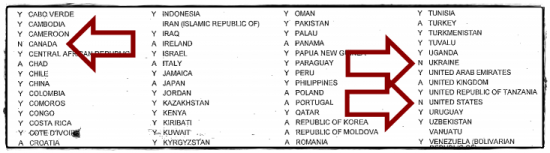
The following is the text of Amendment 134, Section 1266 that passed the US House of Representatives’ military appropriations bill on 21 May 2014, as recorded in the Congressional Report (background and more coverage here).
News & Views
“Double Genocide” Language Accepted by the US Congress on 21 May 2014
Statement of Staff Writer Evaldas Balčiūnas on Summons from Police
My name is Evaldas Balčiūnas and I write for Defending History, in addition to various Lithuanian web journals. On May 14, 2014, I was contacted by local Lithuanian police investigator Reda Šimkutė by telephone at a number which is not registered in my name. She said she needed to “carry out inquiries” about me.
I asked her what the nature of the matter was. She refused to answer, so I suggested she follow normal procedure and send me what they call “an invitation” (in other words a summons) to come to an interrogation at the police department.
DH Staff Writer Evaldas Balčiūnas is Investigated by Lithuanian Police
Summons Issued
Statement by Evaldas Balčiūnas; DH section on Free Speech
He is author of a series of bold articles about state sanitization and glorification of Holocaust perpetrators and collaborators
Newest investigation follows recent police and prosecutorial harassment of Giedrius Grabauskas and Saulius Beržinis
A Jewish Tragedy (Flute and Composition)
M U S I C
by Roland Binet (Braine-l’Alleud, Belgium)
Starting in 2009, after my first visit in Riga, I became interested in the fate of the Jews in the Baltic States during the war. I returned several times to Latvia and also visited Estonia and Lithuania. In 2013 while in Riga, I went to see the Rumbula Memorial to see for myself what that well-known and fateful place looked like. That year in Vilnius, I visited the Ponár (Paneriai) memorial site, another of those well-known fateful places.
UK Labour MP Gareth Thomas is Concerned Over Conservatives’ Alliances in the European Parliament
Latest on One-Sided June 2014 Prague Conference
“Double Genociders” in Prague Triumphantly Announce Participation of “Cabinet of Viviane Reding” at 12-13 June Conference on “Legacy of Totalitarianism Today”…
Will there be a single paper on current glorification of Nazi collaborators in a conference on “Legacy of Totalitarianism Today”?
The Stones Tell Me. After All, They Lived Here.
O P I N I O N
by Genrich Agranovski
Genrich Agranovski is co-author (with Irina Guzenberg) of Vilnius: Sites of Jewish Memory as well as other works on Jewish Vilna. This comment was translated from the Russian by Ludmila Makedonskaya. See also DH’s section on old Jewish cemeteries and mass graves.
At the beginning of the 1990s a commission tentatively called “Memorial” was founded at the Jewish Community of Lithuania. Its aims included collecting information about the mass murder and burial sites of the World war II period, Jewish cemeteries, as well as other issues connected with the memory of the perished. The commission was headed by Joseph Levinson. Being a member of the commission, I was in charge of collecting information on Jewish cemeteries in Vilnius. There had been two large Jewish cemeteries in Vilnius before the war: the “old one,” founded, according to Vilna Jewish lore, at the end of the fifteenth century and used till 1830, and Zarechenskoye [“beyond the river”; in Yiddish Zarétshe] (Antokolskoye), which was used from 1828 up to June 1941. The latter was the biggest in the city. According to the Jewish ethnographer Solomon Shik, seventy thousand people had been buried there by 1937. In Soviet times both cemeteries were destroyed and the gravestones were used for construction purposes.
Revisionism and Resurrection
B O O K S
by Peter Jukes
The following review of Laima Vince’s Journeys through the Backwaters of the Heart originally appeared in Aspen Review (Dec. 2013). The review is now republished here by permission of Peter Jukes, whose latest book is The Fall of the House of Murdoch.
Ms. Vince’s Journeys was also reviewed in Defending History by Geoff Vasil.
◊
While filming a re-enactment of a battle between Lithuanian nationalists and their Soviet- backed NKVD persecutors, Jonas Kadzionis (a survivor of the “Forest Brothers” partisans) warned the author Laima Vince: “Don’t get lost in the forest, and don’t lose your conscience.”
Unfortunately, in her book Journeys through the Backwaters of the Heart Vince has managed to do both.
Latvian School Features “Judenfrei” Sign
The entrance to a nursery school in Latvia owned by a traditionalist lawmaker featured a German-language sign advertising the establishment as being “Jew-free.”
The posting of the sign, which reads “Judenfrei,” was revealed Monday by the Latvian daily Vesti Segodniya. The paper published a photo of the sign on the fence of the Pucite (“Owlet”) private school.
According to the Coordinating Forum for Countering Antisemitism, the establishment is owned by Imants Paradnieks, an ultranationalist Latvian lawmaker.
On Tuesday, Twitter users confronted him to ask whether the sign was genuine or just “a provocation.” He provided no reply, but wrote: “The Kremlin is full of jackals.”
The Riga-based school has a history of Nazi sympathies. In 2012, Pucite hosted two men dressed in Waffen SS uniforms, who held what they defined as “a lesson of patriotic upbringing” for the school’s early childhood program. A video of the lesson, which was uploaded to the nursery school’s website, showed two men encouraging 3-year-old children to play with World War II-era weapons.
Holocaust Survivor Asks UK Prime Minister to Support the Seventy Years Declaration
Hundreds of Holocaust survivors in the UK were invited to the 5 May 2014 Prime Minister’s Holocaust Commission Survivors’ Consultation Event. Greetings from Prime Minister David Cameron and Prince Charles were distributed at the Wembley Park event to the survivors and their families.
One of the participants, 91 year old Ernst Lowenberg had participated in a friendly protest outside the Lithuanian embassy in London in December 2012, where he handed the consul a copy of an international petition (that is still underway online).

Back in Dec. 2012, Ernst Lowenberg (center) handed the Lithuanian consul in London a petition. Report here. PHOTO: MARK DAVIDSON
He has been closely following the efforts to obfuscate the Holocaust emanating from some East European governments that are investing heavily in exporting the “Double Genocide” revisionist model of Holocaust history.
Mr. Lowenberg followed up today with a letter to Prime Minister David Cameron, which he released for publication in Defending History. In the letter, he asks the British government to help preserve the memory of the Holocaust by rejecting the current revisionist campaign and supporting the Seventy Years Declaration (SYD) of 2012, which was signed by fifteen British parliamentarians from across the political spectrum (DH section on the SYD).
Mr. Lowenberg’s letter follows.
Reply to a Roger Cohen Opinion Piece on Ukraine and Lithuania
The following is the text of a letter to the editor sent to the New York Times on 8 March 2014 in response to Roger Cohen’s “Ukraine Fights for its Truth.” As it was not published, it is now included here for the record, and for the sake of the continuing discussion. The embedded links, and square-bracketed updates, have been added today.
Even the brightest can have a blind spot. Yet again, razor-sharp, liberal humanist Roger Cohen has been taken in by PR from the ultranationalists in Eastern Europe. Missing from his “Ukraine Fights for its Truth” (INYT, 6 March) — where he discusses both Ukraine and his ancestral town here in Lithuania — is all that is wrong with the revisionist narrative that is based on a far-right rewriting of history known as “Double Genocide.”
Translation of Donatas Glodenis’s Article on a Troubling Conviction for “Genocide” . . .
The following, for our readers’ interest, is a translation by Geoff Vasil of a recent article that appeared on Donatas Glodenis’s website. The translation appears here with the author’s permission.
Cases, Part IV. Vasiliauskas Convicted of Genocide without Foundation
by Donatas Glodenis
Dan Stone’s “Goodbye to All That?” Has Discussion on Battle of the Declarations
Dan Stone’s new book, Goodbye to All That? A History of Europe Since 1945 (Oxford University Press, March 2014) has some discussion on the “Battle of the Declarations” in Europe: the Prague Declaration (“PD” of 2008) and the Seventy Years Declaration (“SYD” of 2012).
Each of the declarations has its own website: the PD at praguedeclaration.eu; SYD at: seventyyearsdeclaration.org. The SYD was produced as an initiative of Defending History, which has its (openly partisan) section on the Seventy Years Declaration, its text in European languages, and a page of critiques of the Prague Declaration. The SYD’s launch was greeted by the then Lithuanian foreign minister’s “moustache comparison” and his attack on the eight Lithuanian parliamentarians who had signed it. The 2012 documentary film Rewriting History focuses on the origins of the Seventy Years Declaration.
The following is a brief excerpt from Dan Stone’s Goodbye to All That? from page 281:
Distorted Nationalist History in Ukraine
O P I N I O N
Grzegorz Rossolinski-Liebe interviewed by Christopher Hale on 15 March 2012. This interview originally appeared on Christopher Hale’s blog. It is reproduced in Defending History with Dr. Rossolinski-Liebe’s permission.
Roma: Presumption of Guilt
O P I N I O N
by Vilma Fiokla Kiurė

Vilma Fiokla Kiurė (photo: Benediktas Januševičius)
The first international congress of Roma was held on April 8, 1971 in Oprington, England. In 1990, the date was designated International Roma Day.
On this day Roma celebrate and hold concerts, but also remember the most tragic eras in the history of the Roma: persecution by the Nazis and their collaborators in World War II and the resulting genocide of the Roma people. On this day the Vilnius Roma community floats wreaths of flowers on the Neris River in remembrance of their compatriots.
Roma who survived the Second World War, ethnic cleansing and genocide remember that the Nazi soldiers and their local police collaborators used simple external recognition to persecute the Roma. At that time the Roma were still wanderers, and it was a rare member of the community who had identification documents. Few had relationships with sedentary residents, making physical resemblance to the typical Roma the main indicator of ethnicity, in many cases guaranteeing death.
Respublika “Slightly” Edits Efraim Zuroff’s Obituary for Shimon Alperovich
M E D I A W A T C H
Vitas Tomkus’s daily tabloid, Respublika has, alongside its sister title, Vakaro Žinios (Evening News, also owned by Tomkus) in many views inflicted tangible damage upon Lithuania and its image. The papers leave a long trail of racist, antisemitic, and homophobic invective, not seldom in sensationalistic formats that mirror the 1930s.
The most notorious instance was perhaps the 2004 front page featuring the unseemly cartoon of the The Jew and The Gay holding up a globe under the headline “Who runs the world?” recycled (and again, on page 1), in 2009. Vakaro Žinios (Evening News) even featured a sickening photo montage of the then head of the Jewish community Dr. Shimon Alperovich, and a Soviet-era abacus, with text suggesting the Jews were conspiring to defraud the Lithuanian people. More recently, a front page was devoted to a local rabbi with a headline about Jews not having to pay taxes. The word Žydai (Jews) alone was in massive size type, as on numerous occasions, e.g. when the paper accused “The Jews” of plotting to steal the building housing the Culture Ministry. It is almost all out of a dark satire.
Is the Vilnius Police Criminal Division Harassing a Veteran Holocaust Researcher?
VILNIUS—Defending History confirmed today that renowned documentary film maker and Holocaust researcher Saulius Beržinis, founding director of the Independent Holocaust Archive of Lithuania (IHAL), has been the latest recipient of a letter from police on account of his work documenting the alleged Nazi collaboration of various Lithuanian “1941 freedom fighters” who allegedly collaborated with the Nazi regime and in the murder of their civilian Jewish-citizen neighbors in the days, weeks and months following 22 June 1941. The letter demands he turn over a “list” of criminals which it was never his, nor the Archives’ intention, to produce or comment upon. Over the years, the Holocaust specialist has won the confidence of groups worldwide for his willingness to seek out and tell the unvarnished truth, among them the Wiesenthal Center’s Israel office.
The March 19th letter to IHAL’s director, letterheaded “Vilnius District Senior Police Commission, Vilnius City First Police Commission, Police Criminal Division” is reproduced below (followed by translation into English).
Saulius Beržinis has been collecting testimonies on the Holocaust for a quarter of a century. He is known internationally for his singular achievement of interviewing on camera actual admitted killers (some are in the film Lovely Faces of the Killers, 2002), and his extensive documentation work with survivors and witnesses. He has partnered over the years with BBC, The United States Holocaust Museum, the Vilna Gaon Jewish State Museum of Lithuania, Yad Vashem, and other international bodies, in addition to dozens of Holocaust survivors. His Holocaust documentaries include Farewell Jerusalem of Lithuania (1994), Yudel’s Unwritten Diary (2004), The Road to Treblinka (1997). Most recently, his film on the Holocaust in Jurbarkas (Yúrberik) became controversial for daring to name the killers of the town’s Jewish citizens in 1941 (see reviews by Milan Chersonski and Geoff Vasil).
Simon Wiesenthal Center’s Statement on the Death of Lithuanian Jewish Community Leader Dr. Shimon Alperovich
JERUSALEM—The Simon Wiesenthal Center’s Israel Office issued this statement today in the wake of the passing of Dr. Shimon Alperovich, the former Chairman of the Lithuanian Jewish community (PDF here):
Wiesenthal Center Mourns the Passing Today of Courageous Leader of Lithuanian Jewish Community
“It is with great sorrow that we learned of the passing last night of Dr. Shimon Alperovich, the venerable leader for many years of the Lithuanian Jewish community. Dr. Alperovich displayed great courage and fortitude in leading the renewed Lithuanian Jewish community and fought bravely against the ongoing efforts to minimize local participation in Nazi crimes and the promotion of the canard of equivalency between Nazi and Communist atrocities.
Footprints of Adolfas Ramanauskas-Vanagas in the Mass Murder of the Jews of Druskininkai
O P I N I O N
by Evaldas Balčiūnas
Adolfas Ramanauskas Vanagas was a well-known post-war partisan commander. Here’s what the Center for the Study of the Genocide of the Residents of Lithuania has to say about him on their website:
Beloved Leader of Lithuanian Jewry, Simon Alperovich, Dies at 85
Dr. Shimon Alperovich
(Simonas Alperavičius)
11 Oct. 1928 — 27 March 2014
ד″ר שמעון אַלפּעראָוויטש ז″ל