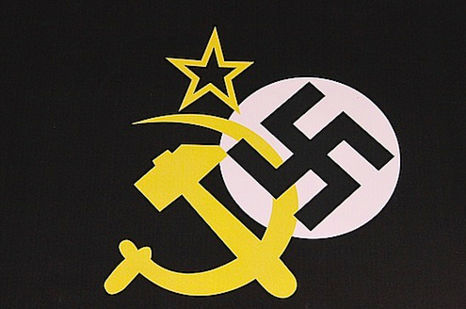
The text of Monica Lowenberg’s petition that appeared today on Change.org. To sign please visit:
Abandon state sponsored Antisemitism and Holocaust Obfuscation
- To:
- HE Ambassador Asta Skaisgirytė-Liauškienė
- Lithuanian Ambassador for London, UK
With the recent Lithuanian elections barely out of the way, and the ruling right-wing Homeland Union Conservatives the undisputed losers, the ultranationalist right is losing no time in pressing ahead aggressively with the Double Genocide “red-equals-brown” agenda, reverting to one of the movement’s original slogans: “United Europe — United History.” For pro-tolerance and liberal forces, the profoundly undemocratic message implied is that a united Europe has to also be united (i.e. have one opinion) on questions of history, and that Double Genocide and its central document, the 2008 Prague Declaration, are inviolable truths.
- April 2010: The Wiesenthal Center’s Dr. Efraim Zuroff comments (in the Guardian) on the American ambassador’s assurance that “The United States and Lithuania are partners in the fight against antisemitism and in efforts to address the legacy of the Holocaust” bereft of any mention of the “slight problems,” e.g. state-sanctioned neo-Nazi marches on independence day, attempted prosecution of Holocaust survivors, glorification of Nazi perpetrators, disturbing comments by top officials and a general decline into the acceptability of antisemitism.
- Continue reading
This week, one of the more shameful events in Lithuanian-Jewish relations since the Baltic republic regained independence in 1991 will be hosted in New York by the once-venerable Yivo Institute. Under the heading “Reclaiming the Jewish Narrative in Lithuania Today,” the Yiddish research institute will host Markas Zingeris, whom it describes as a “Lithuanian-Jewish poet and writer,” to speak about relations between Jews and Lithuanians since the fall of Communism.
The following are among the envelopes designed by Antanas Šakalys who continues to be honored by his (other) works being exhibited at both Vilnius University and the Central Post Office in the Lithuanian capital. Details and further links.
These samples are categorized as follows:
The following letter to the prime minister of Lithuania, Andrius Kubilius, from three members of the United States Congress representing southern California districts was released today to DefendingHistory. The letter is signed by US representatives Brad Sherman (San Fernando Valley, California), Henry Waxman (Santa Monica & Beverley Hills) and Howard Berman (Panorama City & North Hollywood).
According to Vilnius University’s website, a ceremony to open an exhibition of “envelope art” by Antanas Šakalys will be held in the White Hall of the university’s main library on 27 September at 2 PM. Mr. Šakalys’s antisemitic postcards were on sale for many years at the capital’s main Post Office, and were exposed in 2008 by the Jewish community’s newspaper, Jerusalem of Lithuania.
TEL AVIV—The following public statement was received at 2:15 PM Tel Aviv time from the offices of the Association of Lithuanian Jews in Israel at King David Boulevard 1. In addition, the ALJ today released the letter written by its chairman to the head of Yad Vashem (English translation here). Background.
The following is a transcription of the text that appeared in today’s edition of The Australian.
At the end of next week, I will have spent 32 years as a “Nazi-hunter,” trying to facilitate the prosecution of those individuals who in the service of Nazi Germany or in alliance with its regime, engaged in the persecution and/or murder of innocent civilians categorized as “enemies” of the Third Reich. During that period, I have dealt with many dozens of cases of all sorts of criminals from many different nationalities and walks of life, from mass murderers to individuals who were charged with the murder of a single person.
In a curious annual statement to his nation’s diplomats around the globe, Foreign Minister Audronius Ažubalis recently proclaimed publicly that “historical memory policy” would be one of the main goals of Lithuanian’s foreign policy, particularly as it looks forward to its rotating presidency of the EU next year.
EARLIER REPORT
The insistence on the Eastern European right wing’s history appears alongside energy and transport infrastructure, economic development, consular services for citizens resident abroad, military security, international alliances and more. The speech also mentions the need for more coordination of Lithuania’s “body and mind” implying the need for more rather than less diplomatic work in the field of history revisionism internationally.
The United Nation’s Human Rights Committee in its 11 July 2012 report, issued in Geneva, included the following text concerning the Lithuanian government’s arguments regarding the legalization of public swastikas and the ongoing authorization of neo-Nazi parades:
I was surprised to learn that Lithuanian president Dalia Grybauskaitė appointed you ambassador to Belarus. She said Belarus is an important partner for Lithuania with many ties between our countries, and that cooperation should be on an equal footing, constructive and mutually beneficial. I invite you to think about whether you really are able to do this job, or whether you won’t make international relations worse because of certain matters of the past.
Let me remind you of one such thing. On 31 October 2002, you and then-president Valdas Adamkus signed presidential decree no. 1965 posthumously promoting Juozas Krikštaponis (Krištaponis) to the rank of colonel. The decree mistakenly gave his first name as Jonas, a mistake corrected in presidential decree 1K-849 issued by President Adamkus on 5 January 2007.
In spite of the repeated visible damage to Lithuania’s standing emanating from previous attempts, the country’s Ministry of Foreign Affairs has now announced that red-brown politics in the service of Double Genocide would be one of the goals of its upcoming stint in the rotating presidency of the European Union.
There was diplomatic blood on the floor following the foreign ministry’s failed attempt to insinuate Double Genocide into the Stockholm Program in 2010 (reports here, here, and here).
Vytautas Landsbergis is one of the giants of the late twentieth century. Along with Poland’s Lech Wałęsa and then-Czechoslovakia’s Václav Havel, Landsbergis led his people from foreign domination to freedom and democracy. Nothing these gentlemen might later on have said or done to their own legacies, particularly in the subsequent century, can detract from their singular achievements in contributing to the downfall of the Soviet Union and the freedom of the subjugated nations on its western periphery.
Many thanks to the Economist and its online Eastern Approaches section for highlighting this important issue that so many others have just swept under the rug. But frankly speaking, it does our Lithuanian friends no good to slant each report in the direction of sophisticated apologetics for the Lithuanian (and other regional) governments’ tragic veering to the far right on issues of historic integrity, human rights, freedom of speech, antisemitism, racism, gay rights, and perhaps above all, state-sponsored adulation of local Nazi war criminals and collaborators, and actual local mass murderers of the region’s Jewish population. It was, alas, a level of participation that resulted in the Baltics having the highest percentage of murder of its Jewish population in Holocaust-era Europe.
In May Lithuania celebrated the return of the ashes of the Nazi puppet prime minister of June, 1941, Juozas Ambrazevičius (who changed his surname to Brazaitis as a matter of convenience when he began using papers issued to one Brazaitis). The schizophrenic nature of the events were evident from the start, from the Kubilius government’s resolution allocating 30,000 litas in funding to celebrate the Lithuanian Nazi which, several items down the list, also allocated 3,000 litas for a project to “name the names,” to draw up a list of Lithuanian Holocaust victims, in conjunction with the Yad Vashem institution in Jerusalem.
The dissociative shell game continued when the government and state institutions sought to pawn off the events they financed on other institutions: the Catholic Church of the Resurrection of Christ in Kaunas, and an “academic conference/commemoration” planned at Vytautas Magnus University in Kaunas. After a scandal broke and former professor now MEP Leonidas Donskis published an eloquent protest on DH, the rector of VMU, who didn’t want the heat, told the Nazi celebrators to find another venue, one supplied by the Kaunas municipality, the chambers of the Kaunas city council. Then, in keeping with the theme of schizophrenia, VMU decided to allow another “academic conference” on university premises, initially with the exact same list of speakers as the banned event.
E Y E W I T N E S S A C C O U N T / O P I N I O N
An eyewitness account of the memorial conference for 1941 Nazi puppet prime minister Juozas Ambrazevičius-Brazaitis held at Kaunas City Hall on Saturday 19 May 2012. The event had been moved from its earlier scheduled venue at Vytautas Magnus University.
A few months ago, I received an invitation to give a talk at a conference to be held at the Lozoraitis Museum on the campus of Vytautas Magnus University in Kaunas on the 19th of May. That would be my fourth visit to Lithuania and my first to Kaunas.
Members of Lithuania’s small and fragile remnant Jewish community were left in shock as word was spreading that quite secretively, the country’s prime minister and culture minister personally signed off this past March on the 30,000 litas allotment for the expenses of reburying and honoring the wartime fascist leader, Juozas Ambrazevičius (later Brazaitis). Ambrazevičius, as the Nazi puppet “prime minister” during the first weeks of the war in 1941, signed the orders confirming “all means” against Jews (though calling for public executions to halt), for a concentration camp for Lithuania’s Jews, and for the herding of all of Kaunas’s Jews into a ghetto within four weeks (English translation here).
The Lithuanian Jewish Community, in partnership with the Vilna Gaon Jewish museum, has issued a statement of protest against government sponsorship of the events.

Getty Images
Thought experiment: Imagine an African American in the city of Columbia, South Carolina, being called an extremist or fanatic for peacefully expressing the opinion that it is offensive for the Confederate flag to be hoisted on the grounds of the state capitol building. Imagine him or her being called extremist or fanatic for failing to be grateful that the flag was, after much protest, moved from atop the dome to the mere grounds of the capitol and its design slightly changed to conform to the Confederate Battle Flag (as a “concession”).
Imagine if a snow-white editor of a web journal singled out for David Duke style praise “Moderate African Americans” who just say “Thank you” when a pathetic morsel of PR is offered up by local authorities in the face of mounting international opprobrium.
There would be public outrage at the racism.
The Union of Lithuanian Nationalist Youth (ULNY), one of the organizers of the annual neo-Nazi march in the center of Vilnius on the nation’s independence day, has been made a member of the Lithuanian Council of Youth Organizations, a body that is a recipient of European Union structural funds as well as Lithuanian government funding.
Media reports confirm that at the national conference last weekend, there were no votes against granting the ULNY full membership in the nationwide umbrella organization of accredited youth groups eligible for state funding. The vote was 19 in favor, zero against with seven abstentions.