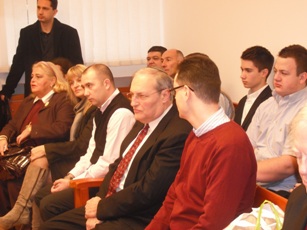
This year’s commemoration ceremony at Ponar (Paneriai) was held today, attended by government officials, the diplomatic corps, and a sizable crowd of mostly Jewish participants. Ponar is the mass grave site near Vilnius where 100,000 civilians ― around 70,000 of them Jews
of Vilna and its environs ― were murdered by Nazi henchmen between 1941 and 1944. In 2005, Yale University Press brought out Kazimierz Sakowicz’s eyewitness account, Ponary Diary, where it is reconfirmed that most of the killing was done by volunteer local killers.
The country’s small but vibrant Jewish community was proudly represented by Faina Kukliansky, head of the Vilnius Jewish Community and vice chairman of the Jewish Community of Lithuania. In her speech (English translation here), Kukliansky, one of the country’s foremost attorneys, did not mince words. She explained that whatever differences of opinion may exist, the community was unanimous in condemning the Double Genocide movement, as well as projects to equate Nazi and Soviet crimes whose purpose is to trivialize or mitigate the Holocaust specifically and the notion genocide more generally. Moreover, she stressed the need to expose the identities of all the local killers who carried out the genocide of Lithuanian Jewry. She also mentioned that it was only the Jewish Community of Lithuania, not the Lithuanian or Israeli government, that established a fund to help each and every Holocaust era Lithuanian rescuer live a better life to the end of his or her days.Continue reading
Attorney Joseph Melamed, chairman of the Association of Lithuanian Jews in Israel (at right) delivered the keynote speech today at an event held at Yad Vashem in Jerusalem to mark the September 23rd anniversary of the 1943 liquidation of the Vilna Ghetto. Because of the Jewish holidays, the event was moved up to the 20th this year.
A pig’s head, adorned with a black hat and makeshift hasidic style earlocks, was placed on the pavement right outside the door, within the courtyard of the main synagogue in Kaunas, Lithuania’s second city, during Sabbath morning services. This caused profound grief to the very small congregation of survivors who pray at the city’s Choral Synagogue, the only prewar Jewish prayerhouse in town that still functions. The service was interrupted as police arrived to investigate. The Lithuanian Jewish Community
Rachel Kostanian, the courageous director, valiantly keeps alive one of the rare local bastions of public integrity on the Holocaust in Lithuania, having constantly to fend off obstacles. Read Esther Goldberg Gilbert’s portrait in the special Jewish New Year’s supplement on great Jewish women of the ages in the