COLLABORATORS GLORIFIED | BOLD LITHUANIAN CITIZENS SPEAK OUT | CHRISTIAN-JEWISH RELATIONS
◊
◊
DH’s Israel Page
◊
◊
Have you ever missed an anniversary, a birthday, or event and regretted it for years, or even a lifetime? I have. It was missing out in attending the 1908 International Conference on Yiddish Language that took place exactly 110 years ago this year at Czernowitz, a city that served as the regional capital of the Hapsburgs (modern day Chernivtsi, Ukraine).
You may ask even how was it distinctly possible that a man my age could have been around 110 years ago. For the past nearly thirty years, I have immersed myself in learning about Jewish life and infrastructure in prewar Europe, plus seeing what the role of Yiddish was, if at all, in that culture. For most Jews of this age, modern history began with the Holocaust and the creation of the third commonwealth, the modern-day State of Israel. Events like the Czernowitz Conference, or the Kishinev Pogroms, World War I or the Leo Frank affair are just not in our lexicon, even though they all occurred in the twentieth century, thus making them modern, not ancient, history.
As Jews, it is incumbent upon us to fulfill the obligation of “Zakhor,” “To Remember.” We are to look back at our history and internalize it in such a way to feel just like we were there, and feel what our brethren felt. This is just not reflected in our reading of the Passover Haggadah, but everything we do and say in life. To do “Zakhor” means we have a fuller understanding of ourselves in order to be able to navigate the future. Zakhor enables us to be more comfortable with self. That is why I went on a personal quest over the last 25 plus years to visit libraries, read books, make visits to Poland and Ukraine to meet with political leaders, rabbis, community leaders, and lay people so that I can learn and experience.
Czernowitz 1908 symbolized to me that turning point in Jewish history. A part of me felt that I did spiritually attend that conference, but realistically, I knew that it was a physical impossibility. Then, in July, Dovid Katz, a leading Yiddish scholar, posted in Facebook that he was invited to be the keynote speaker at the 2018 International Commemorative Conference of Yiddish Culture and Language at Czernowitz to mark the 110th anniversary of the very first conference.
◊
VILNIUS—The 21 person democratically elected board of the Vilnius Jewish Community, representing the approximately 2,200 Jews resident in the Lithuanian capital, today released an approved English translation of its 29 August 2018 statement on Jewish heritage in partnership with a number of smaller regional Jewish communities throughout the country. The original Lithuanian text is available here, and appears at the end of this report below.
Those following the saga of attempts to humiliate the Old Vilna Jewish Cemetery by situating a national convention center in its heart, will be encouraged by the explicit language concerning the project contained in the statement:
◊
VILNIUS—The central office of the World Jewish Congress (WJC) today tweeted uncritical support for “Black Ribbon Day” failing to note that the August 23rd remembrance day sponsored by ultranationalist elements in Eastern Europe, has been one of the most cunning tools for writing the Holocaust out of history via the “Double Genocide” movement that seeks to “equalize” Nazi and Soviet crimes as per the Prague Declaration of 2008 (which indeed has the day among its “requirements”). Defending History is proud to have been part of the team that produced the Europarliamentary rejoinder, the 2012 Seventy Years Declaration (SYD), which was signed by 71 European Union parliamentarians, including eight enormously courageous Lithuanian MPs and MEPs. SYD calls for “distinct days and distinct programs to remember the Holocaust and other victims of other twentieth century totalitarian regimes”.
◊
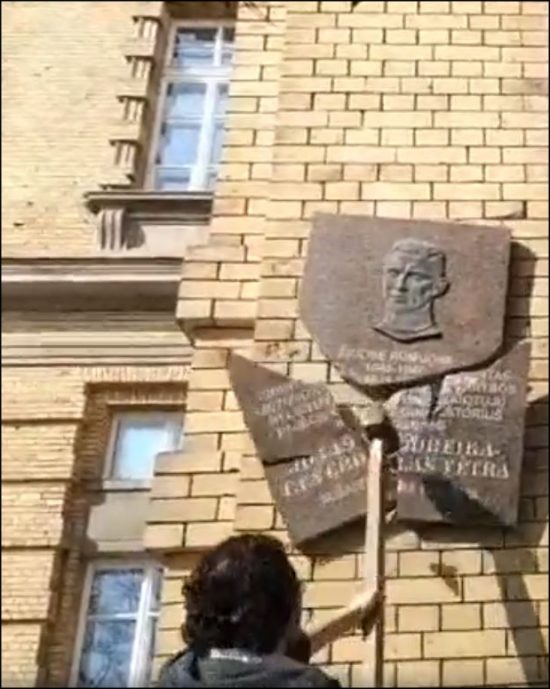
Lithuanian citizen Grant Gochin, a Litvak born in South Africa and living in California, has relentlessly challenged Lithuania’s Genocide Center to tell the truth about Jonas Noreika, whom the Center maintains can be considered an anti-Soviet and anti-Nazi hero despite his role as a Holocaust perpetrator. Gochin’s 40 page Query Regarding Jonas Noreika’s criminal gang, submitted on June 15, 2018, is available in a PDF file which includes the Lithuanian original (pages 49-89), the English translation (pages 1-45), and an extensive list of source materials (pages 90-100). Jonas Noreika’s granddaughter Silvia Foti also contributed a letter in support of Grant’s query (pages 47-48). The Genocide Center has posted its 18 page response in Lithuanian. On its website it warns that “G.A.G Gochin’s ‘investigation’ of J. Noreika, without providing substantial proof, possibly violating the Republic of Lithuania’s Constitution and the Republic of Lithuania’s Criminal Code, accuses many individuals […]”.
VILNIUS—The organizers of the international conference in Yiddish studies to mark the 110th anniversary of the fabled Chernowitz Language Conference of 1908 have today released the final program for the conference. It is available as PDF and follows below (use arrows at upper left to turn pages). It will be held in the same building where the 1908 conference took place in today’s Cernivtsi, Ukraine from 6 to 10 August 2018.
◊
On July 2, 2018, at 11 AM, Lithuania’s state property bank, Turto Bankas, led an open meeting to discuss the rental terms for the operator of the Vilnius Concert and Sports House, previously known as the Soviet Sports Palace (Sporto rūmai), which the Soviets built on Vilnius’s oldest Jewish cemetery. The search for an operator is part of a plan by the Lithuanian government to remake the decrepit building as a modern convention center and a symbol of Vilnius. According to critics, the plan is senseless and the symbol shameful.
◊
VILNIUS—In March of 2017, Vilnius native and resident Ruta Bloshtein, author of the international petition on the Old Vilna Jewish Cemetery that has achieved 44,000 signatures to date, presented a copy of the petition with a full list of signatures to the office of the prime minister. In June of 2017, she received a reply from the government restating the supposed justification for desecrating the five hundred year old Jewish cemetery on the basis of “permissions” obtained from the (allegedly corrupt) “grave-trading CPJCE rabbis” of London, who are currently under investigation in London.
◊
◊
Ką daryti su senosiomis Vilniaus žydų (Piramonto, dabartiniame Šnipiškių rajone) kapinėmis? Atkurti jas. Kad tai įvyktų, sovietiniai griuvėsiai jų viduryje turėtų būti sulyginti su žeme, o žemė kapinėse nekasinėjama – niekada daugiau. Lai šios kapinės amžiams lieka Vilniaus žydų gyvybingumo liudininkėmis.
◊
I have been involved in Jewish community, heritage and Holocaust-restitution issues in Lithuania for almost two decades, through various professional and personal capacities. While I have worked on these matters in other European countries, I have a special interest in and bond with these subjects as almost all my family came to America from Litvak areas. In the past few years I have spent a lot of time on the issue of the Old Vilna Jewish Cemetery in Šnipiškės (Piramónt) and the future plans for the Sports Palace building which has been on that site for decades. I met with many rabbis and community leaders with vastly different views and no meeting or photo should be interpreted as an endorsement of any position.
◊
WASHINGTON DC—Three United States senators, Benjamin L. Cardin (Maryland, D.), Pat Roberts (Kansas, R.), and James E. Risch (Idaho, R.) today wrote to Lithuania’s president, Dalia Grybauskaitė, appealing to her to move the planned national convention center away from the old Vilna Jewish Cemetery to another venue. It follows a similar appeal by twelve members of the American Congress last summer, a wide range of religious, community and religious figures and institutions internationally, and a recent statement to The New York Times by the elected head of the Vilnius Jewish Community, representing the vast majority of Lithuania’s surviving Jewish citizens. Vilnius native and resident Ruta Bloshtein, a prominent figure in Lithuania’s small Orthodox Jewish community, initiated a petition signed by close to 44,000 people internationally.
◊
◊
We develop a concept of “spiritual capital” which has suggested itself in the public debate regarding the future of the Vilnius Sports Palace, a large forum which the Soviets built in the 1960s on a Jewish cemetery which is the oldest in Vilnius and perhaps all of the Baltic states. This concept of spiritual capital is relevant for analyzing cultural surroundings but could also perhaps ground a healthy human relationship with natural surroundings.
◊
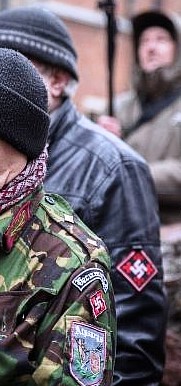
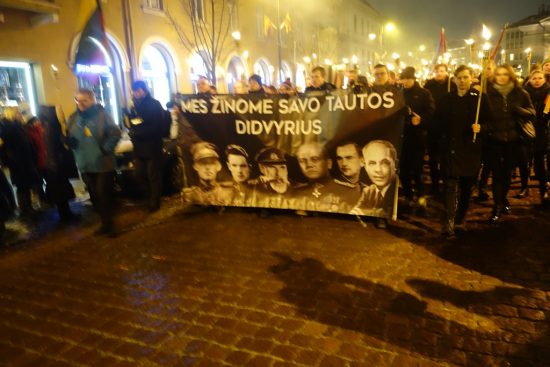
Today’s central Vilnius event celebrated the 77th anniversary of the 23 June 1941 “uprising.” Between fifty and sixty people took part. Half of them are members of the motorbike club. The event was organized by the Lithuanian Seimas (parliament). The Seimas was represented by three MPs – Žygimantas Pavilionis, former ambassador to USA; Audronius Ažubalis, former foreign minister; and Laurynas Kasčiūnas. One of the speakers was the Roman Catholic priest and motorbiker Egidijus Kazlauskas who spoke about the suffering and the perseverance of Lithuanians when persecuted by deportations to the eastern Soviet Union. Vilnius city Mayor Remigijus Šimašius was not present, but he has sent his greetings via advisor Mindaugas Kubilius.
A guest of honor was Vytautas Landsbergis, the elder statesman who was modern democratic Lithuania’s founding head of state. In the new century he became a European parliamentarian dedicated to revision of World War II history, most famously via the Prague Declaration which he signed. The event was co-organized by the Lithuanian Freedom Fighters Union (Lietuvos laisvės kovotojų sąjunga).
◊
◊
Earlier today, I had the honor to be one of three individuals from very different backgrounds who partnered to visit with the highest city authorities we could reach to plead for the Old Vilna Jewish Cemetery. In the current situation, that means, pleading with authorities to move the national convention center projects away from the thousands of Jewish graves going back to the fifteenth century, so as to enable this amazing site in modern Vilnius to be restored to the city’s great benefit and reputation.
The meeting was initiated by Ruta Bloshtein, author of the international petition asking the Lithuanian government to move the convention center project (it has achieved around 44,000 signatures to date). The third participant was Rabbi Samuel Jacob Feffer, a major scholar of the Gaon of Vilna, who has been based in Vilnius for over a quarter of a century. He is co-editor of dozens of books of the works of the Gaon of Vilna.
◊

◊
LONDON—Reliable sources in London reported this morning that solicitors are being instructed by a group of international clients whose ancestors lie buried in the old Vilna Jewish Cemetery at Piramónt, in today’s Snipiskes district of Vilnius, the Lithuanian capital. For years, the Lithuanian government’s justification for planning to situate in the cemetery its new national convention project, confirmed on numerous occasions in writing, is the “permission of the CPJCE in London,” a group of renegade rabbis who have ignored the pleas of all other rabbinical groups, and all major Litvak (Lithuanian origin) rabbis internationally, to give “permission” for the convention center in the heart of the cemetery. When Rabbi Chaim Burshtein, the then chief rabbi of Lithuania dared speak up in opposition, in 2015, he was rapidly dismissed. In late 2016, Rabbis Kalev Krelin and Sholom-Ber Krinsky were among the first to sign the international petition (see also Rabbi Krinsky’s blog and DH section). Rabbi S. J. Feffer, author of dozens of learned books on the Gaon of Vilna, based in the city for a quarter century and head of its Litvak rabbinic authority, published a powerful ruling in 2017.
VILNIUS—As covered sequentially by DH over the past year, the official “Lithuanian Jewish Community” (LJC) saw its democracy abruptly dismantled in the spring of 2017 with the mid-campaign rule-change whereby the three thousand or so surviving Jews of Lithuania were disenfranchised and their voting rights replaced by a roomful of “Jewish oligarchs,” most of whom are beneficiaries of funds allocated by the government’s Good Will Foundation. Some have two or three votes, some represent defunct organizations, and one, who has two votes actually lives in Brussels. Western observers have compared it with some irony to the original Zero Mostel version of the Hollywood film The Producers. In any case, the “election” was ruled illegal by the Lithuanian courts in a case that brought their judicial independence to the fore, to the nation’s great credit.
UPDATES: JTA REPORT
Observers have pointed to the dangers of restitution settlements with East European governments that end up destroying communities’ democracy and independence in the direction of becoming “Jewish PR” units for the state with massive glories falling upon one or a handful of “court Jews” who serve to showcase state policies to the outside world.