[LAST UPDATE]
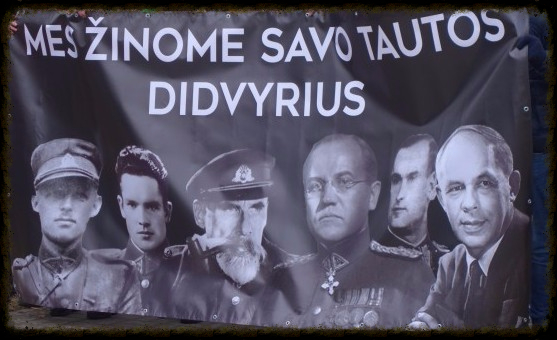
In Vilnius, City Council Holds “Surreal” Public Debate on 29 Nov. 2016 on Street Name Honoring a Nazi Collaborator; But Will the Mayor (Who Did Not Attend) Ever Speak Out with Moral Clarity?


Whenever I drive from Skaudvilė to Batakiai I almost always turn off the road at Šilas, stopping at the location of the mass grave of the people who were shot there in 1941. Here, the sky is always dark. The sunlight over the graves is blocked out by a forest of unruly spruce, birches, aspen. Everything seems completely calm here. Occasionally, I catch the light scent of the forest, carried out on a breeze as the wind roars through the trees. I pause. I remove my hat. Slowly, I pull a photograph out of a notebook I carry with me always. A twelve year old girl smiles out at me from that photograph. The photograph is quite worn out. In places there are creases. That’s because I have been carrying this photograph around with me for many years now. The person who this photograph belongs to is already long gone and buried. I listen and I can almost hear her voice: “My Algis, farewell. I am leaving forever.”Continue reading
◊
◊
I was born in 1927 in the city whose official name was then Wilno, Poland (historically Vilna, today’s Vilnius, the capital of Lithuania). When I was fourteen, the Nazis took over the city, began murdering its Jewish population and set up the Vilna Ghetto. My own survival is due to my having been taken as a teenage repairman of German military vehicles at the plant known as HKP (Heereskraftfahrpark or Army Motor Vehicle Repair Park) on Subotsh Street (today’s Subačiaus). That one enterprise was under the directorship of Major Karl Plagge (1897–1957), a righteous gentile who did everything he could to protect as many Jewish workers as possible from the huge murder machine. Famously, shortly before the Nazi flight from the Soviet army in the summer of 1944, he gave a coded warning to his workers about a need for imminent escape.
UPDATE OF 5 DEC 2016: VILNIUS SYNAGOGUE REOPENED WITHOUT INCIDENT
◊
City’s Last Functioning Pre-Holocaust Prayerhouse Was Shut from 28 Oct. to 4 Dec. 2016

PROF. DOV LEVIN
Kaunas (Kovno) 1925 — Jerusalem 2016

VILNIUS—The 22 November edition of the Jerusalem Post carried the following news item about an international meeting at the Peres Center for Peace and Innovation.
Lithuanian and Israeli diplomats, academics, and government officials, together with representatives of Litvak organizations in Israel, the American Jewish Committee, the World Jewish Congress and the Tel Aviv Municipality, will congregate on Thursday at the Peres Center for Peace and Innovation to discuss Lithuania and Israel – Past, Present and Future. Among the Lithuanians will be Lithuanian Ambassador Edminas Bagdonas, Ronaldas Račinskas, executive director of the International Commission for the Evaluation of the Crimes of the Nazi and Soviet Occupation Regimes in Lithuania; Faina Kukliansky, chairwoman of the Lithuanian Jewish Community; and several other Lithuanian dignitaries. Among the topics tabled for discussion is the reinstatement of Lithuanian citizenship to Lithuanian expatriates living in Israel.
◊
The words “antisemitism in the shtetl” might evoke recollections of Fiddler on the Roof, a touch of family lore “from the old country” way back when, or for those familiar with modern Yiddish literature, a scene from this or that writer. Baffling as it may sound, however, it a substantial contemporary topic in the study of antisemitism, and, perhaps even more surprisingly, part of a phenomenon with implications for the future, given the vast number of cities, towns and villages in the world with a rich Jewish history but no living Jews, where potent anti-Jewish feeling (as well as pro-Jewish feeling) can be observed. As noted back in Flashpoint 21, antisemitism in Eastern Europe is very different from its much better known Western and Middle East incarnations.
22 November 2016. ISGAP Flashpoint: ‘Antisemitism in the 21st century shtetl’ by Dovid Katz.
22 September 2016. Tablet: ‘Holocaust commemorations planned throughout Lithuania this weekend’ by Anna Rudnistky.
9 September 2016. Defending History: ‘My take on Malát’ by Julius Norwilla [Norvila].
8 September 2016. En.Delfi.lt: ‘The day Lithuania became a culture of We’ by Alexandra Kudukis.
8 September 2016. Jewish Community of Lithuania website: ‘Molėtai Holocaust procession draws record crowd’ [unsigned article presumably representing the chairperson’s views].
This paper appeared today in Dapim: Studies on the Holocaust, published by Taylor and Francis.
The demise of twentieth-century-style Holocaust denial in mainstream Western society is aptly symbolized by David Irving’s loss to Deborah Lipstadt in the London High Court in 2000. But around the same time, a new and more irksome method of writing the Holocaust out of history was emerging under the radar, this time without necessarily denying any of the historical events or a single death. Particularly in Eastern Europe, it was being forged with state funding and more subtle powers of persuasion in academia, the media, the arts and international diplomacy.
VILNIUS—While some biographies cite 1937 as the year of Professor Valerijus Čekmonas’s birth, many of his numerous students and admirers both here in Vilnius, and internationally, who were heartboken by his untimately death in 2004, are taking the 1936 year as definitive and celebrating his life this season on the occasion of what would have been his eightieth birthday.
◊
VILNIUS—Defending History announced to its readers today that a new section called Vilnius Jewish Life is being initiated. It will retroactively include dated posts roughly from the beginning of 2016 onward.
◊
Iam very concerned about the situation for the last several years at our Lithuanian Jewish Community (LJC). More specifically, about the LJC’s chairperson, whose policies have brought about instability and disunity in the Jewish community. It is a sad paradox, that a non-religious person is responsible for the most acutely religious questions in our community. It is even more unacceptable that a secular person, drawn to mundane and material things, would deign to push around the rabbis in town as if they are pawns on the chess table. Such behavior is totally opposite to Jewish religious standards. Yet for external consumption it is called “a renaissance of religious Judaism.”
◊
◊
Noriu išreikšti susirūpinimą dėl padėties, kuri jau keletą metų klostosi Lietuvos žydų bendruomenėje. O būtent, dėl LŽB pirmininkės veiksmų, keliančių pavojų Lietuvos žydų gyvenimo vienovei ir darnai. Paradoksas ir liūdna ironija tame, kad žydų religinius klausimus sprendžia nereliginga moteris. Ir dar labiau nepriimtina, kad pasaulietė, siekdama savanaudiškų žemiškų tikslų, stumdo rabinus kaip šachmatų figūras. Tokia elgsena prieštarauja religinėms tradicijoms. Ir tai vadinama „judaizmo atgimimu“?
The following two comments appeared in Facebook on 1 November 2016 and on 3 November 2016, following publication of Dovid Katz’s 1 November article in Defending History. They have been slightly condensed and copy-edited here.
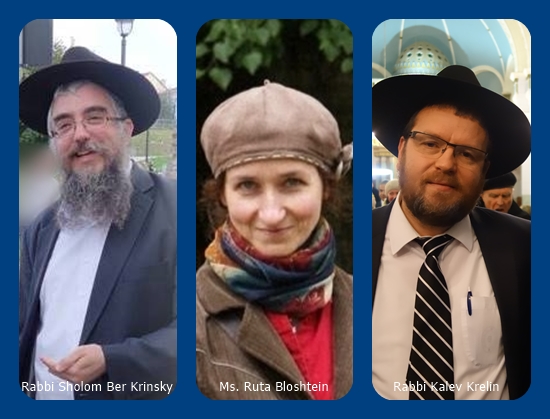
It is time to stand up to this behavior. Does Madam Kukliansky think that in Ponar and the other 250 places of murder that Jews, our brothers and sisters, our children (kinderlakh) had been separated at the time of murder and thrown into a Chabad ditch and into a Misnagdim ditch? If this is a decision by Madam Kukliansky, to call the police or to lock out Krinsky from the building of the Jewish Community, then it is simply disgusting.