by Frank Brendle (Berlin)
Activists in the western Ukrainian city of Lviv wearing uniforms of the former Ukrainian Insurgent Army (known as UPA, from its Ukrainian language initials) marched in a large scale event in the city center today.
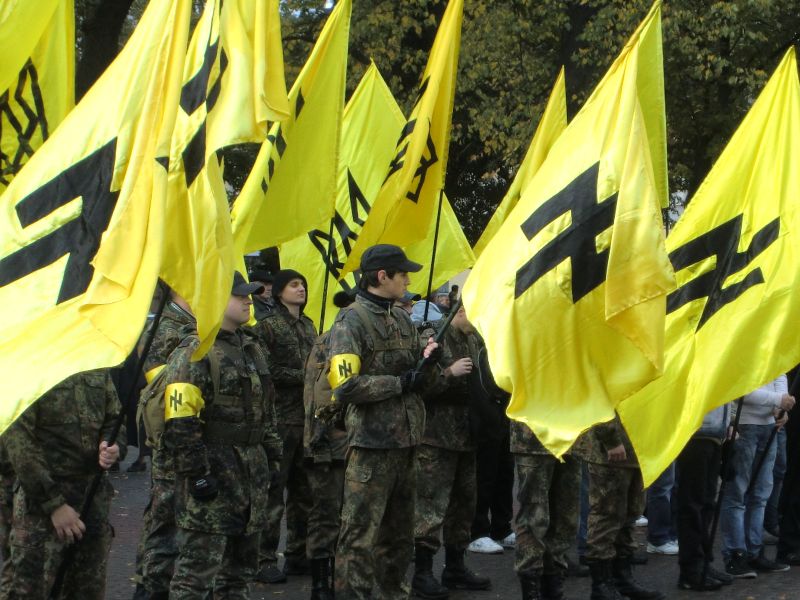


Activists in the western Ukrainian city of Lviv wearing uniforms of the former Ukrainian Insurgent Army (known as UPA, from its Ukrainian language initials) marched in a large scale event in the city center today.
Report in Haaretz by Yossi Melman;
DefendingHistory.com reports here and here;
Geoff Vasil in the Jewish Chronicle

◊
A BNS (Baltic News Service) report released today quotes the foreign ministry as saying for the record today that ‘The attitude of the Russian institutions that by condemning some crimes against humanity (the Stalinist crimes), other crimes, i.e. the crimes of Nazism, are being rehabilitated, shall be regarded as very odd’.
The nation’s prime minister, Andrius Kubilius, weighed in more ardently. In an Lrytas.lt report (which credits ELTA), he is quoted as saying: ‘Thanks to Lithuania’s active policy it is being understood better and more clearly throughout the EU that Stalin’s crimes against humanity need to be judged in the same way Hitler’s crimes against humanity are judged. And not just Stalin’s [crimes], but [those] of the entire Soviet period […].’
The European Union has as one of its main tasks the promotion of cordial understanding between the peoples of Europe and, consequently, it must be careful about the history of the continent as it is being taught. One of the reasons for the foundation of the Union was to bring together peoples that were previously enemies, in two world wars and numerous other conflicts.
Delfi.lt journalist Eglė Samoškaitė reported today on this week’s book event for the Lithuanian language edition of Timothy Snyder’s Bloodlands, held at the Foreign Ministry and with the participation of some leading historians and heads of institutions in the country. A full English translation of Ms. Samoškaitė’s article is available here.
Lithuanian Foreign Minister Audronius Ažubalis was today quoted by BNS as inserting red-brown discourse into his latest commentary on the dispute over the alleged Soviet war crimes perpetrator not extradited to Lithuania from Austria last summer.
The foreign minister is cited as follows:
The following is a reprint, with the author’s permission, of his article in London’s Jewish Chronicle this week.
Today is Lithuanian Holocaust Day. This is the day the Vilna Ghetto was “liquidated” in 1943, but is not generally known among Lithuanians. It does not even appear on the Wikipedia list of Lithuanian holidays, although Molotov-Ribbentrop Day, August 23, does. September 23 usually receives a few minutes on the evening news — after it’s over.
Yad Vashem rescinded the invitations to the Lithuanian culture minister and ambassador to the 19 September event held in memory of the victims of the Lithuanian Holocaust. The cancelation of invitations came in response to the new investigation launched by Vilnius prosecutors (via Interpol) against a Holocaust survivor. The 30 August visit to Mr. Melamed by Interpol liaison officers in Tel Aviv was reported in DefendingHistory.com and by Yossi Melman in Haaretz.
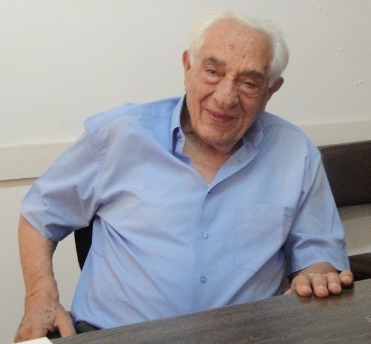
Joe Melamed in his Tel Aviv office
The report on the disinvitation, also by Yossi Melman in Haaretz was rapidly picked up by the Associated Press and carried widely (e.g. CBS News, Fox, MSNBC, Washington Post, YahooNews). Further reports have appeared in the Jerusalem Post, the Jewish Chronicle (London), Mishpacha, and JTA (WJC, JJ, Juedische.at, etc).
A report today from BNS (Baltic News Service) covered the reaction of the Lithuanian foreign minister to the news that Holocaust survivors had protested to Yivo his invitation as guest of honor at an event commemorating the Vilna Ghetto.
The surviving family members of the late Leyzer Ran, led by his wife Basheva Ran, today released a statement concerning Yivo’s decision to honor the Lithuanian foreign minister in New York in the absence of apologies for the accusations against Jewish partisan heroes, and in the absence of progress on widespread antisemitism including legalized swatikas and Holocaust distortionism. Details and a PDF of the letter are available here.
Iurii Andrukhovych complains in an article published in Gazeta Wyborcza about the sorry state of Polish-Ukrainian relations. He correctly informs readers that in the last ten years Polish-Ukrainian relations, in particular concerning contentious World War II questions, have not improved at all and “if something has changed then perhaps only for the worse”. Yet Andrukhovych’s solution to the problem would be to republish Paweł Smoleński’s collections of essays Pochówek dla rezuna (“Burial of a Butcher”) which, like Andrukhovych in his article, looks for solutions in the revision of stereotypes while ignoring the actual historical causes of current problems.
Lithuania’s main newspaper Lietuvos Rytas reported today on an internal investigation by the Lithuanian Ministry of National Defense into participation by Lithuanian soldiers in neo-Nazi marches. The investigation found that the soldiers hadn’t violated the law, but the ministry isn’t making public the contents of the inquiry. The presence of neo-Nazis in the Lithuanian military came to light after the website Antifa.lt published photos of participants in a March 11 neo-Nazi independence day march through central Vilnius, next to pictures of the same people in Lithuanian military uniforms. See Antifa.lt’s posts here and here.

♦
♦
16 Dec 2010; 20 Jan 2011; 28 April 2011; 3 May 2011; 5 May 2011
The Lithuanian ambassador in Washington recently told a Jewish genealogical conference that the investigations against Holocaust Survivors who joined the resistance were “closed”. One questioner wanted to know why, in that case, is there no clear public announcement by a leading official to that effect, as these Holocaust survivors continue to be defamed by prestigious voices in Lithuanian society.
UPDATES: In HAARETZ; LINKS TO INTERNATIONAL COVERAGE; UK PARLIAMENT REACTION; 2014 ECHOES
The saga took a bizarre twist this morning in Tel Aviv, when Israeli police, on demand of Lithuanian prosecutors and police, and referring to international police agreements to which both nations are signatories, felt obligated to hold a meeting with 86 year old Holocaust survivor Joseph Melamed, the long-time and widely beloved director of the Association of Lithuanian Jews in Israel. It is the world’s last active Litvak organization.
O P I N I O N
by Dovid Katz
There is actually a larger issue, and a constructive lesson, that emerges from Alexander Gogun’s reply to Grzegorz Rossoliński-Liebe’s critique of an earlier article co-authored by Gogun, that had appeared on a Ukrainian nationalist website that tends to glorify various Nazi-collaborationist nationalist groups and underplay or ignore their participation in genocide. Tellingly, that issue does not even relate to differences of opinion on any one point of fact, interpretation or analysis. Historians and academics will naturally disagree and from time to time and hasten to correct each other on this or that detail.
In a letter to the editor of today’s edition of the mainstream daily Vakaro žinios (Evening News), three organizations, including the mainstream Sąjūdis, write to complain that the state has not done enough in 2011 to commemorate the 1941 fascist collaborators (including the Lithuanian Activist Front or LAF ‘white-armbanders’), who unleashed the Lithuanian Holocaust, killing Jewish neighbors in dozens of locations before the Germans ever arrived. Many were then recruited for the Germans’ organized killing squads. The organizations signing the letter clearly regard them as national heroes and ‘insurgents’.
The letter to the editor is available online (English translation here).
Lithuania’s major daily newspaper, Lietuvos rytas — Lrytas.lt — made some local journalistic history today with an extensive article by Dovilė Tuskenytė on the dangerous mainstreaming of neo-Nazism in the country that succeeded in its principal interview in eliciting the unvarnished tone of the movement. The article’s title in translation: ‘Lithuanian Neo-Nazis, who use paganism for cover, work in state institutions and claim the swastika is only a historical symbol’. There was general agreement in the human rights community that the article represented an important advance and that its author is to be congratulated. An English translation is available here.
The article is accompanied by a series of 23 photographs making very clear the nature of ‘national patriots’ involved in neo-Nazi activity, as well as the intent of the ‘recycled pagan symbols’ used nowadays by neo-Nazi groups. It follows the recent Delfi.lt article exposing government financial support for such groups.
Ms. Tuskenytė’s article contains an interview with the state-sponsored Genocide Center’s Ričardas Čekutis, who continues to be listed as a ‘chief specialist’ by the Center, some five months after serving as one of the organizers and leaders of a neo-Nazi march through the center of the nation’s capital, Vilnius on 11 March. His statements to Ms. Tuskenytė include the following:
“Čekutis says that the world visions of the EU and Adolf Hitler are identical. Čekutis agrees with neo-Nazis on another issue: that there was no Holocaust. The Lithuanian Nationalist Center chairman says that the victims from all countries in World War II need to be counted, and that most of them lost the same amount of people as the Jews who were murdered. He also explains that the figure of victims in the millions is nothing more than a myth created for contemporary Jews to receive different kinds of compensation from different countries.”
O P I N I O N
by Milan Chersonski
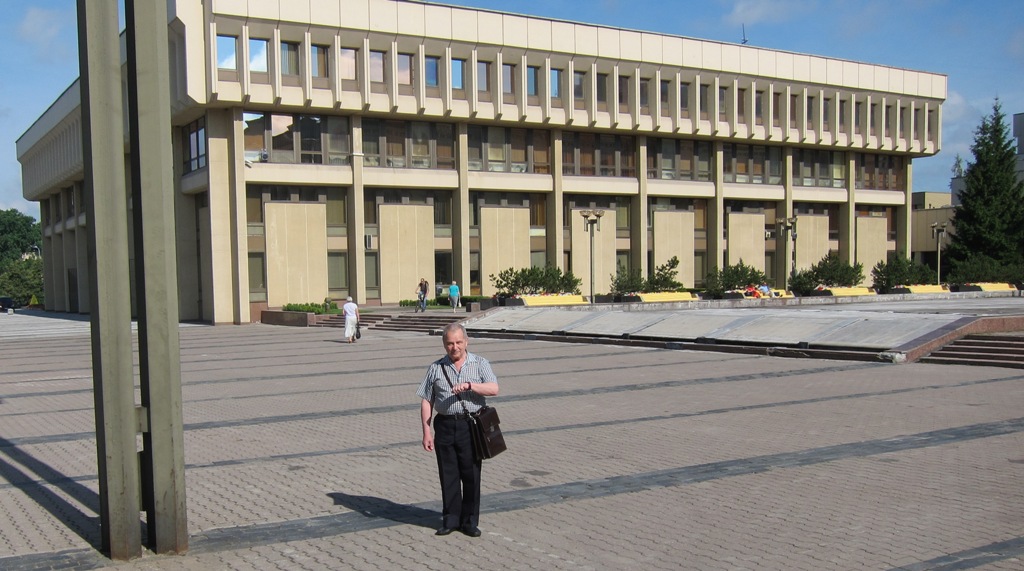
Milan Chersonski at the Lithuanian Parliament. From 1979 to 1999 Chersonski directed the Yiddish Amateur Theater in Vilnius, Lithuania. He worked in various capacities at the quadrilingual (English-Lithuanian-Russian-Yiddish) newspaper Jerusalem of Lithuania, publication of The Jewish Community of Lithuania, from its founding in 1989 until the paper was closed in 2011. He was its editor-in-chief from 1999 to 2011. He is now a senior analyst at DefendingHistory.com and contributes to various publications.
On September 28th 2010, the Parliament of Lithuania announced that 2011 would be the Year of Commemoration of Battles for Freedom and Great Losses. This mysterious name of some sort of anniversary appeared exactly a week after the same year, 2011, was declared the Year of Commemorating the Genocide of Lithuanian Jews. The Jewish Community of Lithuania reacted without delay to the ‘dual track’, apartheidized commemorations.
Now which “battles for freedom” are they talking about in the resolution? What sort of great losses? The resolution does not say specifically. Yes, Lithuanians valiantly rebelled for freedom in 1794, and in 1831, as well as in 1863, and then there were serious demonstrations on behalf of freedom in 1904-1905, and then there were the battles from 1918 to 1920 for the independence and borders of the newly founded state.
But it is impossible to understand exactly which events and which dates they now had in mind from the text of Lithuanian parliamentary resolution no. XI-1038 of September 28th 2010. And this is probably no accident, as shown by the subsequent actions of the Lithuanian government and leading organizations here.
My dear friends, it is precisely because I am a proud official of the government of independent, democratic, Lithuania, and I love my country, that I am able to speak here today openly, on the seventieth anniversary of the murder of the Jews of Plungė — Plungyán, as they proudly called it in the Yiddish that rang through its streets for so many centuries.
The Holocaust Obfuscation movement suffered a severe blow today with the public resignation from the Lithuanian government’s red-brown commission of Professor Konrad Kwiet, a major international scholar of the Lithuanian Holocaust. The resignation had been announced verbally at the recent ‘Aftermath’ conference held in Melbourne at the Australian Centre for the Study of Jewish Civilisation.
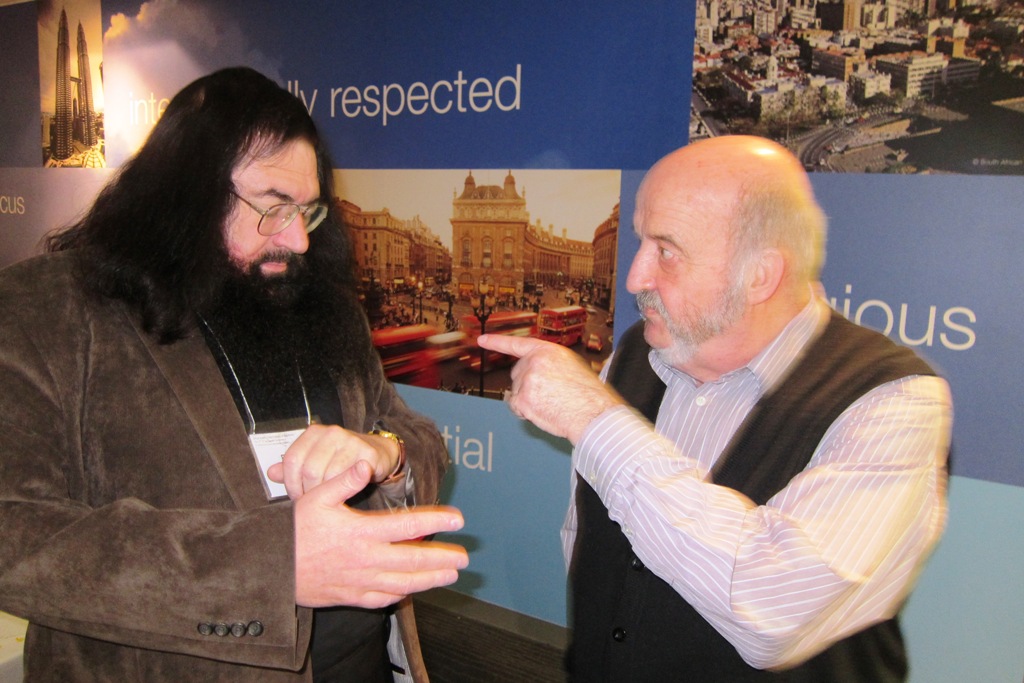
Professor Konrad Kwiet (right) makes a point to Dovid Katz at the June 2011 Aftermath conference at Monash University in Melbourne. Photo: Ariella Leski.