DOCUMENTS | THE OLD VILNA JEWISH CEMETERY | OPPOSITION TO CONVENTION CENTER PROJECT | INTERNATIONAL PETITION | CHRISTIAN-JEWISH RELATIONS | CEMETERIES | VILNIUS JEWISH LIFE | HUMAN RIGHTS
◊
◊
◊
VILNIUS—The following statement by Professor Shnayer (Sid) Leiman, appeared today in the respected American weekly Five Towns Jewish Times. It is a reaction to the comments by Lithuania’s top leaders, made after receiving a letter of protest from twelve United States congressmen concerning plans to site a projected new national convention center in the heart of the territory of the Old Vilna Jewish Cemetery at Piramónt (in the Šnipiškės district of modern Vilnius). International opposition to “the convention center in the old Jewish cemetery” continues to mount.
The dispute over Vilna’s oldest synagogue has been brewing for more than a decade. Recently, as a result of the involvement and protestations of a coalition of rabbinic leaders and activists, the fight has intensified.
The Jewish community in Lithuania is hundreds of years old. The Vilna Gaon, who lived in the 18th century, and other great Torah luminaries helped Vilna earn its reputation as the Jerusalem of Eastern Europe.
The Shoah. Lithuania has rightfully earned one of the most sordid reputations of anti-Semitism based upon its participation in the Holocaust. While almost everyone heard of Babi Yar, where 33,000 men, women, and children were murdered, many have not heard about Ponary (Ponár), the forest outside of Vilna where double that amount — approximately 70,000 Jews — were rounded up and massacred by Lithuanian Nazi collaborators.
◊
VILNIUS—The following statement by Vilnius native and resident Ruta Bloshtein, an active member of the city’s religious Jewish community, appeared today as an update to her international petition, which has just approached the 40,000 signature mark. Her update was issued as a reaction to the comments by Lithuania’s top leaders, made after receiving a letter of protest from twelve United States congressmen concerning plans to site a projected new national convention center in the heart of the territory of the Old Vilna Jewish Cemetery at Piramónt (in the Šnipiškės district of modern Vilnius). International opposition to “the convention center in the old Jewish cemetery” continues to mount.
◊
VILNIUS—The Weekly of Vilnius, widely considered to be this city’s most prestigious English-language news publication, was today the first in the Lithuanian capital to cover news of the letter from twelve United States congressmen to the president of Lithuania concerning current plans to situate a projected new national convention center in the heart of the city’s historic old Jewish cemetery, at Piramónt, in the Šnipiškės section of modern Vilnius. With the permission of the publishers, we are reproducing the title page of today’s edition and the entire article concerning the cemetery. In the spirit of classic journalism, The Weekly of Vilnius has no online edition (only an online description page) and is available weekly by emailed PDF or hard copy to its elite group of subscribers, known to include embassies, government agencies, captains of industry, politicians, academics and relevant institutions, libraries, and think tanks around the world. It is edited by the distinguished economist and journalist Mr. Nehro Khalil. A PDF facsimile of today’s report follows. Please use the arrows in the upper left hand corner to turn pages in either direction.
WASHINGTON—A resolute letter (facsimile below; as PDF) signed by twelve United States congressmen to the president of Lithuania, Dalia Grybauskaitė, was released here today. Dated 28 July 2017, the letter expresses American “opposition to the conversion of the old Vilnius Palace of Concerts and Sports into a convention center on the site of the old Jewish cemetery.” It asserts that “the very presence of the existing structure in the middle of the old Jewish cemetery desecrates it and conflicts with the respect for human dignity that forms the basis of Western Civilization. By contrast, moving the convention center project to another site, and permitting the dismantling of the abandoned Sports Palace it was to replace, would affirm the Lithuanian government’s commitment to basic human rights.”
◊
VILNIUS—Defending History today released here a Yiddish version of Julius Norwilla’s Lithuanian and English posters produced in the course of the current campaign to save the Old Vilna Jewish Cemetery from becoming the “geo-basis” for a new national convention center where revelers would cheer, clap, sing, and dance, and use bars and toilets, surrounded by thousands of Jewish graves from the fifteenth to the nineteenth centuries. Human rights specialists concur that such a fate would not be contemplated for a Christian cemetery in the European Union, much less with the proposed EU contribution of millions of euros in “structural funds”.
As in the case of the Lithuanian and English posters, readers are invited to make as many printouts as possible, and to distribute them far and wide, mentioning wherever possible the ongoing international petition which has to date attracted some 40,000 signatures from many parts of the globe. The Yiddish poster is also available as PDF and higher-res image.
◊
VILNIUS—Following his recent release of a Lithuanian-language poster calling for restoration of the Old Vilna Jewish Cemetery at Piramónt, Julius Norwilla (Norvila) today released the English-language version, which follows. Readers are invited to print out copies of the poster to help in the campaign (as PDF; as image). [UPDATE: A Yiddish version of the poster was subsequently published.]
◊
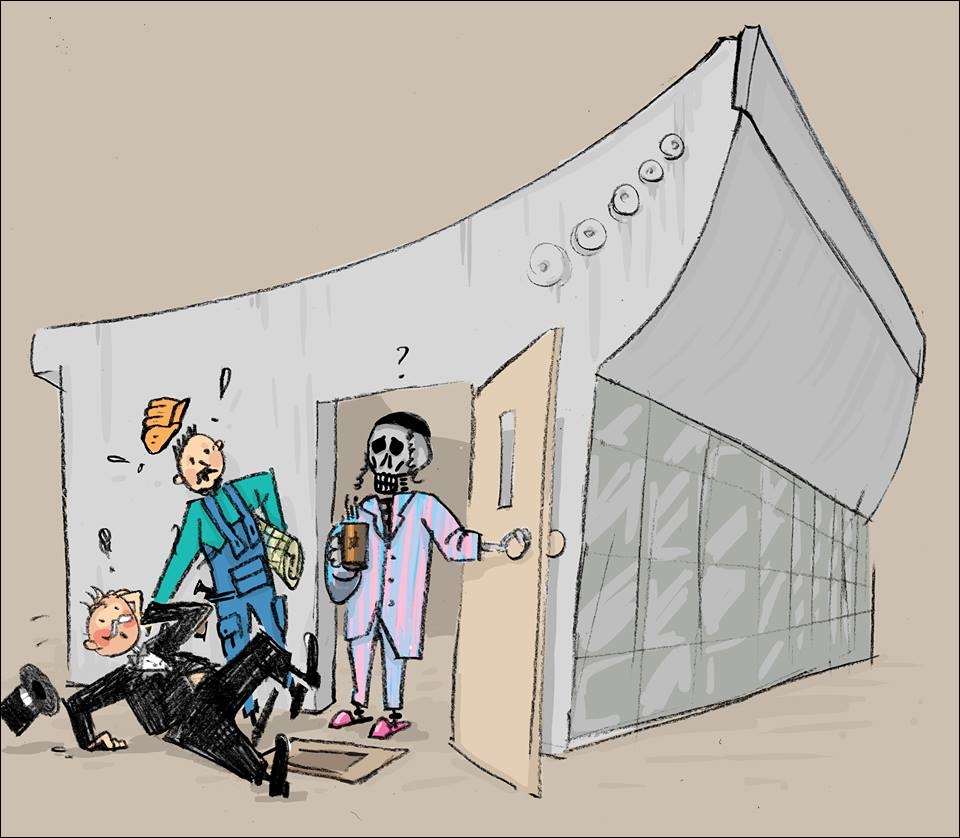
VILNIUS—For the first time in the history of modern Lithuania, a non-Jewish campaign initiative for a Jewish cause has seen its poster flood the streets of this city’s storied Old Town at the height of the summer tourist season. Conceived and produced by Julius Norwilla (Norvila), a former Protestant minister, using a quote from Dr. Andrius Kulikauskas, a Catholic philosopher, and based on an artistic visualization of a young Vilnius artist who supports the campaign, the poster is entitled “Vilnius Without its Ugliest Soviet Eyesore”. That is a reference to the hated ruin of the Soviet Sports Palace which stands in the middle of the old Vilna cemetery, where the city’s Jewish residents were buried in graves paid for by their families as freehold property, from the 15th to the 19th century. The poster makes reference to Vilnius native Ruta Bloshtein’s international petition, which is, at 40,000 signatures to date, arguably the largest Litvak initiative since the Holocaust. Members of Lithuania’s Jewish community who have spoken out to date include Moyshe Bairak, Ruta Bloshtein, Milan Chersonski, Pinchos Fridberg, Dovid Katz, and Josif Parasonis (more here). Current and recent rabbis in Vilnius who have taken a public stand include Chaim Burshtein, Shmuel Jacob Feffer, Kalev Krelin, and Sholom Ber Krinsky.
◊
VILNIUS—Ms. Milda Dargužaitė, since December 2016 the highly respected Chancellor of the Office of the Government of the Republic of Lithuania, on 2 June 2017 issued a written reply to Ruta Bloshtein, the Vilnius-born Orthodox Jew who last December initiated a petition on the old Vilna Jewish cemetery at Piramónt, in today’s Šnipiškės (Yiddish: Shnípishek). The petition asks the Lithuanian government to move the national convention center project away from the old Jewish cemetery, and to restore the historic burial ground which dates to the fifteenth century and contains the remains of many of the greatest Lithuanian Jewish scholars. There has been a massive international outcry against plans to cite a convention center in the heart of the old cemetery where revelers would cheer, clap, do politics, sing, drink at bars and use toilets surrounded by thousands of Jewish graves. Ms. Bloshtein’s petition has been signed by 40,000 people, and has been the subject of coverage in Algemeiner.com, Ami, the Jewish Chronicle, Jewish Journal, Tablet, and numerous other publications.

◊
VILNIUS—In recent weeks, Lithuania’s Jewish community has been shaken by a number of vicious attacks against various of its members, apparently written by operatives out to provoke “senseless interethnic strife and division” who have infiltrated to echelons of the official community’s power structures, and published personal invective replete with “demonstrable falsehoods” under the imprimatur not of any named author but of the “Lithuanian Jewish Community” per se (examples here, here, and here). Against that backdrop many Jews and Lithuanians alike, who enjoy some of the best daily relations of any two groups in Eastern Europe, have been finding it necessary to stress that Lithuanian-Jewish relations are excellent and will not be disturbed by such mischief makers (see also today’s JTA report, and a 2015 paper by this journal’s editor). The ongoing passionate debates about the Holocaust, “Double Genocide”, defamation of Jewish partisans, glorification of local Nazi collaborators, city-center neo-Nazi marches on independence days, plans to have a new national convention center in the heart of the old Jewish cemetery, and the fair allocation of restitution funds, are not disputes between “Jews and Lithuanians”: there are, at least locally, proponents from both groups on all sides of each of these debates and various others.
Julius Norwilla’s speech at the Lithuanian Embassy in Tel Aviv: in English, in Lithuanian
◊
TEL AVIV—The following is the text of the speech delivered by Julius Norwilla during the gathering earlier today at the Lithuanian Embassy in Tel Aviv where a delegation of major Litvak rabbis, joined at their request by Mr. Norwilla, who flew in from Vilnius for the event, was welcomed by Ambassador Edminas Bagdonas. Details of the event are here.
◊
The Simon Wiesenthal Center issued the following statement on 18 May, bringing it into full de facto support of Ruta Bloshtein’s petition which now approaches 40,000 signatures from around the world.
LOS ANGELES AND JERUSALEM—The leaders of the Simon Wiesenthal Center have appealed to Lithuanian President Dalia Grybauskaite to change the current plans of the government to build a convention center on the grounds of the ancient Jewish cemetery at Piramónt in the heart of the Lithuanian capital.
◊
The following is a full translation of the radio debate on the fate of the Old Vilna Jewish Cemetery at Piramónt (in the capital’s Snipiskes district), aired by LRT.lt radio as part of its People and Ideas series on 1 March and again on 5 March 2017 and available in the original Lithuanian on the station’s website. The debate was hosted by Audra Girijotė with the participants (in alphabetical order here): Renaldas Augustinavičius, Ruta Bloshtein, Faina Kukliansky, Andrius Kulikauskas, Shnayer Leiman, Remigijus Šimašius.
Note that this translation works from the Lithuanian voice-over on Professor Leiman’s originally English contribution, rather than from a separate tape of the full English interview with Professor Leiman used by the organizers (who put together the “debate” after separate interviews with the participants). This was decided upon in the spirit of trying to characterize, as best we can, the text and texture actually received by the Lithuanian language audience.
◊
I am studying How do people behave? How should they behave? and as part of that, How do issues come to matter? or no longer matter? Today I will share what I am learning about the theoretical power of our imagination to produce and resolve a real life controversy.
What should be done with the Old Vilna Jewish Cemetery (Piramónt, in the Šnipiškės district of modern Vilnius)? It should be restored. For this to happen, the Soviet ruin in its center should be taken down to ground level, with no further earthworks in the cemetery, ever. Let it forever remain a testimonial to the vibrancy of Jewish life in Vilna.
THIS ARTICLE IN LITHUANIAN TRANSLATION
Two of Vilna’s greatest photographers and artists, Juozapas Kamarauskas (d. 1946) and Jan Bulhak (d. 1950) were mesmerized by Vilna’s Jewish sites, and especially by the Old Jewish Cemetery. They left us with an abundance of photographs and sketches of the Old Jewish Cemetery. Jewish scholars of the 19th and 20th centuries, residents of Vilna, recorded and published for posterity meticulous transcriptions of the texts of hundreds of epitaphs inscribed on the tombstones of the Old Jewish Cemetery.
VILNIUS—The Hon. Herbert Block, a prominent and popular personality known to New Yorkers from his days as the highly successful Jewish affairs liaison for the campaign and administration of New York City mayor David Dinkins years ago has emerged as a major force at the confluence of Jewish-Hasidic, American and Lithuanian-government politics on issues in Lithuanian-Jewish affairs. There are conflicting views about his myriad, and some would say conflict-of-interest laden, entanglements that include a Satmar group in Monroe, New York intent on fulfilling the wishes of Vilnius builders for a convention center and annex in the heart of the old Jewish cemetery of Vilnius (allegedly for the financial benefit of their London followers in the CPJCE), a US taxpayer funded agency that exists to preserve Jewish cemeteries (but has yet to issue a word of protest at the “convention center in the Jewish cemetery” project) and the Lithuanian government’s “Good Will Foundation” that allocates monies deriving from the religious properties of the annihilated Jewish communities of Lithuania.
NEW SECTION ON MR. BLOCK’S LITHUANIAN INVOLVEMENTS
VILNIUS—An invitation has been extended by the office of Dr. Andrius Kulikauskas to all interested colleagues to attend a seminar in Vilnius Old Town this Monday, 10 April 2017, from 1 to 5 PM (1300 to 1700) at the campus of Vilnius Gediminas Technical University on “Self-Identity and the Old Jewish Cemetery.” People who can only stop in for part of the event may come and go as needed.
MONDAY 10 APRIL
Come and visit between 1 and 5 PM at Workshop on Self-Identity and the Old Jewish Cemetery, at Vilnius Gediminas Technical University, Traku Street 1, corner of Pylimo, entrance from Pylimo. Defending History’s section, opposition tracker, and paper trail.
EVERYBODY WELCOME