


According to a 17 January 2011 report on The Baltic Course, the foreign ministers of the Czech Republic and of Lithuania agreed to ‘continue cooperating with an aim to properly evaluate at the EU level the crimes of totalitarian regimes’ (Obfuspeak for the red-brown movement in the European Parliament) as well as ‘the agenda of Lithuania’s chairmanship [of the OSCE] and plans for the conference on antisemitism, which is co-organized by Lithuania and the Czech Republic in Prague’.
Antisemitism & Bias
Two Conferences in Late March: Red-Brown Brigades and — on Antisemitism. . .
Posted in Antisemitism & Bias, Double Genocide: The New Form of Holocaust Revisionism & Denial, News & Views
Comments Off on Two Conferences in Late March: Red-Brown Brigades and — on Antisemitism. . .
Vilnius Municipality’s Response to Wiesenthal Center’s Comments on Planned Neo-Nazi Parade on March 11th
The Vilnius city administration (municipality) said today that it had ‘no intention of responding to the statement’ issued by the Simon Wiesenthal Center on 17 February condemning its decision to provide a permit for yet another city-center Neo-Nazi parade in the capital on the occasion of its March 11th Independence Day.
The statement, issued by Dr Efraim Zuroff, director of the Wiesenthal Center’s Israel office quotes Dr Zuroff as follows:
Posted in Antisemitism & Bias, Celebrations of Fascism, Events, Neo-Nazi & Fascist Marches, Vilnius
Comments Off on Vilnius Municipality’s Response to Wiesenthal Center’s Comments on Planned Neo-Nazi Parade on March 11th
‘Today on the Street, Tomorrow in Parliament’ is neo-Nazi Rallying Cry in Kaunas
Neo-Nazi marchers in Kaunas today, Lithuania’s February 16th Indendence Day celebration, carried a banner reading (in translation): ‘Today in the Street, Tomorrow in Parliament’. The reference was both to the general goal of the movement, and in reference to a neo-Nazi employed as an assistant to a prominent member of parliament (the Seimas), herself formerly the head of the antisemitic Genocide Center, who has announced his own candidacy in forthcoming municipal elections.
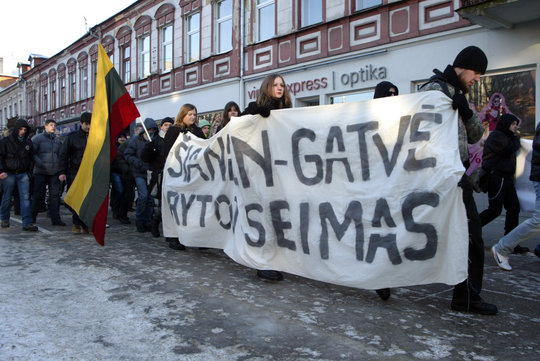
'Today on the Street, Tomorrow in Parliament' reads this sign displayed during the neo-Nazi march in Kaunas on 16 February 2011. Photo by N. Povilaitis (Lrytas.lt).
By apparent agreement with authorities, the marchers brandished swasticals rather than classical swastikas.
Report and images on Lrytas.lt.
Posted in Antisemitism & Bias, Celebrations of Fascism, Free Speech & Democracy, Human Rights, Kaunas, Neo-Nazi & Fascist Marches, News & Views
Comments Off on ‘Today on the Street, Tomorrow in Parliament’ is neo-Nazi Rallying Cry in Kaunas
Text of the Letter Delivered to the Lithuanian Ambassador in London on 7 February 2011
Text of the letter delivered to the Lithuanian ambassador in London Monday morning 7 February 2011 by the Right Honourable Denis MacShane MP. The letter was drafted by Danny Ben-Moshe and evolved with input from the other signatories. Signatories include Lord Janner of Braunstone, Rabbi Barry Marcus of Central Synagogue, and Professor Ada Rapoport-Albert, head of the Department of Hebrew and Jewish Studies at University College London which hosted the main conference. PDF here. Background and further links to press coverage here.
H.E. Dr Oskaras Jusys
Ambassador
Embassy of the Republic of Lithuania
84 Gloucester Place
London W1U 6AU
7 February 2011
Dear Ambassador
Posted in A 21st Century Campaign Against Lithuanian Holocaust Survivors?, Antisemitism & Bias, Documents, Dov Levin (1925 - 2016), Efraim Zuroff, EU, Events, Foreign Ministries: Holocaust Politics Abuse?, Identity Theft of Litvak Heritage, Lithuania, Litvak Affairs, News & Views, Opinion, Politics of Memory, UCL Manipulated?, United Kingdom
Tagged Ada Rapoport-Albert, Clemens Heni, Danny Ben-Moshe, Danny Stone, Dov Levin, Dovid Katz, Efraim Zuroff, Harry Shukman, Lord Janner of Braunstone, Michael Freedland, Mikail Iossel, Saul Issroff, Uri Chanoch
Comments Off on Text of the Letter Delivered to the Lithuanian Ambassador in London on 7 February 2011
Latvian National Front Releases its Letter to the American Ambassador in Riga
The organization Latvian National Front has sent to the email address of the Embassy of the USA, as well as other embassies, including the Embassy of Israel, a letter with the following content (translated from Latvian):
Posted in Antisemitism & Bias, Latvia, Riga's Waffen SS Marches
Comments Off on Latvian National Front Releases its Letter to the American Ambassador in Riga
Polish Ambassador to Lithuania HE Janusz Skolimowski Speaks Out Boldly on Latest Holocaust Denial
VILNIUS—The following is the text of HE Polish ambassador Janusz Skolimowski’s 26 November letter in Veidas, which the ambassador copied to Lithuania’s Minister of the Interior. This authorized English translation was kindly provided to Defending History by the Embassy of Poland here. The letter followed one by seven other ambassadors regarding the same events in Lithuania.
From: Ambassador of the Republic of Poland in Vilnius
To: Editor-in-Chief of the weekly magazine “Veidas”
For the attention of: Mr. Raimundas Palaitis, Minister of the Interior of the Republic of Lithuania
Concerns: Article of Petras Stankeras dated November 14th, 2010:
“The International Military Tribunal at Nuremberg — the biggest legal farce in history”
Dear Mr. Editor-in-Chief,
Posted in Antisemitism & Bias, Documents, Human Rights, Lithuania, Media Watch, News & Views, Opinion, Poland, Politics of Memory
Tagged Holocaust in Lithuania, Janusz Skolimowski, Nuremberg Trials, Petras Stankeras, Polish Embassy in Vilnius, Raimundas Palaitis, Veidas
Comments Off on Polish Ambassador to Lithuania HE Janusz Skolimowski Speaks Out Boldly on Latest Holocaust Denial
Bloomington Scholar Exposes Racist Images in Popular Language Manual
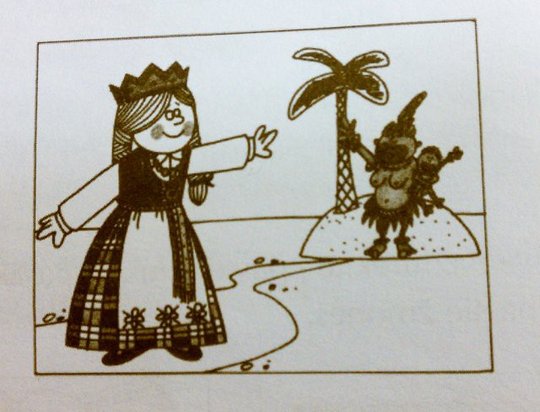
Christine Beresniova, a doctoral scholar at Indiana University (Bloomington) has exposed the disturbingly racist images in a popular Lithuanian language manual that have disturbed foreign Lithuanian language students for many years. The public disclosure is reported today in an article in the main daily newspaper in Vilnius, Lietuvos rytas.
The most infamous image features two pairs of stereotypes. There is the Lithuanian woman in national folk costume and a crown on her head, and as foreign counterpart, a bare-breasted black woman in Africa with weird headgear. The caption to the illustration translates ‘This woman is a Lithuanian, and that one is an African’, as if Africa is a country, one-to-one comparable to ‘Lithuania’.
Posted in Antisemitism & Bias, Human Rights, Racism, United States
Tagged Christine Beresniova, Lietuvos rytas, Racism in Lithuania
Comments Off on Bloomington Scholar Exposes Racist Images in Popular Language Manual
When a ‘Human Rights Association’ accepts and repeats the antisemitic canards in town
O P I N I O N
by Dovid Katz
“Also, it has been started to require the sentence of the citizens of the Jewish nationality ― Yitzhak Arad, Fania Brantsovsky and Rachel Margolis, as these citizens (former Soviet guerrillas) have organized the massive slaughter of civilians in Kaniūkai Village, Lithuania (killing 38 civilians) on 29 January 1944. Attention should be paid to the fact that the very Y. Arad has departed to Israel.” — from the statement just published by the Lithuanian Human Rights Association (LHRA), signed by ten of its leading experts and approved by its committee.
Posted in A 21st Century Campaign Against Lithuanian Holocaust Survivors?, Antisemitism & Bias, Double Genocide: The New Form of Holocaust Revisionism & Denial, Dovid Katz, Fania Yocheles Brantsovsky (Fania Brancovskaja): 1922-2024, Free Speech & Democracy, Human Rights, Israel, News & Views, Opinion, Užgavėnės, UŽGAVĖNĖS (SHROVETIDE)
Comments Off on When a ‘Human Rights Association’ accepts and repeats the antisemitic canards in town
Jewish and Holocaust Polemics Flare up in Vilnius
There has been a two-pronged assault today in the mainstream mass media in Lithuania on the tiny but vibrant Jewish Community of Lithuania. The community has been busy in recent days with concluding Chanukah festivities and moving on one day later to a photography contest for young people. The judges include some of the top Lithuanian art photographers, and the event, popular on Facebook, features Jewish and Lithuanian photography lovers enjoying themselves together in harmony.
Posted in Antisemitism & Bias, News & Views, Yitzhak Arad
Comments Off on Jewish and Holocaust Polemics Flare up in Vilnius
Lithuania’s Foreign Minister tells of Jewish Conspiracy during Discussion on Dual Citizenship
At a 13 October parliamentary meeting of the right-wing faction that  governs Lithuania, the country’s Foreign Minister, Audronius Ažubalis, began a discussion of proposals to again permit dual citizenship by saying that ‘everyone knows’ who is pushing the bill in parliament. Pressed for details, he went on to explain that the culprits are foreign Jews of Litvak origin (i.e. the same precise group being targeted for PR by his Foreign Ministry for its Fake Litvak Forum).
Slipping deeper into classic antisemitic canards, the foreign minister went on to propose that ‘they’ are doing this in order to reap financial benefits by way of property restitution that depends upon citizenship under the country’s citizenship laws that racially favor ethnic Lithuanians.
The main news report of the incident by a highly respected journalist, in the country’s main daily, Lietuvos rytas is headlined:
FOREIGN AFFAIRS STRATEGIST SEES JEWISH CONSPIRACY
Posted in Antisemitism & Bias, Citizenship, Foreign Ministries: Holocaust Politics Abuse?, Human Rights, News & Views
Comments Off on Lithuania’s Foreign Minister tells of Jewish Conspiracy during Discussion on Dual Citizenship
Jewish Community of Lithuania Writes to Lithuania’s President After Foreign Minister’s Antisemitic Tirade
[AUTHORIZED TRANSLATION OF THE LITHUANIAN ORIGINAL]
This letter was approved unanimously at a meeting of the board of directors of the Lithuanian Jewish Community on October 14, 2010, in which 21 board members participated.
To the President of the Republic of Lithuania
Ms. Dalia Grybauskaitė
15 October 2010
Your Excellency,
The Lithuanian Jewish Community wishes to express its great concern concerning the thoughts expressed by the foreign minister of the Republic of Lithuania, A. Ažubalis, which sow discord between Lithuanians and Jews.
Reports have appeared in the mass media that A. Ažubalis said that “Everyone knows very well” by whom this law (Lithuanian dual citizenship) is most needed, and explained that Jews of Lithuanian origin are the main force pushing this law to the forefront. Moreover, the politician hinted that they probably expect to regain property here more easily in this manner.
Posted in Antisemitism & Bias, Double Games, Foreign Ministries: Holocaust Politics Abuse?, Human Rights, News & Views, Opinion, Shimon Alperovich (1928 – 2014)
Tagged Antisemitism in Lithuania, Audronius Azubalis, Foreign Minister of Lithuania, Shimon Alperovich (Simonas Alperavicius)
Comments Off on Jewish Community of Lithuania Writes to Lithuania’s President After Foreign Minister’s Antisemitic Tirade
Lithuania’s Foreign Minister Believes a Jewish Conspiracy to be Pushing Proposals for Allowing Dual Citizenship
A sensational front-page story in today’s Lietuvos rytas, Lithuania’s main national daily, reports that the foreign minister, Audronius Ažubalis, told his ruling party colleagues at a meeting that ‘the new law [regarding possibilities for dual citizenship] was being pushed by Jews who seek citizenship on order to press compensation claims against the state’.
Posted in Antisemitism & Bias, Citizenship, Foreign Ministries: Holocaust Politics Abuse?, Human Rights, News & Views
Comments Off on Lithuania’s Foreign Minister Believes a Jewish Conspiracy to be Pushing Proposals for Allowing Dual Citizenship
Attacks on the Panevezys (Ponevezh) Jewish Community Office
A report in Jerusalem of Lithuania describes the most recent attacks on the offices of the small Jewish community that remains in Panevezys (Ponevezh). The report is available here.
Posted in Antisemitism & Bias, News & Views
Comments Off on Attacks on the Panevezys (Ponevezh) Jewish Community Office
Gruto Parkas, the Fun Park near Druskininkai
O P I N I O N
by Dovid Katz
Photos by Richard Schofield (© R. Schofield)
A ‘Lenin Statue Theme Park’ near the resort town of Druskininkai featuring: ‘Soviet Sculpture Exposition, Museum, Picture Gallery, Events, Cafes, Souvenirs, Lunapark, Zoo’ etc. Their website here. A summer 2010 visit.
Gruto Parkas (situated at Grutas, near Druskininkai and often popularly called ‘the Lenin Park’) is a private enterprise, but a large sign near the entrance boasts that the historical inscriptions were donated by the state-sponsored ‘Genocide and Resistance Research Centre of Lithuania’.
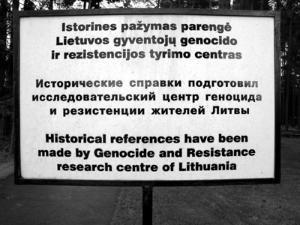
THE QUESTION: Can you imagine a major theme park dedicated to the history of the Soviet period, in a member state of the European Union and NATO, that tries its best to present Soviet Communism as a largely Jewish enterprise? With a presentation in the spirit of a most infamous brand of 20th century antisemitism? That singles out by nationality only Jews among the many ‘rogues’ featured in its exhibits? That defames the memory of Holocaust Survivors who escaped Nazi ghettos to join the anti-Nazi partisans in the forests of Lithuania? And all this, without once mentioning the Holocaust . . .
Posted in Antisemitism & Bias, Collaborators Glorified, Double Genocide: The New Form of Holocaust Revisionism & Denial, EU, Exotic Jewish Tourism, Identity Theft of Litvak Heritage, Museums, News & Views, Opinion, Politics of Memory
Comments Off on Gruto Parkas, the Fun Park near Druskininkai
Pig’s Head, with Hat and Earlocks, Placed at Kaunas Synagogue Door During Sabbath Service
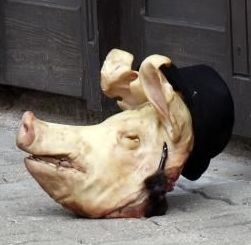 A pig’s head, adorned with a black hat and makeshift hasidic style earlocks, was placed on the pavement right outside the door, within the courtyard of the main synagogue in Kaunas, Lithuania’s second city, during Sabbath morning services. This caused profound grief to the very small congregation of survivors who pray at the city’s Choral Synagogue, the only prewar Jewish prayerhouse in town that still functions. The service was interrupted as police arrived to investigate. The Lithuanian Jewish Community described it as a neo-Nazi antisemitic attack. The police however told BNS that the incident ‘is still qualified as a disturbance of the public peace’. Moreover, the commander of the Central Police Commissariat Gintautas Dirmeikis told BNS that ‘There are no suspects so far’. Photo by Laimutis Brundza / Kauno diena.
Posted in Antisemitism & Bias, Human Rights, News & Views, Symbology
Comments Off on Pig’s Head, with Hat and Earlocks, Placed at Kaunas Synagogue Door During Sabbath Service
Swastika Sanitization
In May 2010 a Lithuanian court legalized public displays of swastikas, with nearly no reaction from foreign embassies or human rights groups. Reports here and here. Jewish community’s reaction here. See also the page on Antisemitism. On the term swasticals, see our report for 8 May 2010.
REPRESENTATIVE SELECTION
11 March 2008
Gedimino Boulevard, Vilnius. This is the ‘Lithuanian swastika’ with the added lines meant to evoke the ‘Columns of Gediminas‘. Details and video of the parade here.
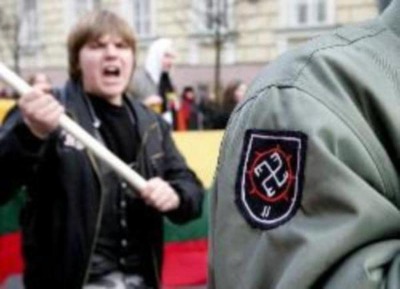
16 February 2010
Posted in Antisemitism & Bias, Celebrations of Fascism, Christian-Jewish Issues, Lithuania, Litvak Affairs, News & Views, Politics of Memory, Swastikas in Lithuania, Symbology
Tagged swastica sanitization, swastikas in Eastern Europe, swastikas in Lithuania
Comments Off on Swastika Sanitization
Litvak Studies Institute Protests “Fake Litvak” Game by Politicians; Director Mikhail Iossel Issues Statement
Professor Mikhail Iossel, director of Summer Literary Seminars (SLS) and the newly established Litvak Studies Institute (LSI) released this statement today on the LSI website [archived copy].
Litvak Studies Institute Protests Lithuanian Government’s “Fake Litvak” Forum, Calls on State to Halt PR Gimmickry and Reverse Anti-Jewish Policies
Posted in Press — 20 July 2010
For the dwindling number of aged Litvak survivors who grew up in the East European Jewish civilization decimated by the Holocaust, the anti-Jewish and Holocaust-distorting policies of the Lithuanian government in recent years are deeply painful.
Posted in "Jewish" Events as Cover?, Antisemitism & Bias, Double Games, Identity Theft of Litvak Heritage, Lithuania, Litvak Affairs, Mikhail Iossel, News & Views, The Great SLS About-Face, What Do Fake Litvak Games Look Like?
Tagged Andrius Kubilius, Deividas Matulionis, Dovid Katz, Fake Litvak Forum, Holocaust in the Baltics, Jewish partisans in Lithuania, Lithuanian-Jewish relations, Litvak Studies Institute (LSI), Mikhail Iossel, Mikhail Iossel + Vilnius, Summer Literary Seminars (SLS Lithuania)
Comments Off on Litvak Studies Institute Protests “Fake Litvak” Game by Politicians; Director Mikhail Iossel Issues Statement
Lithuanian Court Legalizes Public Swastikas as ‘Historical Heritage’; 2008 Ban on ‘Nazi and Soviet Symbols’ now Excludes… Swastikas
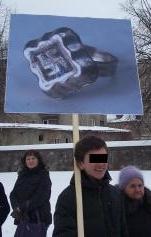 A Lithuanian court in Klaipeda approved the public display of swastikas on the grounds that they are ‘Lithuania’s historical heritage rather than symbols of Nazi Germany’. An ultranationalist ‘expert’ transported from Vilnius was easily able to persuade the court, which did not bother to ask a contrasting view of the Holocaust Survivor community, or the Jewish Community of Lithuania, in a European country with one of the highest proportions of Holocaust genocide on the continent. This sad distinction resulted from massive local participation. Image from 16 Feb Klaipeda demonstration courtesy DMN atKaunodiena.lt.
BNS report on the court’s 19 May decision here. So much for the parliament’s 2008 ban on ‘Nazi and Soviet symbols’ which only caused pain to aged veterans of the anti-Nazi war effort, and which was ultimately part of the machinations in support of the Double Genocide movement in the European Parliament, in cooperation with the movement’s local power structures.
The United States Embassy has remained silent on the legalization of public swastikas.
Posted in Antisemitism & Bias, Celebrations of Fascism, Collaborators Glorified, EU, Human Rights, Neo-Nazi & Fascist Marches, News & Views, Politics of Memory, Swastikas in Lithuania, Symbology, US State Department, Vilnius
Comments Off on Lithuanian Court Legalizes Public Swastikas as ‘Historical Heritage’; 2008 Ban on ‘Nazi and Soviet Symbols’ now Excludes… Swastikas
Lithuanian Court Approves Display of Swastikas in Public
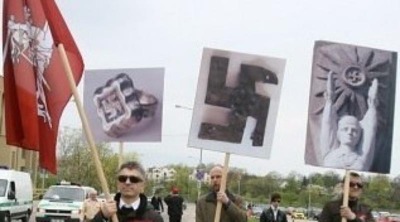 A Lithuanian court in Klaipeda approved the public display of swastikas on the grounds that they are ‘Lithuania’s historical heritage rather than symbols of Nazi Germany’. An ‘expert’ transported from Vilnius was easily able to persuade the court, which did not bother to ask a contrasting view of the Holocaust Survivor community, or the Jewish Community of Lithuania, in a European country with the highest proportion of Holocaust genocide on the continent. This sad distinction resulted from massive local collaboration and actual participation.
Media coverage: BNS report on the court’s 19 May decision here. Delfi report. JTA report on the court’s decision and Dr. Efraim Zuroff’s reaction. Photo by J. Markevicius on Delfi.
Posted in Antisemitism & Bias, Celebrations of Fascism, Collaborators Glorified, Human Rights, Neo-Nazi & Fascist Marches, News & Views, Politics of Memory, Swastikas in Lithuania, Symbology, US State Department, Vilnius
Comments Off on Lithuanian Court Approves Display of Swastikas in Public
Neo-Nazis, Protected by Police, flaunt Swasticals near Reval Lietuva Hotel During Baltic Pride Parade
BNS summary here. Video here. The state prosecution service that continues to ‘investigate for war crimes’ Holocaust survivors who joined the anti-Nazi resistance, and passes over neo-Nazi marches in utter silence, tried hard (but failed) to stop the May 8th Baltic Pride Tolerance march in Vilnius.

OUR EYEWITNESS REPORT:
After being refused entry into the actual Baltic Pride marchers’ area, on grounds that we did not have individual permits, we were directed to the plaza between the Reval Lietuva Hotel and the CUP department store where we were told the march’s concluding point could be observed. There, police eagerly directed visitors and sympathisers into an ‘observation area’ just below on a grassy hillside. It soon became evident that while limiting the formal numbers of Baltic Pride participants, the police were shepherding visitors into an area occupied by neo-fascists and bolstering their apparent numbers.
Posted in Antisemitism & Bias, Celebrations of Fascism, Collaborators Glorified, Events, Human Rights, LGBTQ Equal Rights, Neo-Nazi & Fascist Marches, News & Views, Swastikas in Lithuania, Symbology
Comments Off on Neo-Nazis, Protected by Police, flaunt Swasticals near Reval Lietuva Hotel During Baltic Pride Parade