APOLOGIES
THIS PAGE HAS MOVED HERE
NEW URL: https://defendinghistory.com/blaming-the-victims-documents-and-sources/120225


On the occasion of Holocaust Remembrance Day, the Margolis family in the United States released to the media a 3 December 2009 letter from the United States Congress to the prime minister of Lithuania, protesting in no uncertain terms the campaign being waged against 88 year old historian, museum builder and biologist, Dr Rachel Margolis; 87 year old Fania Yocheles Brantsovsky, librarian of the Vilnius Yiddish Institute; and 83 year old Holocaust scholar Dr Yitzhak Arad, who was founding director of Yad Vashem. All three have been the subject of ongoing ‘investigations into war crimes’ by Lithuanian prosecutors and of extensive defamation by the country’s mainstream media. Since the saga got underway in the spring of 2006, none has been charged, and not one has been cleared. Holocaust studies specialists increasingly suspect a ruse to create a bogus paper trail of ‘investigations’ of Holocaust survivors as a diversion to the documented history of massive Baltic participation in the Nazi-led genocide of the Jewish population, as well as to the region’s dismal record of not punishing a single Nazi war criminal since independence. See the media coverage; responses to the anti-survivor campaign; critiques of the underlying ‘red=brown’ movement and the state-funded apparatus that underpins it.
04 December 2009
![In June 1941, members of the Lithuanian Militia lead Jews to locations outside the city of Kovno. In all, some 10,000 Jews were murdered within the first six weeks following the German invasion. [photo: Yad Vashem]](https://www.worldjewishcongress.org/userfiles/image/091204_focusl.jpg) Lithuanian Justice Minister Remigijus Šimašius has said his country should answer questions regarding its behavior during World War II with its head held high. Writing in his internet blog, Šimašius dismissed accusations that Lithuania had been an anti-Semitic country and collaborated with the Nazis. “First of all, the fact that many Jews were killed in Lithuania does not in itself mean that Lithuanians were Jew killers. Quite on the contrary: Lithuania was a place where Jews were safe and lived in peace. Until the Nazis came. Had Lithuanians been anti-Semitic, Lithuania would not have become a haven for the Jews, and Vilnius would not have been known as ‘Jerusalem of the North’,” the justice minister argued.
Lithuanian Justice Minister Remigijus Šimašius has said his country should answer questions regarding its behavior during World War II with its head held high. Writing in his internet blog, Šimašius dismissed accusations that Lithuania had been an anti-Semitic country and collaborated with the Nazis. “First of all, the fact that many Jews were killed in Lithuania does not in itself mean that Lithuanians were Jew killers. Quite on the contrary: Lithuania was a place where Jews were safe and lived in peace. Until the Nazis came. Had Lithuanians been anti-Semitic, Lithuania would not have become a haven for the Jews, and Vilnius would not have been known as ‘Jerusalem of the North’,” the justice minister argued.
◊
This essay first appeared in Transitions on Line on 10 October 2008, with the following editor’s note: “Lithuanian authorities in late September closed their two-year investigation into the wartime partisan activities of Yitzhak Arad, a Lithuanian-born Israeli historian and a former head of the Yad Vashem Holocaust memorial, reportedly on the urging of the European Union and the United States. Prosecutors said there was insufficient evidence to link Arad to possible war crimes committed by Soviet partisans during a 1944 fight with German forces that left many Lithuanian civilians dead. The authorities are still considering whether to put two Lithuanian Jewish women, Fania Brantsovskaya (Brantsovsky) and Rachel Margolis, on the witness stand in connection with the killings.”
It is republished here with Professor Donskis’s permission. For a history of the issue, see our page on the subject of Holocaust survivors defamed by prosecutors.
See more of Professor Donskis’s work in Defending History.
A disturbing tendency has recently appeared in Lithuania. In the words of the eminent scholar of Yiddish Dovid Katz, this tendency may best be described as the “Holocaust Obfuscation movement.” Its essence lies in subversion of the logic and evidence of the Holocaust, whitewashing or at least selectively reading the history of the Second World War and drastically shifting the roles of victims and evil-doers.
The Lithuanian parliament (Seimas) will host a reception on 12 November in honor of the appearance of the English translation of the book of memoirs by Juozas Lukša-Daumantas, a postwar hero of the ‘Forest Brothers’ resistance movement against Soviet occupation. There is lively argument among scholars about whether Lukša is or is not the person on an infamous photograph of LAF butchers at the Lietukis Garage. But there is no dispute that he was an active member of the LAF and that he never expressed a word of regret about the LAF’s principal ‘accomplishment’: premeditated announcement, launch and intense participation in the actual butchery of Lithuanian Jewry (leaflet extracts) starting on 23 June 1941, committing mass murder in dozens of locations before arrival of the first German forces and their setting up of their administration.
The diplomatic corps in Vilnius was invited to the 12 November reception (invitation here). The ambassadors of France, Germany, Ireland, Norway, and others directly informed Defending History that they would not attend.
Jonathan Freedland’s article in today’s Guardian includes the sad tale of the founder of the Vilnius Yiddish Institute having to give his lectures at students’ homes after being banned by the (non-Yiddish-specialist) government operative installed as “director” after state prosecutors launched proceedings against Holocaust survivors for their “crime” of having escaped the ghetto to join up with anti-N azi Soviet forced who were, in alliance with the United States and Great Britain during the Holocaust, the only force seriously fighting the Nazis in Lithuania and the rest of Eastern Europe.
Is the Vilnius Yiddish Institute about to become a PR unit of the government agencies responsible for Holocaust manipulation and the ongoing investment in Yiddish and Jewish projects as cover for history manipulation?
The article, by Jonathan Freedland is available here.
The Tel Aviv office of the Association of Lithuanian Jews in Israel, one of the world’s last active organizations of Holocaust survivors hailing from Lithuania, today authorized HolocaustInTheBaltics to publish its 6 November 1998 letter to the president of Lithuania protesting the establishment of the “International Commission for the Evaluation of the Crimes of the Nazi and Soviet Occupation Regimes in Lithuania.” The letter first appeared in facsimile form in the book Crime and Punishment, edited by the association’s chairman, Tel Aviv attorney Joseph A. Melamed. The letter follows.
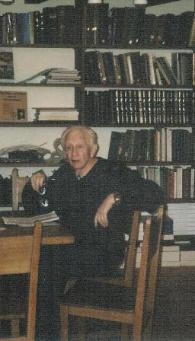
Professor Meir Shub
Holocaust in the Baltics, established on 6 September 2009, is dedicated to the memory of Professor Meir Shub (1924—2009), pictured at right teaching a class at Vilnius University in the early 2000s.
A historian and philosopher, he dedicated the last decades of his life to rebuilding Jewish studies in Vilnius, despite severe health issues deriving from his World War II wounds sustained as a Red Army soldier during the struggle against Nazism.
He was determined to inspire and train students of all backgrounds who would freely research Judaic topics, including the Holocaust. He was convinced that the success of these studies depended on the retention of a robust and intellectually free-feeling Jewish community component in such projects in Eastern Europe.
Meir Shub’s booming voice (which grew louder as his deafness worsened), straight talk, and high Litvak expectations of his students were trademarks. He is sorely missed. He played a pivotal role in achieving the first Oxford-Vilnius agreement in Judaic studies, and, in 1991-1992, was a visiting fellow at the Centre for Hebrew and Jewish Studies at Oxford University. His works include a study of the Gaon of Vilna.
 ‘Jewish property and a burnt-out land’ on the country’s main news portal Delfi.lt by the former director of the ‘Litvak Foundation’ (Litvaku fondas), whose accomplishments include the projects to erect statues of famed Jewish personalities Tsemakh Shabad and Romain Gary; image published with the article. Text includes the statement: ‘There are about 3000 Jews in Lithuania, and one must keep in mind that only some 1000 are really Lithuanian Jews (heirs and successors to the former Jewish communities), rather than aliens from the East.’ English translation.
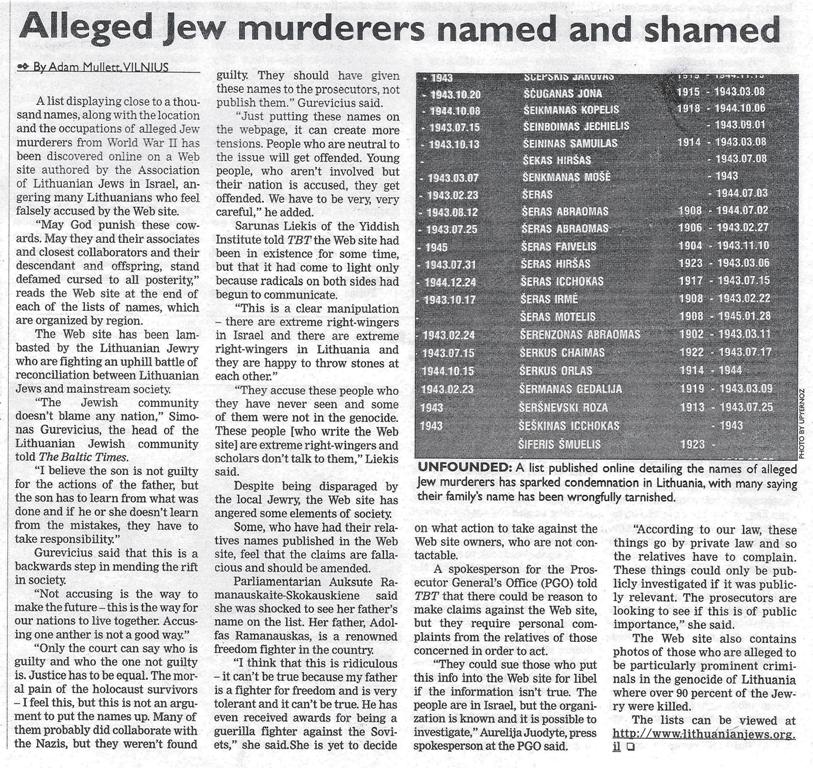
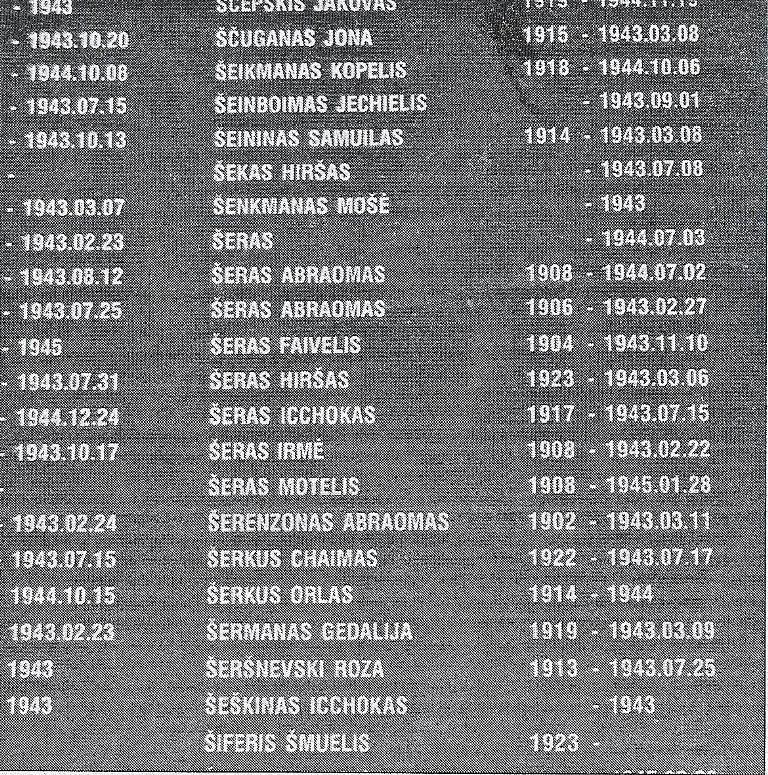
Part of a list of Jewish victims of the Vilna Ghetto (including fallen resistance hero Yechiel Sheinboim) appears in the Baltic Times instead of the captioned list of alleged Nazi-allied murderers (zoom-in).
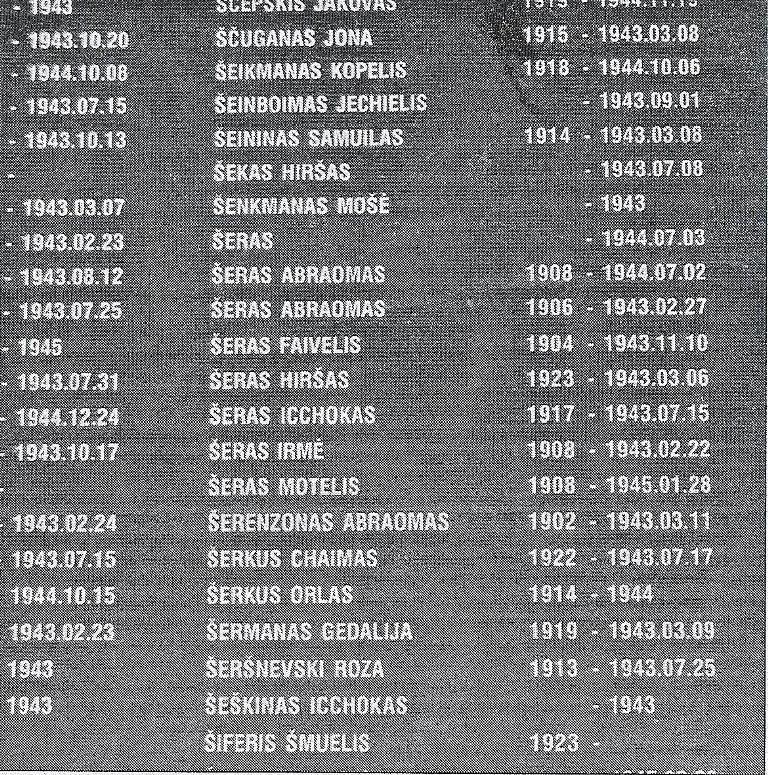
The young foreign reporter was wholly innocent; a still unidentified source provided the wrong list. An obscure and ambiguous correction appeared the following week.
Moreover, director of the Vilnius Yiddish Institute Sarunas Liekis is quoted (misquoted?) in the article (column 2), as calling the last active group of Litvak Holocaust survivors in the world (the ALJ in Tel Aviv) ‘extreme right-wingers’, adding that ‘scholars don’t talk to them’. Although now aged, these survivors’ ranks still include prominent Holocaust scholars.
The Baltic trend to delegitimize Holocaust survivors and their supporters is part of the wider series of attempted conceptual realignments deemed ‘necessary’ to propagate the Double Genocide bandwagon, and obfuscation of the Holocaust, within the context of regional unltranationalism.
◊
Last week I was caught in a debate with myself: whether or not to appear, despite the feeling of nausea, in a discussion with Lithuanian historians, writers and poets at the International Book Fair in Jerusalem. The idea made me so sick that in the end I decided to stay away and I also convinced my friend, former partisan and former chairman of Yad Vashem Yitzhak Arad, to excuse himself from the discussions.
This English version of the essay (the original Lithuanian text appeared in Lietuvos aidas, 28 November 2008) first appeared in the English edition of Jerusalem of Lithuania (Oct-Dec 2008, PDF here) and is republished here with the author’s and editor’s permission.
I have already written that we live in a period of not only monetary inflation, but of concept and value inflation as well. In our time oaths have become worthless, while formerly a person who broke one lost not only all of his own power, but the capacity to represent his values and to participate in the public sphere as well. Nothing, other than his own person and his private life, remained. He no longer had the right to speak on behalf of either his group, his nation, or his society.
VILNIUS, 1 SEPTEMBER 2008
AN OPEN LETTER TO HIS EXCELLENCY VALDAS ADAMKUS, PRESIDENT OF THE REPUBLIC OF LITHUANIA
ČESLOVAS JURŠĖNAS, SPEAKER OF THE SEIMAS OF THE REPUBLIC OF LITHUANIA
GEDIMINAS KIRKILAS, PRIME MINISTER OF THE REPUBLIC OF LITHUANIA
ALGIMANTAS VALANTINAS, PROSECUTOR GENERAL OF THE REPUBLIC OF LITHUANIA
The Lithuanian Jewish Community did not fail to notice the quite rapid reaction of the country’s President and Prime Minister, who urged law enforcement authorities and special services to find as quickly as possible the criminals (and their masterminds) who organized the attack on the LJC building in Vilnius on August 9-10.
At the initiative of the UK’s ambassador to Lithuania, HE Simon Butt, Fania Yocheles Brantsovsky, one of the Jewish partisan veterans being subjected to “war crimes investigations” by Lithuanian prosecutors, was asked to give a talk and lead a walk through the streets of what had been the Vilna Ghetto during the Holocaust in Lithuania. Fania was incarcerated in the ghetto from its first day, 6 September 1941, through to its last, 23 September 1943, when she and Dobke Develtov (now of Los Angeles) escaped through a hole in the wall to join up with the Jewish veterans in the forests where both women fought heroically against the Nazis and their collaborators.
The participants in today’s event to honor Fania Brantsovky and, by extension, the Jewish partisans generally, were:
The British Embassy in Vilnius today released a letter, organized by the British ambassador, HE Simon Butt, signed by nine ambassadors to Lithuania, to Dr. Rachel Margolis, now resident in Rehovot, Israel. The initiative comes in response to Lithuanian prosecutors’ campaign of defamation, harassment and attempted prosecution of Dr. Margolis and other heroes of the Jewish resistance against Nazi forces and their allies during the Holocaust.
The nine participating embassies are those of Austria, Canada, Czech Republic, Finland, France, Ireland, Sweden the United Kingdom, and the United States of America.
The letter is available as PDF and follows below.
 The Embassy of Ireland in Lithuania issued a certificate of lifetime achievement to Fania Yocheles Brantsovsky, signed by HE Ambassador Dónal Denham, who presented the award at a reception today at the ambassador’s residence. Ambassador Denham’s speech concluded with the words: ‘Fania is one brave woman! You are a beautiful person, a special person, an inspiration to us all.’
The Embassy of the United States of America in Vilnius, Lithuania, today issued a Certificate of Appreciation to Holocaust survivor and veteran of the anti-Nazi Jewish partisans Fania Yocheles Brantsovsky. The certificate, signed by the American ambassador to Lithuania HE John A. Cloud, was presented by political officer Joe Boski at a Vilnius luncheon hosted by the Vilnius Yiddish Institute, and partly videographed for the records of history.
The historical significance stems from the recent spate of mainstream media and academics’ attacks on Fania Brantsovsky, Dr. Rachel Margolis, and other heroes of the anti-Nazi resistance calling them “war criminals” for escaping the Vilna Ghetto to emerge in the anti-Nazi resistance. They are heroes of the free world.
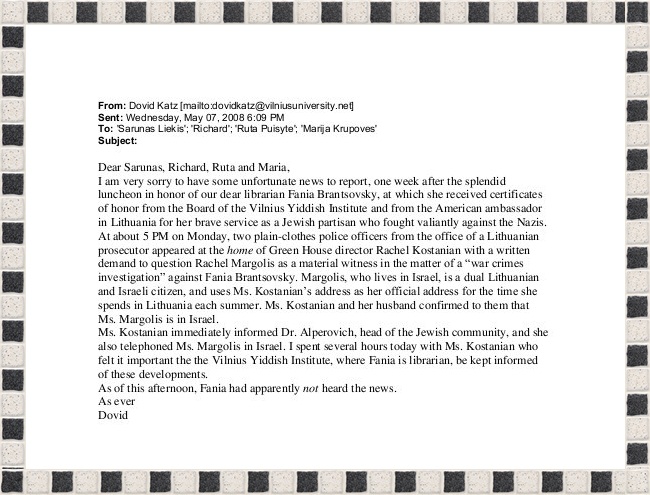
The following memo was today circulated by Professor Dovid Katz to the board members of the American Friends of the Vilnius Yiddish Institute, centered in Los Angeles, California. It references the public defamation of the institute’s beloved librarian Fania Yocheles Brantsovsky, a survivor of the Vilna Ghetto and veteran of the anti-Nazi Jewish partisan resistance in the forests of Lithuania. Please use the page-turning handles in the upper left-hand corner, or access as PDF.