O P I N I O N
by Pinchos Fridberg
Editor’s note [with updates to 3 March 2013]:
Editor’s note: This adapted translation from the Lithuanian original, by Geoff Vasil, has been approved by the author.
On February 16 I visited Kaunas. I heard the neo-Nazis would try to desecrate the nation’s freedom, for which people of the country of all ethnicities had struggled. Sadly, the neo-Nazis are now shouting loudly: “Lithuania for Lithuanians…”
One of the organizers of the march boasted the vanguard of the march would be carrying a portrait of Ambrazevičius.
It’s worth recalling what sort of person he was. In 1941 Ambrazevičius led the Provisional Government formed by the LAF (Lithuanian Activist Front), the Provisional Government which called Lithuanian policemen to serve the Nazis, set up a concentration camp (at the Seventh Fort, where it all ended in the murder of several thousand Jews), and even while realizing the Nazis no longer needed their service, this gang went on to promulgate the “Regulations on the Situation of the Jews,” which legally deprived their neighbors of human rights, while on the ground armed people were already murdering Jews throughout Lithuania.

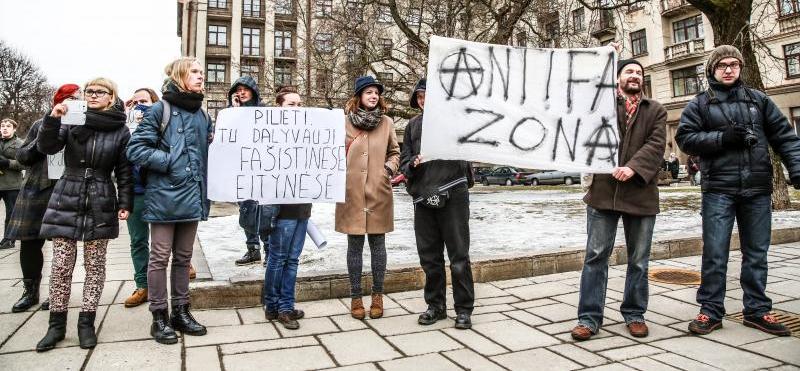
The author and his friends and colleagues who constituted the small “anti-fascist zone” at the March 16th neo-Nazi parade in Kaunas, Lithuania on the occasion of the nation’s independence day.
Readers and supporters of Defending History likely realize there is a diversity of opinion and views held by contributors (made explicit on the About us page), and in that spirit I’d like to share my own impressions of the neo-Nazi march on Lithuanian Independence Day 2013 in Kaunas (Kovno), Lithuania’s second-largest city and the provisional capital in the interwar period.
First, Kaunas was colder than expected. The breeze contributed to the chill. There seemed to be half as many police as protestors at the staging area, Ramybės Parkas, next to the bus station in central Kaunas. The police wore three uniforms: green, grey and, I was told by someone representing himself as being from Interpol, a large number of plain-clothes officers dispersed among the crowd, presumably meaning the marchers, since the number of protestors was paltry, just a handful of people.
See also the memoirs of Evaldas Balčiūnas, Dovid Katz (and 2nd), Efraim Zuroff

Somebody’s idea of “tolerance education”? Extract from the official website of the “International Commission for the Evaluation of the Crimes of the Nazi and Soviet Occupation Regimes in Lithuania” (known for short as the “red-brown commission”)
Educators, diplomats, historians and journalists thought they had seen it all when it came to Holocaust-in-Lithuania issues in recent times. But an online attack by the state sponsored “history commission” on a local Holocaust survivor, Professor Pinchos Fridberg, who is deeply involved in honoring righteous Lithuanians who saved a Jewish neighbor, because he expressed his views against distortion of the Holocaust? That is a bit much even for here.
UPDATE of 21 February 2014:
One year later: Defamation continues on Commission website;
See Chronology of a Debate and what Pinchos Fridberg actually said…
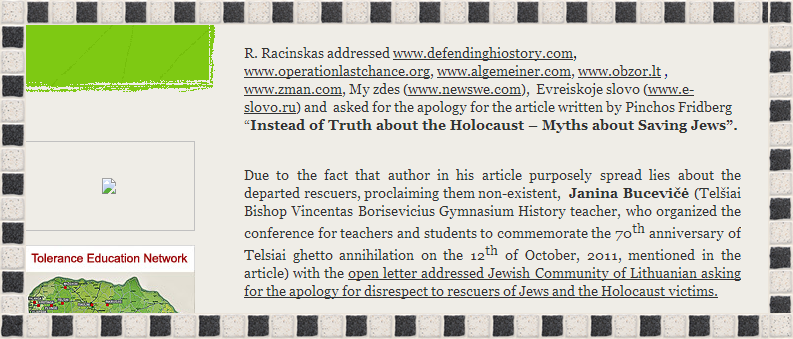
I am submitting this reply in view of the article which for several weeks is being kept in the first page of Lithuanian Jewish Community website (www.lzb.lt/en/) “Instead of Truth about the Holocaust – Myths about Saving Jews” written by Pinchos Fridberg. In this article the author mentions the conference organized by me for teachers and students to commemorate the seventieth anniversary of Telšiai ghetto annihilation on the 12th of October, 2011. During the conference Jadvyga Stulpinaitė, who is a daughter of Jew rescuers, shared her memories about her parents and neighbors saving Jews in the Telšiai region and Žemaičių Kalvarija district.
NOTE: A personal word of thanks to journalist Nerijus Povilaitis for graciously facilitating communication with Kaunas police to ensure the security of the small Defending History team monitoring/protesting the event, and to the Kaunas police for their excellent work.
[UPDATE of 19 Feb: I later learned from Lithuanian colleagues that this protection and respect seem to have been extended only to Dr. Efraim Zuroff and myself, not to the Lithuanian-citizen protesters.]
[UPDATE of 25 Feb: See now the memoirs of the same march by Evaldas Balčiūnas, Geoff Vasil and Efraim Zuroff, and my own later article in Algemeiner.com.]
The estimates of the crowd ranged from five hundred to a thousand depending (in part) on whether the march’s many supporters who stood outside its bordering police cordons were counted. Following yesterday’s Vilnius press conference led by Dr. Efraim Zuroff, who flew in from Israel for the event, and the earlier denunciation of racist manifestations by the new prime minister — these being possible rather than proven factors — the event was rather milder than last year’s (eyewitness report here). The major difference was the lack this year of visible swastikas (whether “classic” or “Lithuanian with added lines”), the more perfected police performance in keeping order, and the lack of overtly racist slogans. But there was no lack of graphic ingenuity in coming up with symbols that bring to mind the swastika (which was in fact made legal in Lithuania in 2010) and there was no lack of adulation of Holocaust-era fascist icons; the lead banner glorified the 1941 Nazi puppet prime minister who was earlier this year reburied with full honors; he had signed the papers for the first murder camp for the Jewish citizens of this city, Kaunas, during his first week in office. Moreover, the Kaunas police had confirmed in writing beforehand that the 2013 march was proceeding with full authorization from the municipality. All this “patriotism” rooted in 1941 genocide of the Jews is proceeding with the blessings of the state and the silence of its foreign partners.
Translator’s note: The original article in Lithuanian with all the graphics is available at https://defendinghistory.com/vienos-provokacijos-fotografijose-chronika/49453.
An email was sent to the Lithuanian Jewish Community at the end of the work-day on February 5, 2013:
From: Janina Bucevičė siwe22@gma…. Sent: 4:56 P.M. February 5, 2013 To: info@lzb… Subject: response to article Hello, I read Pinchos Fridberg’s article on your internet publication which refers to a conference I organized. I would like to correct certain facts in that article. For that reason I come to you with an open letter. Thank you. Respectfully, Janina Bucevičė attached: Janina Bucevičė.doc
The email contained as an attachment an open letter, a portion of which you can see below:
The following is a translation of the 10 February blog of Artūras Račas, editor-in-chief of Baltic News Service (BNS). Only embedded links (marked by underlining) have been added, along with editorial editions enclosed in square brackets [ ], enabling readers to better follow Mr. Račas’s attacks on Holocaust survivor Professor Pinchos Fridberg and Holocaust historian Dr. Efraim Zuroff, director of the Simon Wiesenthal Center Israel office.
Westerners looking at the political landscape of Lithuania should not be duped into thinking, as has been stated on this site before, that those sitting on a board for Jewish cemeteries are necessarily in it for their dedication to the Litvak heritage, or, as I am about to illustrate here, that those sitting in committees for defending equal rights are necessarily in favor of universal equal rights.
The question we need to examine is why someone opposed to equal rights would aim to become a spokesperson of those same rights. Membership of such a committee or board can in fact be a good opportunity to hijack a concept in order to hide certain failures and shortcomings and to tailor its meaning to fit certain political goals. This is what in my opinion is happening in the appointment of Leonard Talmont as Chair and Mantas Adomėnas as Deputy Chair of the Parliamentary Committee on Human Rights.
Artūras Račas, head of Baltic News Service (BNS), the main news agency in the Baltics, in a tweet today heaped scorn on Vilnius Holocaust survivor Professor Pinchos Fridberg and on the director of the Simon Wiesenthal Center’s Israel office, Dr. Efraim Zuroff. The tweet is reproduced below and links to the tweeter’s article, which is also available in English translation [updates: Prof. Fridberg’s reply; later report].
I’ve never met Christine Beresniova, but I’ve followed her career, so to speak, through the media and mutual acquaintances, and wish her only the best. She first came to my attention after apparently making some very limited and not very public criticisms of Lithuanian Holocaust education, which sufficiently pissed off the Holocaust Obfuscation establishment ensconced within the corridors of state power for them to label her some kind of Russian agent in informal conversations.
The blog Christine Beresniova and Rokas Beresniovas recently published the article “A lamentable absence of sexy scandals.” We will refrain from comment on their understanding of the concept “sexy scandals” and stick to the work of fellow human rights advocates, which entails standing up to powerful establishments on behalf of minorities, victims of prejudice, and in the case of Eastern Europe, the victims (and handful of survivors) of genocide. Those who stand up know all too well that to do so is not all that often convenient, easygoing or self-serving.
http://evreiskiy.kiev.ua
http://groups.yahoo.com/group/Jewish_Daily_News/message/92
http://www.facebook.com/evreiskiy.kiev.ua
In the 2012 elections to the Verkhovna Rada the far-right nationalist Svoboda party passed. To date, the Svoboda fraction has 37 parliament members, within the total of 450 parliament members.
I caught part of the Lithuanian “International” Red-Brown Commission’s “international” conference in the Lithuanian parliament last month, and obtained video of the parts I missed. There are a lot of things intellectually wrong with what the majority of the speakers said, but I can’t help thinking, feeling, that the emotional content was the overriding message, not the various sophistic, sham arguments and contrived non-debate “debate” between Emanuelis Zingeris and other speakers.
It was my feeling that only two of the speakers really spoke with any reverence or respect for the dead, in a tone appropriate to discussing the subject at hand. One was a sociologist I’d never heard of before who spoke in simple statistical figures about current popular Lithuanian views of the Holocaust and Jews.
The other was Saulius Sužiedėlis, a Lithuanian-American scholar (I believe that’s a fair way to characterize his national identity), who said so much that was simply wrong, but at least delivered his somewhat stochastic and very personal message with the sort of sincerity and honor which one expects in a seeker after truth, and which leads one to assume that even if that seeker has some of the details wrong at the moment, he will eventually get it right and will find the inner courage to correct himself.
It is the 24th of December 2012, three days after the announced end of the world. I am sitting at my desk drinking a cup of a tea. No gaping hole has suddenly swallowed me up, no heavens have collapsed, no earthquakes have caused Tsunamis to sweep coastal towns. My cat is blissfully unaware of the commotion millions of people around the world have caused on mountain tops, at sacred sites and even in a museum in Russia which for apparently only $1,500 offered salvation in the underground bunker of the former Soviet dictator Josef Stalin. Apparently the museum sold all 1,000 tickets in one fell swoop and I am sure now regret that they offered a 50% discount if nothing happened. Tant pis. It is amazing how people will believe anything today. Even some very intelligent people.
The last time I looked at the international petition site I set up against the SS marches in Latvia, in number one place, above any human rights cause, came the rights of Shetland ponies. I am not sure what happened to the Shetland ponies but clearly something must have, as thousands and thousands of people across the world vitriolically and vociferously protested and voted for their rights and rightly so. However, when it comes to the rights of humans the voting finger is in most cases nowhere to be seen.
From today’s Times of Israel.
The visit to Israel of a foreign prime minister used to be a big deal. That’s why there were so many photos of Burmese head of state U Nu’s visit in the early sixties. Those days, however, are long gone and today when most prime ministers visit us it’s usually of little or no interest to anybody and they get almost no coverage unless they are major world figures.
That would help explain why I only found out Tuesday morning that Estonian Prime Minister Andrus Ansip was to be touring Yad Vashem that day.
Ostensibly, that is no occasion of any particular significance, and the visit is more or less a pro forma requirement for any head of state coming to Israel in that capacity, especially if he or she has never been here before. But that is not true in the case of the Estonian leader, who heads a country that is suffering from a severe Baltic variant of post-Communist Eastern European Holocaust amnesia. This is an intellectual disease whose four main characteristics are a systematic minimization of crimes by local Nazi collaborators, a distinct lack of political will to prosecute and punish such individuals, a tendency to glorify locals who fought alongside the Nazis – in Estonia’s case in Waffen-SS units – and a determination to promote the historical canard of supposed equivalency between Nazi and Communist crimes.
The following letter was released today by Professor Weisskirchen’s office. It is followed by an English translation by Irene Fick.
Dezember 17, 2012
H.E. Ambassador Asta Skaisgiryte Liauskiene
The Embassy of Lithuania
Exzellenz, sehr geehrte Frau Botschafterin,
The following is the text of the author’s letter today to the provost of University College London, following up on his earlier communication of 29 November.
Dear Professor Grant,
I attach an earlier communication to you in which I asked you to consider the wisdom of hosting the above conference at UCL as a former student who takes great pride in having studied at UCL and the objectives and principles established by its founders.