Defense of Old Jewish Cemeteries and Mass Grave Sites
Att. Mr. Mayor of Vilnius: Streets Named for Hitler’s Local Partners, and Plans for Congress Center on Top of Old Jewish Cemetery
12 Holocaust Massacre Sites in Vilnius Region; Taking a Closer Look at 2
CEMETERIES AND MASS GRAVES | COMMEMORATIONS | LITHUANIA
◊
by Julius Norwilla
◊
There are at least twelve Holocaust mass murder sites in the immediate Vilnius region that are marked by some kind of memorial. They are noted in the online Holocaust Atlas of Lithuania, founded by Milda Jakulytė. In Lithuania, there are over 227 such sites that are described in the atlas, which is historically a continuation of the painstaking 1990s work of the late Joseph Levinson, published in his The Book of Sorrow (Vilnius 1997) that documented close to 200 such sites.
The best known is the Paneriai Memorial as the largest mass grave in the country, known as Ponár in Yiddish and Ponary in Polish. It is the site where 100,000 people were humiliated and murdered, around 70,000 of them Jews. This is where official commemorations take place, particularly each year on September 23rd, the day (controversially) designated by the Lithuanian government as the Holocaust Remembrance Day, rather than the international day, on January 27th, or days specific to the Lithuania-wide Holocaust such as June 23rd when violence against and humiliation of Jewish neighbors broke out across Lithuania.
Other mass murder sites in the Vilnius region are visited much less frequently and very often — not at all. But visiting these places is important for the respect for those murdered there and for a deeper understanding of the Holocaust which has so distorted our nation’s qualities.
My Take On Malát
OPINION | SHTETL COMMEMORATIONS | EVENTS | POLITICS OF MEMORY | COLLABORATOR GLORIFICATION
◊
by Julius Norwilla
◊
The year 2016 marks the 75th anniversary of the genocide of the Jews of the Lithuanian shtetls, the smaller towns, villages and countryside, in fact, a solid majority of Lithuanian Jewry (with a smaller component being kept alive in four cities for slave labor and rolling annihilation over the remaining years of the Holocaust). Marking the anniversary, at the end of August and beginning of September this year (a period in 1941 when a number of the local massacres were concentrated), there have been commemorative events in (Yiddish names first) Birzh (now: Biržai), Dusát (Dusetos), Malát (Molėtai), Shádov (Šeduva), Vílkomir (Ukmergė) and more. By far the largest event took place at Malát on the 29th of August. The project, leading to establishment of a new foundation, was initiated by Tzvi Kritzer. The speakers included high representatives from the Lithuanian government, its official Jewish community, and various public and cultural representatives.
Leon Kaplan’s Speech on the 75th Anniversary of the Malát Massacre
Leon (Liova) Kaplan (in Lithuanian: Leonas Kaplanas) is a native of Vilnius, Lithuania who settled in Washington DC in the early 1970s. He founded the Washington Conservatory of Music and is a noted pianist and master piano educator. He returned to live in Vilnius in 2004, and has over the past year and a half been one of the people involved in enabling the major series of events that culminated in a march by thousands, unveiling of a multilingual monument, and launch of an exhibition, book, and film, in the small town (former shtetl) Malát (Moletai, northeastern Lithuania) on 29 August 2016. The day marked the 75th anniversary of the 1941 massacre of the town’s 2,000 Jews, then a majority of its population. This year’s day of memorial events there has drawn wide and varied media comment and coverage.
The following is the English text of Liova Kaplan’s speech, provided by his office at the request of Defending History. At the event the speech was given in both English and Lithuanian.
◊
Honorable Guests,
Thank you to all gathered here, thanks to all those whose conscience does not allow them to forget the tragic events that happened here in Molėtai (Malát), and in almost 300 places across Lithuania, seventy-five years ago. Allow me to quote the book Night by Nobel prize laureate, the late Elie Wiesel:
Lithuanian State Bank and Major UK Firm Seem Deeply Involved in Vilnius Jewish Cemetery Scandal
PAPER TRAIL | REGISTRY OF OPPOSITION TO CONVENTION CENTER | DH SECTION
◊
VILNIUS—Turto Bankas, the state bank here whose main mission is to “organize and coordinate renewal of state-owned real estate,” has again revealed itself to be deeply involved in the international scandal of constructing a new National Congress Center in the heart of the old Vilna Jewish cemetery, whose graves date back to the fifteenth century and include some of the leading European Jewish scholars of the last millennium. The project continues to attract opposition from various parts of the world, including major Lithuania-descended rabbis internationally and some members of Lithuania’s small Jewish community. Moreover, Protestant and Catholic authors have pointed out that this would not likely be the fate of an analogous medieval vintage Christian cemetery.
Julius Norwilla to Speak on 12 Vilnius Mass Graves
THIS THURSDAY EVENING 4 AUGUST 2016 IN VILNIUS:
Defending History veteran writer-researcher Julius Norwilla will give an illustrated talk on
“A Dozen Holocaust Mass Graves in the Vilnius Area: What is the Actual State of Respect for the Victims?”
Thursday evening, 4 August, 6 PM (1800) at the Jewish Cultural and Information Center, Mėsinių 3 in Vilnius Old Town. Lecture in English, questions in any language. Admission free. Everyone welcome.
Wiesenthal Center Calls on Kaunas Mayor to End Abuse of “Seventh Fort”; Pressure Builds on Vilnius Mayor’s Jewish Politics
JERUSALEM—The Simon Wiesenthal Center’s Israel Office today issued a press release (text below), including a quote from its director, Dr. Efraim Zuroff, calling on Visvaldas Matijošaitis, the mayor of Kaunas (Kovno), Lithuania’s second city, to ban weddings and other celebrations from the now privatized parts of the historic Seventh Fort, where thousands of Kaunas Jews were humiliated, tortured and murdered starting with the first week of the Lithuanian Holocaust in late June 1941.
Defending History Responds to Vilnius Architects’ Three “Visualizations” for “Convention Center in the Jewish Cemetery”
Architects Publish Three Visualizations for National Convention Center Planned for Old Vilna Jewish Cemetery, Where Thousands Still Lie Buried
But critics warn that property magnates, politicians, and their foreign Jewish shmendriks will be haunted for generations by a rather different visualization…
Vulovak / DefendingHistory.com
Now We [Who Lie Buried in the Old Vilna Jewish Cemetery], Know…
PAPER TRAIL | REGISTRY OF OPPOSITION TO CONVENTION CENTER | DH SECTION
◊
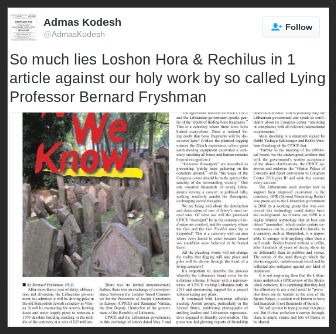
VILNIUS—The following is a reprint of the article published on 2 July 2016 in Yated Ne’eman, authored by the eminent scholar, Professor Bernard Fryshman. The title refers to the accompanying illustration which considers the views of the many thousands of Jews buried at Piramónt, Vilna’s old Jewish cemetery in the Šnipiškės (Shnípishok) district, in active use from the fifteenth to the nineteenth centuries. See also background to the article, PDF of the original article, the catalogue of international opposition, the paper trail, the DH section, and our editor’s summary of the issue published in December 2015 in The Times of Israel.
NY Professor Exposes Rabbis — and the US Federal Agency — that Enable Lithuanian Gov’s Sham New “Convention Center in the Old Jewish Cemetery”
PAPER TRAIL | REGISTRY OF OPPOSITION TO CONVENTION CENTER | DH SECTION
◊
NEW YORK CITY—Dr. Bernard Fryshman, physics professor at the New York Institute of Technology here, today published a new article concerning the imminent danger to thousands of Jewish graves in Vilna’s old Jewish cemetery upon which a huge $25,000,000 convention center, structured to yield hundreds of millions for property developers is about to be erected, where revelers will clap, sing and use toilets surrounded by the graves of Vilna Jewry paid for, on the understanding of possession in perpetuity, by untold thousands of families between the late fifteenth and the early nineteenth centuries. Protestant and Catholic ethicists have noted that such would never be the disrespect shown a cemetery full of Christian (or majority ethnicity) scholars in a great capital city of Europe. Last summer, Lithuania’s chief rabbi was rapidly fired by the Jewish community’s lay-leader-cum-private-attorney, after he spoke against the convention center project. His replacement has yet to speak out for the record; in the interim the search for a new chief rabbi was the subject of latter day Vilna folklore).
Asra Kadisha on Vilna Cemetery: From Proud Powerhouse of Historic Truth to Silent Mouse?
PAPER TRAIL | REGISTRY OF OPPOSITION TO CONVENTION CENTER | DH SECTION
◊
O P I N I O N
◊
VILNIUS—Between October 2014 and October 2015, the international Jewish-cemetery group Asra Kadisha, coordinated by haredim largely affiliated with the “Zalmen” branch of the split Hasidic Satmar group (today the world’s largest Hasidic group) made a number of contributions that will remain permanent. Thanks in whole or in part to Asra Kadisha, eighteen important documents were published opposing the antisemitic decision of some Lithuanian government officials to allow a convention center to rise, surrounded by thousands upon thousands of skeletons on all four sides, skeletons of Jewish citizens of Vilnius buried there between the fifteenth and nineteenth centuries. As a Protestant minister and Catholic philosopher have pointed out, such would not have been the decision were it a Christian cemetery or one housing heroes of Lithuanian culture between the fourteenth and nineteenth centuries. Of course the millions in store for property developers and their many “beneficiaries” (for decades to come) play a prime role; antisemitism enters the picture when the state fails to put in play the same brakes which it applies for majority culture and majority religion sacred sites.
Document Unearthed: 1935 Tel Aviv Protest Against Plans to Defile the Old Vilna Jewish Cemetery
DOCUMENTS | PIRAMÓNT | OPPOSITION TO CONVENTION CENTER | CEMETERIES
◊
VILNIUS—Professor Sid (Shnayer) Leiman, widely considered to be the world’s leading scholar on the old Vilna Jewish cemetery at Piramónt (in the Šnipiškės district), today released a remarkable document: a spirited 1935 protest, in Hebrew, from the Vilna Gaon Synagogue in Tel Aviv, against the then Polish municipal authorities’ plans to construct a sports stadium in the heart of the old cemetery.
Ruta Bloshtein Discovers 1935 Vilna Rabbis’ Condemnation of Plans to Desecrate Old Jewish Cemetery at Piramónt
DOCUMENTS | PIRAMÓNT | OPPOSITION TO CONVENTION CENTER | CEMETERIES
◊
VILNIUS—In a strictly private capacity, Ruta (Reyzke) Bloshtein, a Vilnius born member of Lithuania’s small Jewish community, whose maternal ancestors hail from the shtetl Tríshik (Tryškiai), has released to the media a remarkable Yiddish public poster issued by the Vilna Board of Rabbis on 30 Nissan 5695 — the Jewish calendar date corresponding with 3 May 1935 — that she discovered in Lithuania’s central state archive. It is an impassioned plea by the Board of Rabbis asking the then Polish authorities in the city to abandon their plans for a sports stadium on the site of Piramónt (in the Šnipiškės district), the old Vilna Jewish cemetery that goes back to the late fifteenth century, and where thousands of luminous Litvak scholars lie buried.
GioBaltic’s Report on Piramónt
PIRAMÓNT | PAPER TRAIL | OPPOSITION | CEMETERIES
◊
VILNIUS—Defending History today obtained from multiple sources here PDF copies (all with some faulty representation of Lithuanian language diacritics) of a new geophysical report by the company GeoBaltic, specialists in oil and gas exploration, on the territory of the old Jewish cemetery at Piramónt in the Šnipiškės section of modern Vilnius. The entire document is now available online, and it is anticipated in some quarters that one or more of the funded bodies tasked with preserving Jewish heritage in Europe (e.g. the US taxpayer-funded Commission for the Preservation of America’s Heritage Abroad in Washington DC and the CPJCE in London) will rapidly publish a full English translation along with their own reactions and responses.
First Test of Torah Integrity for New Vilnius Rabbi Samson Daniel Izakson?
PIRAMÓNT | PAPER TRAIL | OPPOSITION | CEMETERIES
◊
VILNIUS—When Lithuania’s official chief rabbi of eleven years’ standing, Rabbi Chaim Burshtein, was dismissed last summer after disagreeing with the government’s plan to erect a national convention center in the heart of Vilna’s old Jewish cemetery, the event caught the attention of both local and international media. It was quietly hoped, both in Vilnius and abroad, that the eventual replacement would be loyal to sacred Jewish causes (see Rabbi Burshtein’s final statement of his tenure in Vilnius), someone who would not dare, for the considerations of a job, betray the letter and spirit of Jewish law, or the living and the deceased actual Jews of Vilna over the centuries. See Prof. Shnayer Leiman’s essay on the subject, our editor’s summary, a satiric Motke Chabad take, and Dr. Bernard Fryshman’s reminder that “Even now, the cemetery contains the bodies of the Chayey Odom and the Be’eyr ha-Goylo among many others.” A second essay by Professor Leiman paves the way for inspiring reconstruction of many of the major historic structures of Lithuania’s foremost Jewish cemetery.
Jews and Other Minorities in Eastern Europe Concerned by EU Chief’s Addition of a Single Word about Old Jewish Cemetery
CEMETERY PAPER TRAIL | OPPOSITION TO DATE | DH SECTION | BACKGROUND
◊
BRUSSELS—Back in October, 2015, high-level European Union spokesperson Chiara Adamo had replied to French human rights activist Didier Bertin on behalf of European Commission president Jean-Claude Juncker, assuring the public that
“Contrary to reports in some Lithuanian newspapers and international media, the planned renovation project at the Vilnius Snipisek cemetery is not supported by European Union funds.”
A Picture and its One Thousand Words: The Old Vilna Jewish Cemetery Revisited
HISTORY | PIRAMÓNT | CEMETERIES | PAPER TRAIL | OPPOSITION
◊
by Sid (Shnayer) Leiman
The following is a reprint, with Professor Leiman’s permission, of his essay originally published on 14 January 2016 in The Seforim Blog. His October 2015 essay on the current plans for a convention center in the heart of the same cemetery is available here. He is Professor Emeritus of Jewish History and Literature at Brooklyn College in the City University of New York.
◊
A: The Photograph
1: R. Menahem Manes Chajes (1560-1636)
2: R. Shaul Katzenellenbogen (ca. 1770-1825)
3: R. Moshe, Dayyan of Vilna (ca. 1670-1740)
4: R. Hillel b. Yonah (d. 1706)
5: R. Moshe Darshan (d. 1726)
6: R. Yaakov Kahana (d. 1826)
7: R. Eliyahu Hasid (d. 1710)
8: R. Yosef b. Elyah (d. 1718)
B: A Visit to the Old Jewish Cemetery in 1940
NOTES
DEDICATION OF THIS ESSAY TO R. KHAYKL LUNSKI
Massive New Vilnius Construction Site: Within or Bordering City’s Old Jewish Cemetery?
PIRAMÓNT | PAPER TRAIL | OPPOSITION | CEMETERIES
◊
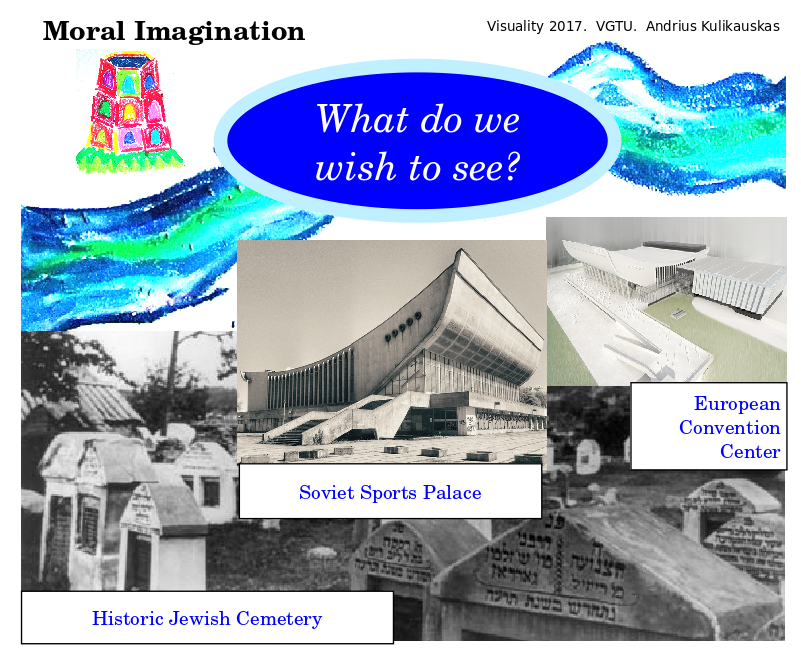
VILNIUS—A massive new construction site is being dug up next door to the Soviet-era Sports Palace building in the Šnipiškės section of Vilnius. The former Sports Palace, now the subject of intense international debate over plans for a 25 million dollar conversion into a national conference center, itself “indisputably rests in the middle of the former cemetery,” as confirmed by the United States government a decade ago. But what is unknown is where that may leave this bordering site, which may or may not lie outside various hypothesized boundaries of the old Vilna Jewish cemetery, in use from the late fifteenth century to the 1830s. The last generations of pre-Holocaust Vilna Jewry called the cemetery Piramónt.
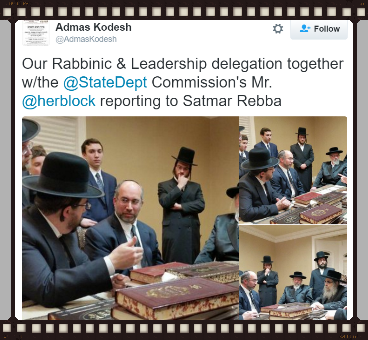
NY Satmar Affiliate of “London Grave Traders” Tweets Triumphant Photos with US Gov “Heritage Abroad Commission” Rep
DOCUMENTS| | US GOV’S “HERITAGE ABROAD” COMMISSION | OPPOSITION TO DATE | PAPER TRAIL | SECTION | EU ASPECTS
◊
KIRYAS JOEL, NY—The “Satmar Headquarters” of the movement’s “Aaronite” branch, partners of the London-based “CPJCE / Admas Kodesh” issued this tweet earlier today, which some observers take to convey the message that the politically connected Hasidic group continues to boast of preventing the “United States Commission for the Preservation [emphasis added] of America’s Heritage Abroad” from expressing even the mildest protest at plans to erect a twenty-five million dollar convention center in the heart of Vilnius’s oldest Jewish cemetery. With the exception of the CPJCE, exposed in Wikileaks as having demanded money for their “supervision” at the same cemetery in 2009 (see Jerusalem Post and JTA reports), major rabbis and rabbinic associations, alongside a variety of Jewish and non-Jewish figures, have expressed unanimous condemnation of the project.
The condemnations include the major groups of Lithuanian (Litvak) rabbis internationally, and also the rival branch of Satmar itself, the “Zalmanite” branch, whose own highest rabbinic court last summer added its voice to the Lithuanian rabbis worldwide. Vilnius has numerous venues appropriate for the new convention center. Some observers remain baffled at the insistence on the old cemetery site, where thousands of graves lie intact, and where revelers would clap, cheer, and use bars and toilets surrounded by a half millennium’s Jewish graves, including major Jewish scholars of the city, historically Vilna, once known as the Jerusalem of Lithuania.
Let’s Dismantle the Sports Palace and Revoke the “Revocation of Hospitality”
OPINION | PIRAMÓNT | PAPER TRAIL | OPPOSITION | CEMETERIES
by Andrius Kulikauskas
◊
I am inspired by the deep feelings which have been stirred amongst Litvaks regarding the fate of the Vilnius Sports Palace built on top of the Jewish cemetery. I wish for our state of Lithuania to do its utmost on behalf of Lithuanians to restore the Jewish cemetery in Vilnius as a symbol of our aspiration for the closest friendship between Lithuanians and Jews. I realized that it would be most helpful for me to present my thoughts in Lithuanian.
“From the top of Gediminas Castle, do we want to see and cherish, for hundreds of years to come, what the Communist Party Chief saw (the Sports Palace) or what the Grand Duke of Lithuania saw (the Jewish cemetery)?”