D O C U M E N T S / P I R A M O N T / S T A T E D E P T.
The following image and text appeared on the website of the Jewish Community of Lithuania earlier today.
WASHINGTON, DC—The chairman of “Admas Kodesh” today posted on a public Facebook page the following item and images, including an obviously posed photo featuring the chairperson of the United States Commission for the Preservation of America’s Heritage Abroad, and Rabbi Andrew Baker of the American Jewish Committee, a close ally of the Lithuanian government and member of its controversial “red-brown commission” that has caused some pain to Holocaust survivors via its support of Baltic “Double Genocide” Holocaust revisionism. “Admas Kodesh” (‘holy earth) is generally used interchangeably for the London-based CPJCE (“Committee for the Preservation of Jewish Cemeteries in Europe”), which is currently involved in a potentially major scandal over alleged payments in return for paid “supervisions” of cemetery desecrations allowed at the old Jewish cemetery in Vilnius. The CPJCE continues to adamantly defend the twenty-five million dollar convention center slated for the middle of the old Jewish cemetery, at a time of virtually unanimous condemnation by rabbis internationally and local people alike. That story was covered in today’s Jerusalem Post.
First, a brief review: In June 2005, Reb Chizkiya Kalmanowitz discovered construction taking place in the Shnipishek Jewish Cemetery in Vilnius. The Shnipishek Cemetery is where the Gaon of Vilna was buried, as was the Ger Tzedek. Even now, the cemetery contains the bodies of the Chayei Adam and the Be’er Hagolah among many others.
LOS ANGELES—Richard A. Maullin, elected less than a year ago as the chair of the California Independent System Operator (ISO) Board, was lavishly honored here on May 31st by both the Lithuanian ambassador to the United States and the Foreign Minister of Lithuania. The latter, in the tradition of royalty, meticulously placed the Lithuanian Diplomatic Star around the neck of Dr. Maullin, a major American pollster and principal of the LA polling and public policy research firm FM3, often still known by its older name Fairbank, Maslin, Maullin, Metz & Associates.
VILNIUS—According to Lithuanian media sources, including the highly respected English-language Lithuania Tribune (now merged with Delfi.lt), the government, working in concert with property developers, plans to declare the controversial project of a huge convention and entertainment center in the heart of the old Vilna Jewish cemetery site as a “project of national importance.” The move enables an application to the European Union for a grant of 13 million euros (14.64 million US dollars at current rates) as part of a grand-total (for now) of 22.8 million euros (25.67 million US dollars) for the new complex. The nation’s prime minister has told Lithuanian media that “after the modern congress center is completed, private investors could build a hotel, parking lots and other infrastructure,” eliciting fears that all of the old Jewish cemetery is becoming a cash cow slated for developers for years to come. The Lithuania Tribune / Delfi.lt report concludes with an estimate of “110 million euros in economic and social benefits over 15 years” in addition to “600,000 foreign tourists and 2.2 million local tourists to Vilnius over that time period, with their spending estimated at 183 million and 60 million euros, respectively,” in other words, with profits from the old Jewish cemetery exceeding the equivalent of 250 million dollars, apart from the millions to be had from the building projects per se. Some estimates are provided in Baltic Course.
Editor’s note: The following is a translation of the open letter by Professor Pinchos Fridberg, a Holocaust survivor in Vilnius, and the reply by Yivo’s director, Dr. Jonathan Brent. Both were published in the Yiddish Forward (Forverts) on 1 March 2015. Prof. Fridberg has also posted an audio file of his reading his letter aloud in his native Vilna Yiddish. In the case of any issue arising, the Yiddish text is authoritative. For readers’ reference, hyperlinks have been added (by Defending History) to various of the documents and topics cited. See also the Pinchos Fridberg page and section in Defending History, page and section on the state-sponsored commission discussed, and section on Yivo issues.

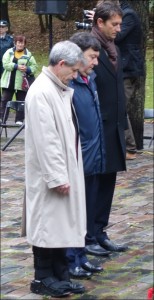
September 2014 at Ponár, the mass muder site of Vilna Jewry: Three representatives of the controversial state sponsored commission on Nazi and Soviet crimes pay respects in unison: (from left): Dr. Jonathan Brent, Emanuelis Zingeris, Ronaldas Račinskas. Photo: Defending History.
D
ear Dr. Jonathan Brent,
I appeal to you in Yiddish. Do you know why? Because I believe, that a person who is the leader of the Yivo institute will understand me. My name is Pinchos Fridberg. I was born in Vilna before the war and am a survivor of the Holocaust. My grandmother and grandfather, and all our relatives on my mother’s side — 28 people — lie [at the mass murder site] Ponár.
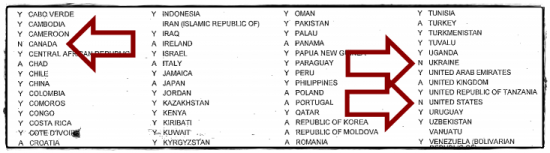
The following is the official 21 Nov. 2014 United Nations voting sheet for the resolution (A/C.3/69/L.56/Rev.1) “Combating glorification of Nazism, neo-nazism and other practices that contribute to fuelling contemporary forms of racism, racial discrimination, xenophobia and related intolerance.” The original is posted on the UN website. This copy has three added arrows for rapid identification of the three states that voted “No.”
Media coverage includes: Margaret Besheer in Voice of America; Joseph Brean in Canada’s National Post; Ken Hanly in Digital Journal; Dovid Katz in The Times of Israel; Ryan Maloney in Huffington Post; Jim Miles in CounterPunch; Boruch Shubert in JP Updates; Sam Sokol in the Jerusalem Post.
Glorification of Nazi collaborators (and local perpetrators) by states and their elites is a serious issue in various countries, including Estonia, Hungary, Latvia, Lithuania, and Ukraine.
Defending History has obtained the full text, available to our readers as PDF, and as images (following this text) of US Congressman John Conyers’ proposed amendment that would have restricted US military aid to units that extol Nazi perpetrators or use Nazi, racist or white supremacist symbols. The amendment proposed by Mr. Conyers, who represents Michigan’s 13th congressional district, failed to pass.
The amendment, dated 19 May 2014, contains language that would instruct the Secretary of Defense to restrict aid in cases where he “has credible evidence that the unit or its members have taken public stances or taken actions that are indicative of extremism,” including three categories:
Text of the Resolution
Yivo leaders manipulated by Lithuanian government PR operatives? Chronology of a crisis of confidence, 2011-2014 (in reverse chronological order)
◊
Early this summer (for the second year in a row), several participants in the annual Helix trip to Eastern Europe contacted Defending History asking to meet with us during their stay here in Vilnius. We promptly replied to each, explaining that one of us would be delighted to speak to the group, even for a very short talk, and gratis, but that we did not feel comfortable with the idea of them meeting us “secretly,” in other words without the agreement of the group’s leadership and/or sponsors.
The following is the text of Amendment 134, Section 1266 that passed the US House of Representatives’ military appropriations bill on 21 May 2014, as recorded in the Congressional Report (background and more coverage here).
Many thanks to Yivo for posting the video of the discussion “Unresolved History: Jews and Lithuanians after the Holocaust.” In my opinion, the champion panelist was Leonidas Donskis who opened his heart with conviction and courage. As a Jewish Lithuanian his understanding of and sympathy for both Jews and Lithuanians have generated wise insights and pervasive truths. Among his magnitude of analytical comments to be applauded, Donskis explained that the Far Right in Lithuania has managed to get close to the center of power where they have been “mainstreamed” rather than marginalized. He also reflected on how difficult it is for Lithuanians who have decided to tell the truth. As a nation “we lack the political courage,” he remarked.
Members of the US-based “Litvak SIG” (both those on the free lists, and those who paid their $36 a year dues for full membership), have been informed of the following event and the book it features, coming up this Thursday evening in San Francisco. (When Messiah will come, the subscribers to both “SIG” sections will learn about the existence of Defending History, too and its modest, but free, Litvak interest sections. We must have patience.)
Nobody could love or respect the Yivo Institute for Jewish Research more than I do. It was founded as the Yiddish Scientific Institute in Vilna, Poland (now Vilnius, Lithuania) in 1925. Yivo remains a symbol for all who cherish our Yiddish heritage and, now, its last prewar survivors. Through the years I have spent many wondrous hours at Yivo, digging, discovering, and learning about my Litvak ancestors, their shtetlakh, and their culture. Being there always felt like being home. The books and documents I handled seemed almost sacred. Memories of conversations with Yivo’s’s revered librarian Dina Abramowicz still make me smile. . .
Dr. Efraim Zuroff, Holocaust historian, Nazi-hunter, and director of the Simon Wiesenthal Center’s Israel office, has posted the following comment on the website of Tablet magazine, as one of the comments to a new book review. The comment also appears separately on Facebook.