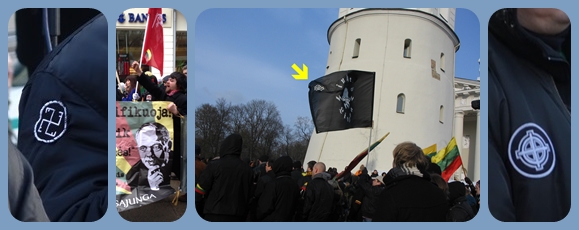
From our front page of 29 September 2015:
◊


◊
VILNIUS—For many years it has been a source of deep pain to many Lithuanians, Jews and others that the capital (and cities and towns around the country) continue to have street names honoring Holocaust perpetrators and collaborators but none for the true heroes of the Lithuanian Holocaust — the Lithuanian rescuers, who risked their and their families’ lives to “just do the right thing” and rescue some person or persons of a minority marked for rapid murder on the basis of Jewish birth. In the Baltics, the rescuers had to have much more courage even than in many other countries, because they were regarded as enemies of nationalist patriotism, as then constructed, not only as defiers of the German occupying forces’ program of extermination. They were regarded here as “enemies of Lithuania” (or Latvia, or Estonia), and sympathizes of communism who could expect no mercy if found out either by the German authorities or the local Lithuanian forces.
In 2013, Defending History objected to the plan to name a street for Ona Šimaitė in the boondocks and pressed for her street to be right in the city center.
VILNIUS—Despite the relatively modest number of participants in the hall, around fifty, the 90th Anniversary Conference of Yivo in Vilnius was unanimously judged to be a major success with Yiddish scholars and cultural leaders from Buenos Aires, New York, Tel Aviv and Vilnius reading papers in English, Lithuanian, and Yiddish. Four papers were in Yiddish (by Lea Garfinkel, Dovid Katz, Abraham Lichtenbaum and Mordehay Yushkovsky), representing a serious Yiddish-in-Yiddish component of an academic conference for the first time in years. Yiddish greetings were also delivered by Emanuelis Zingeris, parliamentarian and founder of the city’s Jewish museum. There were greetings from the Israeli ambassador and the Lithuanian parliament and foreign ministry.
◊
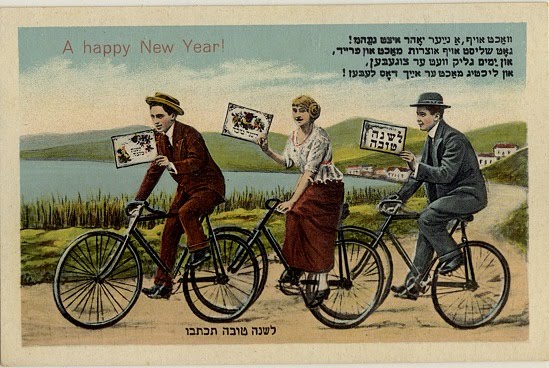
For many years, international visitors to Rokiškis (in Yiddish: Rákishok, or less formally: Rákeshik), in northeastern Lithuania, have remarked that the town’s central area seemed to preserve little (or no) trace or commemoration of its erstwhile Jewish population, though a large monument now graces the entrance to the old Jewish cemetery outside town. Before the Holocaust, this town was home to around 3,500 Jews (some 40% of the total population, and the overwhelming majority in its central area). Luckily, a short film of pre-Holocaust Jewish Rákishok survives (from 1937), and is available on Youtube. Thanks to Polish film maker Tomek Wisniewski for circulating the link in recent days.
KAUNAS—The Postal Service of Lithuania today launched two handsome commemorative envelopes in memory of two celebrated European consuls in Kaunas who helped thousands of Jews obtain visas that enabled them to leave Lithuania during the final year before the Nazi invasion and the Holocaust came to the country. The two, Chiune Sugihara (1900−1986) of Japan and Jan Zwartendijk (1896−1976) of the Netherlands risked their careers, and more, to disobey instructions and the letter of the law to save those who came to them for help. These were primarily citizens of prewar Poland who found themselves in Lithuania in the summer of 1940, when the country was being absorbed into the USSR, and the consulates and embassies in Kaunas were under pressure to close down altogether.
To mark the 74th anniversary of one of the iconic events of the Lithuanian Holocaust, the infamous Lietūkis Garage Massacre of 27 June 1941, the Kaunas Jewish Community organized its annual memorial event at the site, last Friday, 26 June 2015. The massacre, carried out by local Lithuanian “patriots” wearing the white armbands of the Lithuanian Activist Front (LAF), butchered dozens of Jewish passers-by at a garage on Kaunas’s Vytautas Avenue, using a variety of execution methods, including clubbing to death with crowbars, and particularly, forcing water from high-pressure hoses into bodily orifices of the victims until they burst. A growing crowd, including women holding up their young children to get the best views, cheered them on.
Earlier this month, the Ukrainian Youth Association (CYM Great Britain) held a remembrance day at the Tarasivka camp at Weston-on-Trent in Derbyshire. They advertised the event on their website (http://cym.org/uk) and with a poster replete with (ultra)nationalist imagery.
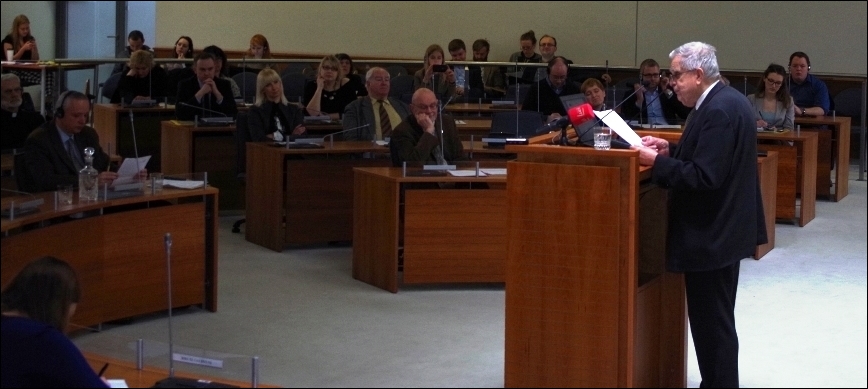
Tomas Venclova addresses Ruta Vanagaite’s conference at Vilnius City Hall on April 17, 2015. Photo: Julius Norwilla.
VIDEO
Dovid Katz in Times of Israel (11 May)
Efraim Zuroff in i24 (12 May)
The Israel office of the Simon Wiesenthal Center today released the response received by its director, Dr. Efraim Zuroff, to his 3 March appeal to the mayor of Vilnius, Lithuania, the nation’s capital, to halt the planned neo-Nazi march in the city’s center on independence day, March 11th. The response was received on 10 March by emailed PDF, and seems to fail to address the requests in the letter that the municipality ensure that Nazi symbols, racially exclusionary slogans and glorification of Holocaust collaborators not be allowed in the city center on the national holiday.
Dr. Zuroff’s letter of March 3rd elicited the following reply on the 10th of March (as PDF):
Afunny thing happened on the way to the neo-Nazi march. I saw a man walking towards me, and thought I knew him. Apparently he thought the same thing, and we both said hello in Lithuanian as we passed one another. As I pondered how we might know each other, it came to me: I had seen him at an earlier neo-Nazi march, probably the one in Kaunas a month earlier. He thought I was a fellow marcher, apparently, or at least not an enemy to the cause.
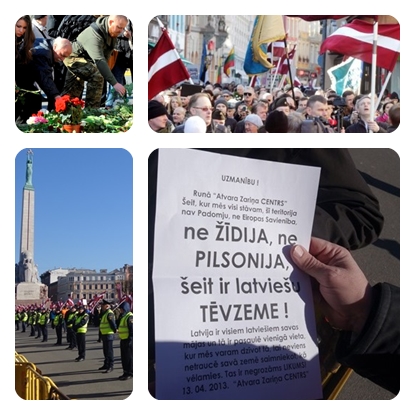
Top left: Sea of flowers placed at Liberty Monument to honor Waffen SS. Top right: throng marches through historic old town. Bottom from left: heavy police presence; an antisemitic poster distributed by one of the event’s supporters.
VILNIUS—The Simon Wiesenthal Center’s Israel Office, in Jerusalem, today issued this statement from Vilnius, where its Director for East European Affairs, Dr. Efraim Zuroff, came to monitor yesterday’s neo-Nazi march on Lithuania’s independence day, as part of his month of monitoring of all four Baltic neo-Nazi events from 16 February to 16 March.
The text of the press release follows:
UPDATES: FOLLOWING THE EVENT — JEWISH COMMUNITY OF LITHUANIA’S STATEMENT AND REPORT; SIMON WIESENTHAL CENTER; GEOFF VASIL IN DH
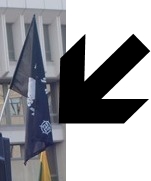
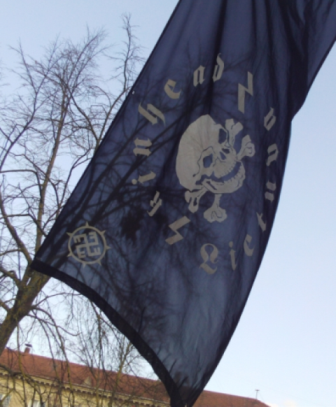
Photos: Geoff Vasil (left image) and Defending History (right image)