UKRAINE | FRANCE | DOUBLE GENOCIDE REVISIONISM | DOUBLE GAMES
◊
The following open Letter of Concern appears on the Academia.edu page of Professor Tarik Cyril Amar and others.
VILNIUS—The 22 November edition of the Jerusalem Post carried the following news item about an international meeting at the Peres Center for Peace and Innovation.
Lithuanian and Israeli diplomats, academics, and government officials, together with representatives of Litvak organizations in Israel, the American Jewish Committee, the World Jewish Congress and the Tel Aviv Municipality, will congregate on Thursday at the Peres Center for Peace and Innovation to discuss Lithuania and Israel – Past, Present and Future. Among the Lithuanians will be Lithuanian Ambassador Edminas Bagdonas, Ronaldas Račinskas, executive director of the International Commission for the Evaluation of the Crimes of the Nazi and Soviet Occupation Regimes in Lithuania; Faina Kukliansky, chairwoman of the Lithuanian Jewish Community; and several other Lithuanian dignitaries. Among the topics tabled for discussion is the reinstatement of Lithuanian citizenship to Lithuanian expatriates living in Israel.

◊
The words “antisemitism in the shtetl” might evoke recollections of Fiddler on the Roof, a touch of family lore “from the old country” way back when, or for those familiar with modern Yiddish literature, a scene from this or that writer. Baffling as it may sound, however, it a substantial contemporary topic in the study of antisemitism, and, perhaps even more surprisingly, part of a phenomenon with implications for the future, given the vast number of cities, towns and villages in the world with a rich Jewish history but no living Jews, where potent anti-Jewish feeling (as well as pro-Jewish feeling) can be observed. As noted back in Flashpoint 21, antisemitism in Eastern Europe is very different from its much better known Western and Middle East incarnations.
This paper appeared today in Dapim: Studies on the Holocaust, published by Taylor and Francis.
The demise of twentieth-century-style Holocaust denial in mainstream Western society is aptly symbolized by David Irving’s loss to Deborah Lipstadt in the London High Court in 2000. But around the same time, a new and more irksome method of writing the Holocaust out of history was emerging under the radar, this time without necessarily denying any of the historical events or a single death. Particularly in Eastern Europe, it was being forged with state funding and more subtle powers of persuasion in academia, the media, the arts and international diplomacy.
NEW YORK—At least a few viewers of the Fox News Channel’s premier prime time program, “The O’Reilly Factor” were taken aback to hear Bill O’Reilly spurt out last night, in his best high-school teacher by-the-way factual tone, “Stalin was as bad as Hitler! Alright, it’s the same thing!” during a segment presented as uncontested truth. The guest inspiring the “truism” was Mr. Marion Smith, executive director of the Washington DC based “Victims of Communism Memorial Foundation” (sometimes known for short as VOC).
◊
A recent Washington Post editorial rightfully takes Russia and China to task for persecuting those who dare challenge the state’s distortions of history. In the case of Russia, there is mention of the disgraceful prosecution of a citizen for pointing out that the September 1939 dismemberment of Poland was a joint venture of Germany and the USSR codified by the infamous Molotov-Ribbentrop pact. But wait a minute.
◊
On 29 October 1998, a few weeks after the parliamentary elections, the outgoing Parliament of Latvia had adopted the Declaration on Latvian Legionnaires in the World War II. The vote was as follows: 50 ayes, 8 nays, 3 abstentions.
The text contains several questionable statements. Those include claiming that “The aim of soldiers who were drafted into the Legion or who joined it voluntary was to protect Latvia from the restoration of Stalin’s regime” and asking the government to “prevent insults against the honour and dignity of Latvian soldiers.” To make it clear — the ones whose reputation was intended to be defended were Nazi collaborators, voluntarily or not. And the intention was pretty obvious — as the rapporteur MP, Mr. Mauliņš, said before the vote, “this decision will be our position towards our soldiers who truly fought for the independence of Latvia”.
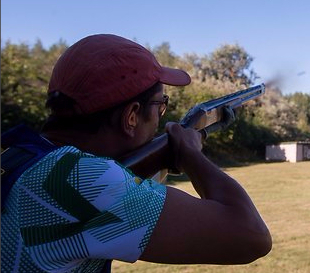
VILNIUS—The news portal Delfi.lt reported yesterday on Lithuanian sharpshooting star Ronaldas Račinskas making a hit at the Rio de Janeiro Olympics not only for his talents with a rifle, but on his work back home for which the headline calls him the “Nazi-Soviet hunter,” in the latest of a long series of Holocaust terms appropriated and ably recast by the Red-Brown movement’s PR wizzards. Besides heading a commission that now includes the gentleman who launched the campaign, a decade ago, to “hunt” Holocaust survivors who joined the Jewish partisans, his “Nazi and Soviet hunting” refers to his role as Director of the Secretariat of that comission, popularly known as the Red-Brown Commission, a state-financed entity that is one of the main European engines for spreading the revisionist far right’s “Double Genocide” model of World War II history. In that history, as an example, those who liberated Auschwitz are declared to be equal in principle to those who committed the genocide there. Moreover the movement’s primary document, the 2008 Prague Declaration (PD), insists that all European “minds” accept the revised history and regard Nazi and Soviet crimes as equal, a stance widely considered to be a camouflage for obfuscating and diminishing the Holocaust. The response in the European arena came in the form of the 2012 Seventy Years Declaration (SYD).

Director of the Secretariat of the state-sponsored International Commission on the Evaluation of the Crimes of the Nazi and Soviet Occupational Regimes in Lithuania (known for short as the “Red-Brown Commission”) is a sharpshooting star at the Rio Olympics. He has rapidly brought red-brown politics into the apolitical environment of the Olympic Games. His views on the Holocaust feature in a new German documentary.
◊
VILNIUS—The latest in a long line of court appearance demanded by summons of Defending History author Evaldas Balčiūnas, will be held this Monday, 13 June, at 1:30 PM (13:30) at Vilnius County Court at Laisves Prospektas 79A, courtroom 019.
COME SUPPORT EVALDAS BALČIŪNAS MONDAY 13 JUNE 2016, 1:30 PM (13:30), VILNIUS COUNTY COURT, LAISVĖS PROSPEKTAS 79A, ROOM 019
CAMPAIGN TO EXPORT DOUBLE GENOCIDE FROM EAST EUROPEAN NATIONALISTS TO THE WIDER EU?
[updated]
As the Lithuanian government-sponsored “Red-Brown Commission” (popular moniker for the “International Commission for Evaluation of the Crimes of the Nazi and Soviet Occupational Regimes of Lithuania“), quiet on the international front for a time, announces a comeback global conclave for 17-19 March 2016, suspense is rising as to whether various Jewish organizations, including Yivo and the AJC, but above all the Israel Foreign Ministry, will again be coming on board to legitimize the body that is the midwife of the Double Genocide movement in the European Parliament.
JTA—The leader of Lithuania’s Jewish community supported a proposal to delay publishing the names of suspected Holocaust perpetrators out of concern for their families’ reputation and privacy. Faina Kukliansky, a former prosecutor and president of the Jewish Community of Lithuania, made this assertion following discussions in Lithuania on publishing a list of 1,000 names that historians from the state-owned Genocide and Resistance Research Center of Lithuania have spent years compiling. The center’s director, Terese Birute Burauskaite, said on Tuesday that her institution would publish the list this year in a book, but later said it would transfer the list to state prosecutors instead. “I have it complete,” she said of the list, “but how will the families [of those named] react if this violates their rights, if their guilt is not proven? I will convey it to the prosecutors.” Burauskaite said she transferred a list with 2,055 names to the government in 2012, but it was neither published nor used in criminal investigations. The center then eliminated more than 1,000 names from that list.
◊
VILNIUS—Over the past decade, few foreign embassies in Lithuania have done as much as Japan’s to help ensure that the Holocaust in Lithuania is never forgotten and indeed, that remembrance events and educational programs feed into both national and international efforts to raise awareness and sensitivities in the cause of averting future massacres of innocent civilians.
Japan’s Holocaust remembrance achievements in Lithuania are manifold. From 2008, when state prosecutors connected to the Genocide Center began defaming local Holocaust survivors, Japan’s embassy joined with others in giving honor to the wrongly accused, including the 2009 “Walk in the Rain” organized by then Norwegian ambassador Steinar Gil. More well known are the embassy’s activities in commemoration of Chiune (Sempo) Sugihara, the inspirational Japanese humanist who saved thousands of lives by issuing visas in Kaunas in 1940 (enabling those people to flee Soviet rule directly, and indirectly from what was to come a year later, in 1941, with Hitler’s invasion and the massive local collaboration in genocide). One of the most important goes back to the turn of our century when the embassy participated actively, and generously, in setting up Sugihara House in Kaunas.
◊
Dear Colleagues:
Re: Conference on the Lithuanian Holocaust scheduled for this week in Vilnius
The newest Lithuanian “Double Genocide Industry” outreach to the French speaking academic world of Holocaust and World War II studies, this week’s conference in Vilnius, combines a number of truly outstanding scholars and papers with a political agenda of finding Francophone legitimization for Baltic Holocaust revisionism. The French component includes outstanding personalities from Mémorial de la Shoah, from Institut d’Histoire du Temps présent, and from the French Embassy in Lithuania. The strategy has recently evolved following a protracted collapse of US/UK/Israeli confidence in both the “Red-Brown Commission” (page) and the “Genocide Center” (page), both of which have been extensively exposed in recent months. Participants from Lithuania include one of the Double Genocide movement’s main “attack dogs” who makes fine hay of smearing local Lithuanian truth tellers as stooges of Moscow or useful idiots, especially when attempting to discredit honest multi-sided conferences (e.g. last April’s Vilnius conference).
Will the European Commission and the Claims Conference ever see the light on how their generosity is abused by Baltic nationalist Holocaust revisionism?
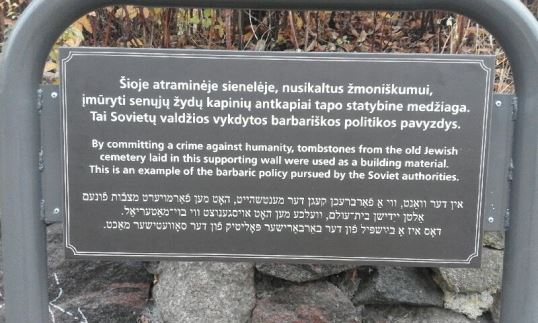
VILNIUS—This city’s dashing young new mayor, Remigijus Šimašius, elected last spring, has now added Yiddish to the previously bilingual (Lithuanian-English) signs, wrought of expensive metal in rounded-edged casement, in times of austerity for pensioners and others in town. These signs are being placed near Soviet-era edifices made of pilfered Jewish gravestones (matséyves) that are a blot on this charming East European capital. This is the latest model featured on the mayor’s office website: