Readers recall that the Lithuanian parliament’s 21 September proclamation of 2011 as the ‘Year of Remembrance for the Victims of the Holocaust in Lithuania’ (text here) was mysteriously reincarnated one week later, on 28 September, as the ‘Year of Commemoration of the Defense of Freedom and of Great Losses’ (text here) with accompanying press explanations restricting the 1941 aspect to Soviet deportations to Siberia and no mention of the Holocaust among the ‘great losses’ (text here).
The text and press releases gave rise to fears that plans were still underway to sanitize, revise and glorify the memory of the 1941 LAF and Provisional Government collaborators of the Nazis. This painful subject was dealt with in a recent statement from the Jewish Community of Lithuania.
The ensuing History Apartheid, as this journal called it (2011 dedicated to one thing for foreigners and Jews and another for the country itself, in effect) led to a letter to the chair of the Seimas from the head of Lithuania’s tiny but proud Jewish community (text here).
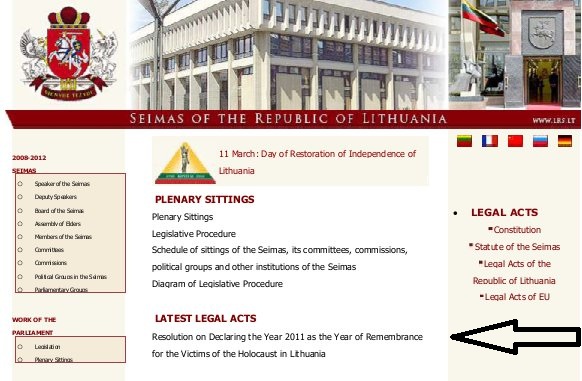
A check today of the official website of Lithuanian parliament (the Seimas) added a further curious aspect to the parliamentarians’ thinking. The English version of the website explains that 2011 has been proclaimed as the ‘Year of Remembrance for the Victims of the Holocaust in Lithuania’.
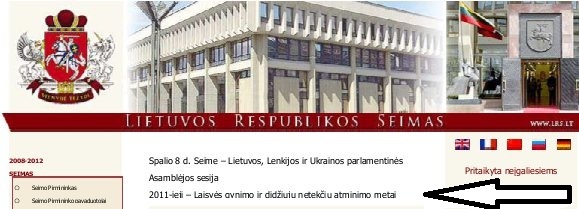
The corresponding sentence on the home page of the Lithuanian version of the official Seimas website indicates however that 2011 is the designated ‘Year of Commemoration of the Defense of Freedom and of Great Losses’.
One Western diplomat who requested anonymity commented to this journal: ‘You see, if you live long enough, you live to see everything’.
 Some would say it could only happen in Eastern Europe. A ninety-six year old convicted war criminal is the plaintiff in a case concerning his Holocaust era crimes. The unlikely libel suit filed by a Hungarian Nazi collaborator,
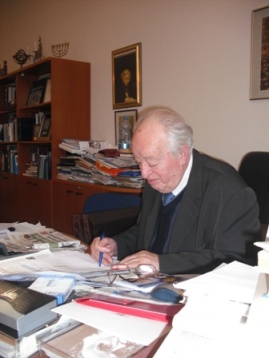
 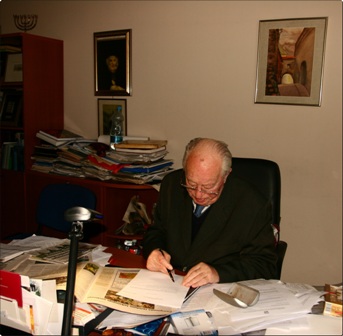 Dr Shimon Alperovich (Simonas Alperavičius), chairman of the Jewish Community of Lithuania, turned 82. Notwithstanding his age and various health issues, he continues to provide proud, courageous, vigorous and independent leadership for the Jewish community at a time when various government agencies continue to pursue painfully disingenuous policies on a range of Jewish issues, including Holocaust history, antisemitism and restitution. His series of public statements (some produced in translation on the
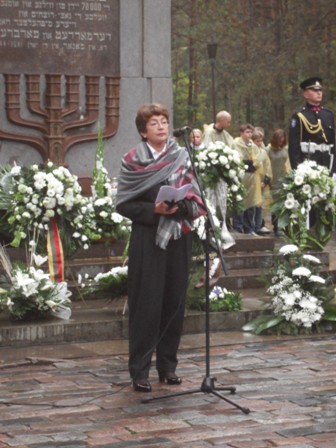
 Švenčioneliai, interwar Poland’s Nowo-Święciany). Such is the custom every year on the first Sunday in October, to remember the eight thousand Jewish civilians murdered there after a gruesome ten days of imprisonment, deprivation of basic human needs, and torture, in makeshift barracks here at the site, in October 1941. The eight thousand Jews were marched (with the lame and the old transported on wagons) from their hometowns in the area to the site on September 27th. They were all shot over a two-day period on the 7th and 8th of October 1941.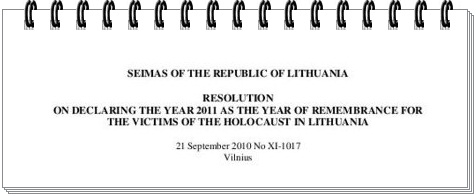
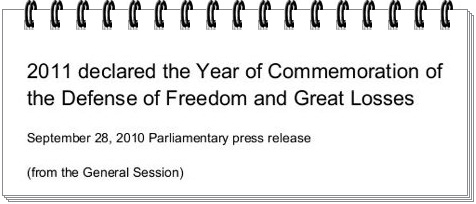 Frankly, there is unease in the Jewish community as to whether this title and text leave open the possibility that the LAF (Lithuanian Activist Front) and PG (Provisional Government), both massively complicit in the early stages of the Lithuanian Holocaust, are going to be celebrated as ‘defenders of freedom’ (or anti-Soviet patriots) during the 2011 seventieth anniversary of events unleashed by Hitler’s invasion of 22 June 1941.
 of Vilna and its environs ― were murdered by Nazi henchmen between 1941 and 1944. In 2005, Yale University Press brought out Kazimierz Sakowicz’s eyewitness account, Ponary Diary, where it is reconfirmed that most of the killing was done by volunteer local killers.
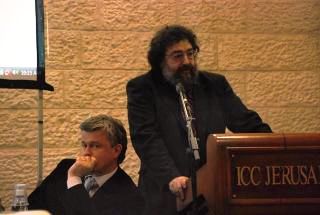
 Attorney Joseph Melamed, chairman of the Association of Lithuanian Jews in Israel (at right) delivered the keynote speech today at an event held at Yad Vashem in Jerusalem to mark the September 23rd anniversary of the 1943 liquidation of the Vilna Ghetto. Because of the Jewish holidays, the event was moved up to the 20th this year.
 The Jewish Community of Lithuania issued an eloquent public statement on 7 Sept 2010 (