This page has moved here. Thank you.
NEW URL:


The mainstream Lithuanian magazine Veidas (Veidas.lt), a glossy publication available at every news stand in the country, published on its website on 14 November an article under the rubric of ‘History’ titled ‘The Nurnberg Military Court Tribunal: The Biggest Legal Farce in History’. Original here. Full English translation here.
Joseph A. Melamed
The Tel-Aviv based Association of Lithuanian Jews, the world’s most active association of Holocaust Survivors from Lithuania and their progeny, today released to the media the letter which its chairman, Joseph A. Melamed, sent on 16 September 2010 to Anne E. Derse, America’s ambassador to Lithuania. Mr Melamed, a Tel Aviv attorney and former Israeli diplomat, told DefendingHistory.com that his office hopes to receive a reply “in the nearest future”. The full text of Mr Melamed’s 16 September letter:
November 16th 2010 has come and gone, but the ‘Public Meeting’ which the Red-equals-Brown lobby in the European Parliament announced extensively the old fashioned way — by disseminating a flyer that is not posted on the internet — seems to have been postponed. The flyer, echoing both the language and spirit of the Prague Declaration, called for overhaul of (all?) European Union textbooks ‘so that children and young people could learn and be warned about Communism and its crimes in the same way as they have been taught to assess the Nazi crimes’.
A sanitized formulation that is posted on the web, in a style uncharacteristic for Brussels exactitude, notes that the public meeting is ‘scheduled for November’ and makes reference to a group meeting held on 22 September.
An even more sanitized formulation announces the event for the 29th of March 2011, referring to a ‘group meeting’ held on 10 November.
Milan Chersonski, editor of the quadrilingual (English-Lithuanian-Russian-Yiddish) Jerusalem of Lithuania, official publication of the Jewish Community of Lithuania, has published a bold new essay, History: Education or Modern Politics.
The author opposes the Lithuanian government’s attempt to monopolize and dictate the ultranationalist version of history by effectively criminalizing the opinion that the Holocaust was the one genocide that occurred in the country in the twentieth century.
The law passed by the Lithuanian parliament and signed by the president last June, and which came into effect in July 2010, imposes jail sentences of up to two years for those who might dissent.
Ponár (Polish Ponary, Lithuanian Paneriai) is the mass murder site outside Vilnius where around a hundred thousand civilians were murdered by the Nazi regime. Some 70,000 of them were the Jews of Vilna and its region.
Ponár (Polish Ponary, Lithuanian Paneriai) is the mass murder site outside Vilnius where around a hundred thousand civilians were murdered by the Nazi regime. Some 70,000 of them were the Jews of Vilna and its region.
Before the war the site was known as a bucolic holiday and picnic spot set in the forest. During the year-long Soviet rule in 1940-1941, large pits were dug for an oil storage facility. After the Nazi invasion the site was converted to a mass murder operation with the ready-dug pits serving as mass graves.
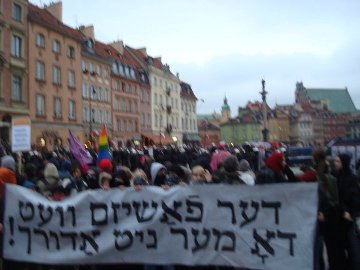
photo courtesy Bogna Eliza Pawlisz
Ponár (Polish Ponary, Lithuanian Paneriai) is the mass murder site outside Vilnius where around a hundred thousand civilians were murdered by the Nazi regime. Some 70,000 of them were the Jews of Vilna and its region.
Before the war the site was known as a bucolic holiday and picnic spot set in the forest. During the year-long Soviet rule in 1940-1941, large pits were dug for an oil storage facility. After the Nazi invasion the site was converted to a mass murder operation with the ready-dug pits serving as mass graves.
The vast majority of the murderers were local nationalist volunteers organized by the Nazis for the purpose of annihilating the country’s Jewish population. The eyewitness account of Christian Polish journalist Kazimierz Sakowicz was brought out in an academic English edition by Yale University Press in 2005 (Ponary Diary).
The small museum at the site has generally won acclaim for providing authentic information in a very small space and modest means. The primary address in Lithuania for visitors and locals wishing to learn more about the site is the Green House in central Vilnius.
O P I N I O N
[Note: A revised version of this comment appeared on Alfa.lt.]
by Dovid Katz
David Lidington, Britain’s Minister for Europe, has praised the recent Lithuanian parliament vote on a (lamentably ambiguous) draft of a bill to deal with restitution of looted Jewish communal property [Details here.] In his statement, he goes on to say: “Passage of the law will bring credit to Lithuania as it prepares to assume the chairmanship of the Organization for Security and Cooperation in Europe (OSCE). I hope that the draft will now advance successfully through its remaining stages.” [The minister’s statement is reported here; it was triumphantly reported in the Lithuanian media.]
Under the leadership of Yidish lebt (‘Yiddish Lives’), a group uniting non-Jewish and Jewish enthusiasts and students of Yiddish language, literature and culture in Warsaw, a peaceful counter-demonstration is being planned in response to the neo-Nazi march slated to take place on November 11th, Polish Independence Day. More details here. Image of the Yiddish group’s poster:Continue reading
The first reading of the long-delayed restitution bill dealing with Jewish communal property in Lithuania passed the Seimas (Lithuanian parliament) today. It will next be considered by the Committee on Legal Affairs on 21 December. There are diverse opinions regarding various aspects of the text of the law and accompanying documents.
Most seriously, experts say that the document contains no clear mention of the actual legal recipient, leading to fears (despite verbal assurances) that the project could in the future be diverted to the ‘Disneyland Vilna Ghetto Theme Park’ as per the wish of powerful forces in the government. That project is anathema to the Jewish community (see here and here).
When the bill was announced, the government’s official Jewish Affairs Advisor, Arkadijus Vinokuras, published a blistering attack on the Jewish Community of Lithuania’s presumed role as future recipient of restitution. Mr Vinokuras is a close ally of Conservative Party MP Emanuelis Zingeris. English translation here.
Reports on Alfa.lt; BNS; European Jewish Press; Ottawa Citizen; Reuters.
[updated 14 Nov 2010]
According to historians, the largest slaughter of people in a single day in the history of the Baltic states occurred on the 29th of October 1941, when between nine and ten thousand Jews were gruesomely killed at the ‘Ninth Fort’ near Kaunas (Kovno), Lithuania, under Nazi German command. Highly motivated local forces carried out most of the killing and the associated humiliation and degradation of the victims. To mark the occasion there is a commemoration ceremony at the site held each year at midday on the last Sunday in October. This year it was held today, under a bright sun that warmed the clear chill of late fall in Lithuania.
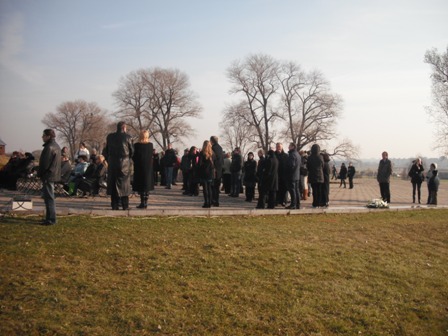 Organized by the Jewish Community of Kaunas, and addressed by its leader, Gercas (Hershl) Žakas, this year’s event drew just over a hundred people, filling less than half the paved plaza near the memorial dais. Survivors present expressed concern for the future status of Ninth Fort remembrance here, and Holocaust commemoration more generally. The concern echoes various factors, including the gradual disappearance of survivors and witnesses, the shrinking of the vestigial Jewish community, and the shifting political trends.
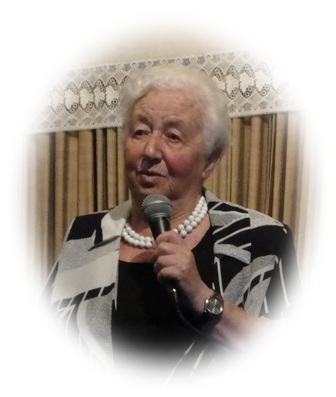
marks the 89th birthday of Dr Rachel Margolis (see also here and here).
The British ambassador to Lithuania, HE Simon Butt, today visited Professor Dovid Katz’s Vilna Yiddish Reading Circle, an advanced Yiddish- in-Yiddish institution that Prof. Katz initiated in September 1999. As guest of honor, Ambassador Butt, who listened to participants reading from the works of Yiddish authors with interest, was invited to say a few words. He told the assembled hat he deeply understands their concerns over resurgent antisemitism, ultranationalism, Holocaust revisionism and the attempted defamation of Jewish partisan heroes. He made it clear that “he is on the case” and gave reasons for hope and optimism.

Front row, from left: Prof. Dovid Katz (standing); Dr. Shimon Alperovich, chairman of the Jewish Community of Lithuania,, Ambassador Simon Butt, and Prof. Izaraelis Lempertas (Israel Lempert). Standing at right at the back if Carole Lemee, a university lecturer from France visiting in Lithuania.
Mr JOSÉ MANUEL BARROSO, ON THE “OCCUPATION MUSEUM” OF RIGA IN LATVIA
Mr President,
Dear Mr Barroso,
I recently visited the “Occupation Museum” in Riga/Latvia where I had the opportunity to see your picture — taken during your visit of that museum in 2008 — displayed on one wall of the entrance hall.
That museum prides itself on having thus welcomed a number of well-known symbolic personalities. Your persona grata is all the more important now that the EU has become an unavoidable partner in the world and, furthermore, now that Latvia has become a full member state of the European Union.
At a 13 October parliamentary meeting of the right-wing faction that  governs Lithuania, the country’s Foreign Minister, Audronius Ažubalis, began a discussion of proposals to again permit dual citizenship by saying that ‘everyone knows’ who is pushing the bill in parliament. Pressed for details, he went on to explain that the culprits are foreign Jews of Litvak origin (i.e. the same precise group being targeted for PR by his Foreign Ministry for its Fake Litvak Forum).
Slipping deeper into classic antisemitic canards, the foreign minister went on to propose that ‘they’ are doing this in order to reap financial benefits by way of property restitution that depends upon citizenship under the country’s citizenship laws that racially favor ethnic Lithuanians.
The main news report of the incident by a highly respected journalist, in the country’s main daily, Lietuvos rytas is headlined:
FOREIGN AFFAIRS STRATEGIST SEES JEWISH CONSPIRACY
The Green House, as the Holocaust exhibit of the Vilna Gaon Jewish State Museum of Lithuania is internationally known, was formally relaunched today in Vilnius after a closure of several months for renovations, technical upgrading of a number of exhibits and the addition of video screens and other facilities.
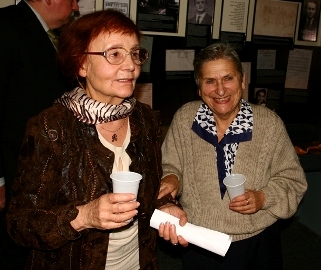
Rachel Kostanian (left) and Fania Yocheles Brantsovsky celebrate at the Green House’s Relaunch. Photo: Sebastian Pammer.
In a massive show of support for Rachel Kostanian, its beloved guardian and director since its inception over two decades ago, the diplomatic corps came out in force, including the ambassadors of Austria, France, Germany, Japan, Norway, UK and chargés d’affaires or consuls of Bulgaria, the Netherlands and the United States. There was a sense of relief that Ms Kostanian and her staff had succeeded to preserve not only the vast majority of images, texts and topics from the venerated old exhibit, but also its key message of straight-talking Holocaust studies that stays clear of the obfuscating discourse of ‘artificial balances, mitigations and excuses’ that runs rampant in this part of Europe.
[AUTHORIZED TRANSLATION OF THE LITHUANIAN ORIGINAL]
This letter was approved unanimously at a meeting of the board of directors of the Lithuanian Jewish Community on October 14, 2010, in which 21 board members participated.
To the President of the Republic of Lithuania
Ms. Dalia Grybauskaitė
15 October 2010
Your Excellency,
The Lithuanian Jewish Community wishes to express its great concern concerning the thoughts expressed by the foreign minister of the Republic of Lithuania, A. Ažubalis, which sow discord between Lithuanians and Jews.
Reports have appeared in the mass media that A. Ažubalis said that “Everyone knows very well” by whom this law (Lithuanian dual citizenship) is most needed, and explained that Jews of Lithuanian origin are the main force pushing this law to the forefront. Moreover, the politician hinted that they probably expect to regain property here more easily in this manner.
A sensational front-page story in today’s Lietuvos rytas, Lithuania’s main national daily, reports that the foreign minister, Audronius Ažubalis, told his ruling party colleagues at a meeting that ‘the new law [regarding possibilities for dual citizenship] was being pushed by Jews who seek citizenship on order to press compensation claims against the state’.