O P I N I O N
Lithuania’s major daily Lietuvos rytas today published a report on the just completed conference called “Legal Regulation of Communist Crimes” held at the European Parliament (full DH.com translation here).


Lithuania’s major daily Lietuvos rytas today published a report on the just completed conference called “Legal Regulation of Communist Crimes” held at the European Parliament (full DH.com translation here).
В литовских СМИ – печатных и виртуальных, местных и центральных – в последнее время уделялось большое внимание конфликту, возникшему между администрацией города Юрбаркаса, с одной стороны, и кинокомпанией «Filmų kopa» (режиссер Саулюс Бержинис, директор Она Бивейнене) – с другой.
It isn’t every Monday and Thursday (as the old Yiddish saying goes) that this journal publishes an opinion piece congratulating a contemporary historian in Lithuania who is a current mainstream player (rather than a pensioner, conceptual or actual exile, or someone painted up as a narrow ethnic-minority champion, anarchist, Soviet apologist, plain old personal maverick, or what-not). It is even more unusual for DefendingHistory.com to go out on a limb without even knowing said historian’s views on the issues that lie at the core of DH’s modest corner in the contemporary marketplace of ideas.
Let it be said at the outset that we sincerely hope that a vote of confidence and congratulations from DefendingHistory.com will not unduly (let alone fatally) harm the man’s future career prospects in the vaunted circles of Lithuania’s most powerful politicians, state institutions and history professors. But come to think of it, the improper leap-into-bed together of this untenable ménage-à-trois goes to the core of the conundrum.
In May Lithuania celebrated the return of the ashes of the Nazi puppet prime minister of June, 1941, Juozas Ambrazevičius (who changed his surname to Brazaitis as a matter of convenience when he began using papers issued to one Brazaitis). The schizophrenic nature of the events were evident from the start, from the Kubilius government’s resolution allocating 30,000 litas in funding to celebrate the Lithuanian Nazi which, several items down the list, also allocated 3,000 litas for a project to “name the names,” to draw up a list of Lithuanian Holocaust victims, in conjunction with the Yad Vashem institution in Jerusalem.
The dissociative shell game continued when the government and state institutions sought to pawn off the events they financed on other institutions: the Catholic Church of the Resurrection of Christ in Kaunas, and an “academic conference/commemoration” planned at Vytautas Magnus University in Kaunas. After a scandal broke and former professor now MEP Leonidas Donskis published an eloquent protest on DH, the rector of VMU, who didn’t want the heat, told the Nazi celebrators to find another venue, one supplied by the Kaunas municipality, the chambers of the Kaunas city council. Then, in keeping with the theme of schizophrenia, VMU decided to allow another “academic conference” on university premises, initially with the exact same list of speakers as the banned event.
Vadym Kolesnychenko, a member of the parliamentary faction of the Party of Regions, recently published a volume (http://r-u.org.ua/kniga/kniga.pdf) of Russian language translations of articles written by Grzegorz Rossolinski-Liebe, Per Anders Rudling and Timothy Snyder.
The articles appeared originally in journals such as Kritika, New York Times Review of Books, Carl Beck Papers and KakanienRevisited. Mr. Kolesnychenko translated and published the volume without the approval or consent of the authors. We regard this conduct as unethical.
Our objections to the political instrumentalization of our work by the Party of Regions are the same as our reservations to analogous instrumentalization by pro-nationalist groups and organizations.
TALLINN―The rehabilitation of Nazi collaborators here in Estonia reached its climax on 14 February 2012, when the Estonian Parliament adopted a declaration sponsored by Defense Minister Mart Laar, in which all who took up arms against the Soviet Union were recognized as “freedom fighters.” The parliament’s statement included the following language, made to sound rather innocuous:
[Updates inserted in square brackets.] According to the website of Vytautas Magnus Univeristy, another event on Juozas Ambrazevičius-Brazaitis, the Nazi puppet “prime minister” of Lithuania who presided over the onset of the genocide of Lithuanian Jewry, will be held tomorrow, 24 May 2012, in the same VMU building (at Donelaičio Street 52) which is reputed to house both a lecture hall (room no. 608) and a bas-relief honoring the wartime fascist. Tomorrow’s event has also been announced on Bernardinai.lt. [Editor’s note of 24 May 2012: Shortly after the appearance of this article, the VMU website program was withdrawn; a screen shot appears below toward the end of this article.]
It is only a week since Vytautas Magnus University (VMU) withdrew from hosting a conference to honor the memory of the wartime collaborator in circumstances that have led to substantial confusion and conflict.
E Y E W I T N E S S A C C O U N T / O P I N I O N
An eyewitness account of the memorial conference for 1941 Nazi puppet prime minister Juozas Ambrazevičius-Brazaitis held at Kaunas City Hall on Saturday 19 May 2012. The event had been moved from its earlier scheduled venue at Vytautas Magnus University.
A few months ago, I received an invitation to give a talk at a conference to be held at the Lozoraitis Museum on the campus of Vytautas Magnus University in Kaunas on the 19th of May. That would be my fourth visit to Lithuania and my first to Kaunas.
The mortal remains of the controversial head of the Lithuanian Provisional Government, Juozas Brazaitis, were flown from the United States to Lithuania and reburied Sunday in Kaunas.
The ceremony for the reburial of Brazaitis gave rise to protests by Jews who judge negatively the activities of the Provisional Government of 1941, which published antisemitic statements.
This led to the decision by Vytautas Magnus University (VMU) not to allow a conference on Brazaitis which had been planned there.
NOTE: This is an authorized republication of today’s letter, which first appeared in the online Algemeiner Journal. [Update: It then appeared in the AJ’s print edition on 25 May, pp. 2, 4, 5.]
Dear Tim,
Greetings, and sorry we missed each other in Vilnius this time. I write in the context of our ongoing and respectful conversation, which started in the Guardian (thanks to Matt Seaton, and prominently including Efraim Zuroff) back in 2010 (I, II, III, IV); continuing through our meeting at Yale, the Aftermath Conference in Melbourne, Australia, in 2011 (thanks to Mark Baker, and with participation of Jan Gross and Patrick Desbois), and more recently, via my review of your book Bloodlands (along with Alexander Prusin’s The Lands Between), in East European Jewish Affairs.
Reporter Andrius Makauskas, in a substantial article in yesterday’s online edition of the respected daily Lietuvos žinios (Lžionios.lt, “Lithuanian News” which is not to be confused with the antisemitic, ultranationalist Vakaro žinios, “Evening News”), makes the sensational claim that the rector of Kaunas’s Vytautas Magnus University (VMU) was untruthful when he told parliament last week that he and his university had not been given advance notice of plans to use VMU premises for a 19 May 2012 “memorial conference” honoring the 1941 Nazi puppet “prime minister” Juozas Ambrazevičius (later Brazaitis).
The 1941 Nazi-puppet prime minister had signed orders for “all means” against the Jews (though asking for a halt to “public executions”), for setting up a concentration camp, and for herding “all of the Jews of Kaunas” into a ghetto within four weeks (English here).
DefendingHistory.com has been able to confirm the following exchange on the floor of the Seimas (Lithuanian parliament) on 17 May 2012. MP Vytenis Povilas Andriukaitis, the Social Democrats’ senior spokesperson for foreign affairs asked a question of the prime minister, Andrius Kubilius, and the foreign minister, Audronius Ažubalis, both from the ruling Conservative / Christian Democrats’ faction. It was answered by the foreign minister.
The following is a translation of the exchange.
It seemed to many Vilnius observers this week that Yale historian Professor Timothy Snyder and Yivo director Mr. Jonathan Brent were both “brought” to Lithuania for various events that would, without their foreknowledge, coincide with the week of the Ambrazevičius-Brazaitis glorification ceremonies financed by the Lithuanian government. These ceremonies have now attracted considerable international criticism (see page one).
It was hoped by some in high places, it is alleged, that their presece would deflect international attention from the honoring of the Nazi puppet prime minister (it didn’t), and that their own fabled reluctance to criticize the Lithuanian government unambiguously would in its own way add legitimacy to the controversial events (it won’t).
Background:
Though neither of the two Foreign Ministry Chosen, both painfully controversial among Holocaust survivors and their families, would issue during their stay in Vilnius a public statement on the series of state-sponsored events to honor a Nazi collaborator, Professor Snyder did answer a question about the reburial in a public interview carried by 15min.lt. The question and answer are as follows:
— There is a controversy in Lithuania surrounding the reburial of Juozas Brazaitis, leader of the provisional government, with the support of the government. Do you think it’s a right thing to do?
“I am going to choose my words very carefully here. I think before you rebury anyone, you should think very very hard and probably wait a very very long time because once you rebury somebody once, you can’t rebury them again.”
The following is a translation of the statement submitted to the Lithuanian parliament (the Seimas) on 17 May 2012 by MPs Vytenis Povilas Andriukaitis and Algirdas Sysas. The original is available here.
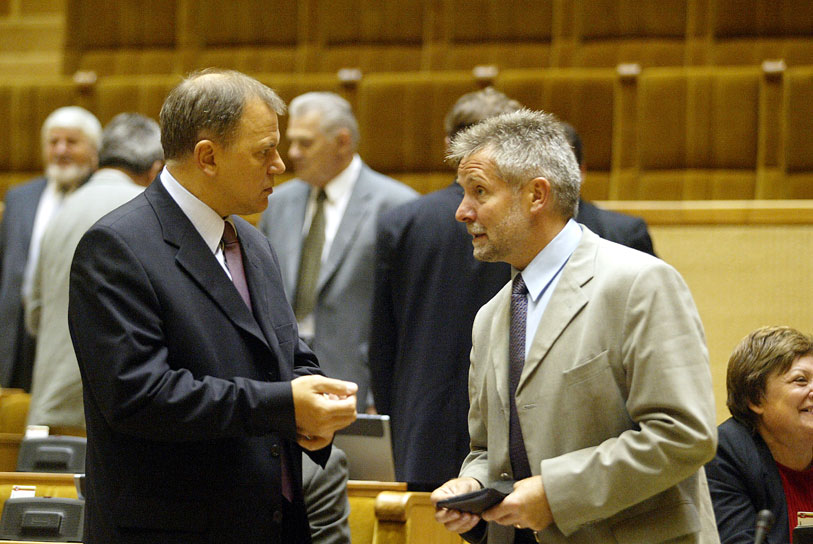
MPs Andriukaitis and Sysas in the Seimas (foreground). Photo courtesy Image Archive of the Seimas.
Several days ago we received an invitation to a ceremony for the reburial of the remains of Juozas Brazaitis Ambrazevičius (1903–1974) in the churchyard of the Kaunas Church of the Resurrection of Christ. A booklet was included with the invitation recounting the life and deeds of Juozas Brazaitis Ambrazevičius. It included his academic and pedagogical activity and his participation in the anti-Nazi and anti-Soviet resistance. It also presented an excerpt from a letter by Joshua Eilberg, chairman of the Immigration, Citizenship and International Law Sub-Committee of the Judiciary Committee of the US House of Representatives, saying that an investigation into the Juozas Brazaitis Ambrazevičius’s collaboration with the Nazis during World War II had been stopped.
Members of Lithuania’s small and fragile remnant Jewish community were left in shock as word was spreading that quite secretively, the country’s prime minister and culture minister personally signed off this past March on the 30,000 litas allotment for the expenses of reburying and honoring the wartime fascist leader, Juozas Ambrazevičius (later Brazaitis). Ambrazevičius, as the Nazi puppet “prime minister” during the first weeks of the war in 1941, signed the orders confirming “all means” against Jews (though calling for public executions to halt), for a concentration camp for Lithuania’s Jews, and for the herding of all of Kaunas’s Jews into a ghetto within four weeks (English translation here).
The Lithuanian Jewish Community, in partnership with the Vilna Gaon Jewish museum, has issued a statement of protest against government sponsorship of the events.
Michael and Fausta Maass, directors of the Lithuania section of the International Christian Embassy Jerusalem (ICEJ) issued the following statement today.
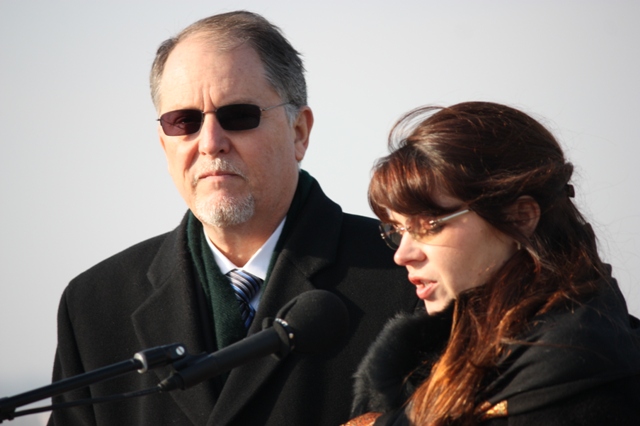
Michael and Fausta Maass, directors of the Lithuania section of the International Christian Embassy Jerusalem (ICEJ)
“The International Christian Embassy Jerusalem, Lithuanian section, calls upon the Lithuanian government and parliament, the Kaunas mayor’s office, the Church of the Resurrection in Kaunas, and other possibly participating entities involved in the ceremonies honoring Juozas Ambrazavičius-Brazaitis, to cancel any and all such ceremonies.
Ambrazevičius, the “provisional government” of 1941 which he led, and the closely associated Lithuanian Activist Front (LAF) were complicit in the murders of many thousands of Lithuanian Jews before and during the German occupation of Lithuania.
According to the right-wing Lithuanian website “Dešinioji Mintis,” you have until May 18th to register for free transportation, courtesy of the Chancellery of the Parliament in Vilnius, to the events in Kaunas scheduled for May 19th and 20th to honor the memory of the head of Nazi puppet “provisional government” (“PG”) of 1941. Specifically, you can attend the memorial conference on the 19th, and/or the re-interment ceremony on the 20th. There is specific reference to the offer being for the good of young people who are not “apathetic.” Contact information at the Lithuanian parliament (Seimas) is also provided.
Is this really how the nation’s parliament wants to educate the country’s youth?
BNS (Baltic News Service) today published in full a statement issued by the Public Relations Department of the Parliament, and signed by member of parliament Professor Arimantas Dumčius. The statement contains an updated schedule of events in honor of the repatriation to Lithuania of the remains of Juozas Ambrazevičius, the “prime minister” of the 1941 Nazi puppet government in Kaunas. Background here, here, here; see also Aderet, Donskis, Zuroff and Krystyna Anna Steiger’s petition).
An earlier BNS report confirmed that the Lithuanian government is financing the transatlantic reburial and four days of events honoring the Nazi collaborator. Today’s press release from the parliament’s official Public Relations Department further underscores the deep government investment in glorification of the country’s 1941 Nazi collaborators.
But one of the scheduled events, a conference on Saturday 20 May, earlier slated for Vytautas Magnus University, is moved on this version to “venue to be announced” after a major scandal that included a letter from the rector of VMU to the nation’s parliament (the Seimas). Still, two VMU professors are among the speakers honoring Ambrazevičius.
Today’s parliamentary press release confirms that the reburial mass for the Nazi collaborator will be conducted by the archbishop metropolitan, Sigitas Tamkevičius, who recently published effusive praise for him in Bernardinai.lt, offering up a deeply revised biography, one that does not mention the onset of the Holocaust during the provisional government’s reign.
The documents signed by Ambrazevičius in his capacity as “prime minister” of the 1941 “provisional government” include the 27 June 1941 statement calling for all means against the Jews but asking that executions not be public; the 30 June 1941 order for a concentration camp for Jews to be set up; and the 7 July 1941 order for all the Jews of Kaunas to be forcibly relocated into a ghetto within four weeks (English here; extract here).

Extract of the Provisional Government order of 7 July 1941 including the signature of J. Ambrazevičius and the sentence “By German order a ghetto for Jews will be established in Vilijampolė, to which all the Jews of the city of Kaunas must be moved within four weeks.”
The following is a full translation of the BNS report containing the text submitted by MP Dumčius. The original Lithuanian text appears on the BNS site (as htm here).
Parliament Public Relations Department May 16, 2012, rsv@lrs.lt
MEP Leonidas Donskis’s letter, in reply to Krystyna Anna Steiger, author of the international petition against the VMU event, was released today by the MEP for immediate publication in DefendingHistory.com (more background here).
The full text is as follows: