A report in Jerusalem of Lithuania describes the most recent attacks on the offices of the small Jewish community that remains in Panevezys (Ponevezh). The report is available here.
News & Views
Attacks on the Panevezys (Ponevezh) Jewish Community Office
‘The Baltic Times’ Does it Again
The 2 September 2010 issue of the Baltic Times carried an unsigned editorial on the Opinion page that refers to Dr Efraim Zuroff, director of the Wiesenthal Center’s Israel office, and the author of Operation Last Chance [excerpt here], as someone who ‘plays Moscow’s political games’, in line with local far-right efforts to tar with a McCarthyist brush of alleged communism those who speak out against racism, antisemitism, and Holocaust revisionism.
Sir Martin Gilbert Releases August 2008 Letter on his Resignation from the Lithuanian Government’s “Red-Brown Commission”
Sir Martin Gilbert has today authorized publication of his 24 August 2008 letter to this journal’s (future) editor. The facsimile follows. The letter had confirmed his April 2008 resignation from the “International Commission for the Evaluation of the Crimes of the Nazi and Soviet Occupation Regimes in Lithuania” (known informally and for brevity as the “Red-Brown Commission”), citing the Yitzhak Arad affair.
In view of the subsequent developments, the 24 August letter also cites the need for the Commission to condemn the defamation of additional Holocaust survivors Fania Yocheles Brantsovsky, Professor Sara Ginaite, and Dr. Rachel Margolis. Professor Gilbert’s authorization for publication came after the Commission’s website failed to remove his name from the list of members in spite of his resignation on principle.
When Will the Truth Finally Set Us Free?
O P I N I O N
by Leonidas Donskis
I will admit that when I read political analyst Kęstutis Girnius’s comments on the Lithuanian Provisional Government and the Lithuanian Activist Front, and about the supposedly low level of academic research and documentation of these phenomena, I found myself in a state of disbelief that a person whom I consider one of the most sober-minded and most insightful of our political commentators could write this. Without citing his earlier statements on radio and in publications on this topic, here is the link to Kęstutis Girnius’s latest commentary [English translation]:
Gruto Parkas, the Fun Park near Druskininkai
O P I N I O N
by Dovid Katz
Photos by Richard Schofield (© R. Schofield)
A ‘Lenin Statue Theme Park’ near the resort town of Druskininkai featuring: ‘Soviet Sculpture Exposition, Museum, Picture Gallery, Events, Cafes, Souvenirs, Lunapark, Zoo’ etc. Their website here. A summer 2010 visit.
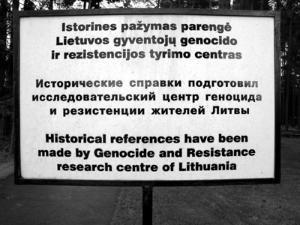
Gruto Parkas (situated at Grutas, near Druskininkai and often popularly called ‘the Lenin Park’) is a private enterprise, but a large sign near the entrance boasts that the historical inscriptions were donated by the state-sponsored ‘Genocide and Resistance Research Centre of Lithuania’.
THE QUESTION: Can you imagine a major theme park dedicated to the history of the Soviet period, in a member state of the European Union and NATO, that tries its best to present Soviet Communism as a largely Jewish enterprise? With a presentation in the spirit of a most infamous brand of 20th century antisemitism? That singles out by nationality only Jews among the many ‘rogues’ featured in its exhibits? That defames the memory of Holocaust Survivors who escaped Nazi ghettos to join the anti-Nazi partisans in the forests of Lithuania? And all this, without once mentioning the Holocaust . . .
Joseph Levinson, 93, Holocaust Historian, Honored in London; But Q & A session is manipulated by translator
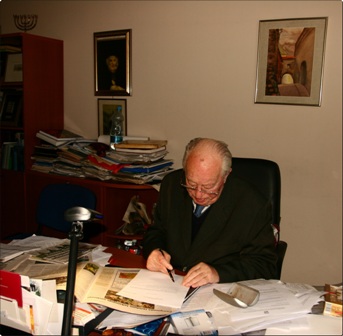
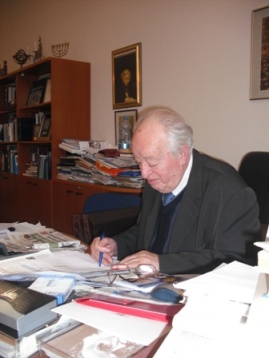
Joseph Levinson of Vilnius, born in March 1917 — an anti-Nazi war veteran, founding figure of Vilnius’s ‘Green House’, historian of the Lithuanian Holocaust, and author of The Book of Sorrow (Vilnius 1997) and The Shoah in Lithuania (English edition: Vilnius 2006) — was honored in London’s Central Synagogue at a splendid event on Wednesday evening 1 September 2010. Details here.
Elegantly chaired by the synagogue’s Rabbi Barry Marcus, a scion of luminous Lithuanian rabbis, himself born in South Africa, it included speeches by Iain Duncan Smith (‘IDS’), Britain’s Secretary of State for Work and Pensions, and the Israeli ambassador to the UK, HE Ron Prosor. The Central Synagogue’s hall was packed. [Added 20 September 2010: See the 2 Sept report in The Jewish News, and Simon Round’s interview with Mr Levinson in The Jewish Chronicle.]
Lithuania’s Last Jewish Professor has Contract Terminated, after Mounting Defense for Holocaust Survivors accused of ‘War Crimes’
Discontinuation of the contract of Lithuania’s last Jewish professor — Dovid Katz, founding Yiddish professor at the Vilnius Yiddish Institute and editor of this website — for having mounted a defense of the defamed Holocaust Survivors, and building (via the Vilnius diplomatic community, op-eds in mainstream publications, and this site) international opposition to the ‘Double Genocide’ movement in Europe, and in Lithuania.
Pig’s Head, with Hat and Earlocks, Placed at Kaunas Synagogue Door During Sabbath Service
A pig’s head, adorned with a black hat and makeshift hasidic style earlocks, was placed on the pavement right outside the door, within the courtyard of the main synagogue in Kaunas, Lithuania’s second city, during Sabbath morning services. This caused profound grief to the very small congregation of survivors who pray at the city’s Choral Synagogue, the only prewar Jewish prayerhouse in town that still functions. The service was interrupted as police arrived to investigate. The Lithuanian Jewish Community described it as a neo-Nazi antisemitic attack. The police however told BNS that the incident ‘is still qualified as a disturbance of the public peace’. Moreover, the commander of the Central Police Commissariat Gintautas Dirmeikis told BNS that ‘There are no suspects so far’. Photo by Laimutis Brundza / Kauno diena.
Mindaugas Peleckis interviews Dovid Katz
- O P I N I O N
- Questions from Mindaugas Peleckis and answers from Dovid Katz (Text of documents sent by email on 21 August 2010).
- [Update: This interview resulted in the article published in Čikagos aidas on 16 Dec 2010. The unabridged text was posted on this page on 23 Dec 2010, by agreement of the interviewer and the interviewee.]
1. I would like to talk to you about Jewish-Lithuanian relationships. You’ve published the wonderful book ‘Lithuanian Jewish Culture’, which sheds light on many things concerning Jewish life in Lithuania and around it. What do you think about when Lithuanians became, so to say, antisemitic? In the 19th and 20th centuries? Or earlier?
Letter to the Editor (Response to Clifford J. Levy’s report)
Letter to the Editor of the New York Times [not published; subsequently entered into the record on HITB for the date of submission]:
Human Rights — and Holocaust Obfuscation — in the Baltic States
To The Editor:
Clifford J. Levy’s fine report (Aug 16 [print edition]) on the humiliations suffered by native-born Estonians whose mother tongue is Russian is particularly important because Estonia is a member of NATO and the European Union, and its human rights policies are therefore automatically a matter for the collective conscience of these alliances and their individual members.
There is just one painful point on which the report accepts uncritically an Estonian (and generally a Baltic) ‘Excuse for Genocide’ that is verily inexcusable. “Before Estonia was seized by the Soviets in 1940, its population was largely ethnic Estonian; resentment was strong enough that many sided with the Germans when Hitler invaded in 1941.”
Actually, the demographic-balance threatening influx of Russian speakers from other Soviet republics came after World War II. But in any case, the idea that the Soviet occupation somehow justifies (or even explains) the Estonian Hitlerists’ (and Lithuanian and Latvian fascists’) gleeful mass murder of the women, children and men of their Jewish minority (making way, in the Baltics, for the highest percentages of Jews slaughtered in all of Holocaust-era Europe) is sheer nonsense. It is one of many ruses underway in the eastern reaches of the European Union to sanitize and obfuscate the Holocaust. Journalists must be sensitized to its box of semantic tricks.
Dovid Katz
The Green House
Pamėnkalnio 12, Vilnius
Note: See also our report on the October 2010 re-opening of the Green House following extensive renovations. Black and white photos below are ©Richard Schofield.
Rachel Kostanian, the courageous director, valiantly keeps alive one of the rare local bastions of public integrity on the Holocaust in Lithuania, having constantly to fend off obstacles. Read Esther Goldberg Gilbert’s portrait in the special Jewish New Year’s supplement on great Jewish women of the ages in the Canadian Jewish News (8 Sept 2010). A follow-up article on Rachel Kostanian’s epic struggle for truth in Holocaust history appeared a month later (7 Oct 2010).
The Last Jewish Fort in the Forests of Lithuania: Fania Yocheles Brantsovsky Calls for its Preservation
by Dovid Katz
◊
Fania Yocheles Brantsovsky, born in 1922, who lost her entire family in the Holocaust, escaped the Vilna Ghetto several moments before it was encircled by police preparing for its final liquidation on 23 September 1943. Together with Dobke Develtov [update: who passed away in 2012 in Los Angeles], she made it to this underground anti-Nazi partisan fort that was home to fighters aligned with the Soviet partisans. The precise number of inhabitants varied with newcomers and deaths in battle. Fania remembers at one time 99 of 101 were Jewish Vilna Ghetto escapees, at another 101 of 107. An underground bunker like this was home until the fall of Nazi rule in July 1944.
Along with other Holocaust Survivors who resisted — including Yitzhak Arad and Rachel Margolis — Ms Brantsovsky, librarian of the Vilnius Yiddish Institute, has in recent years been the object of a campaign of defamation and harassment in Lithuania.
The antisemitic press has targeted her (January 2008). Armed police came to search for her (May 2008). Prosecutors told the press she could not be found (May 2008). The editor of Lithuania’s main news portal called for her to be tried (May 2009). The mainstream media, citing ruling-party members of Lithuania’s parliament, branded her a war criminal (Oct 2009). And one of the country’s leading associations for human rights (!) demanded that she and other Jewish partisan veterans be ‘sentenced’ for committing ‘a massive slaughter’ (Dec. 2010).
All in the absence of any charge or iota of evidence.
The Last Jewish Fort in the Forests of Lithuania: Fania Yocheles Brantsovsky Calls for its Preservation
FANIA YOCHELES BRANTSOVSKY | THE JEWISH FORT IN THE FOREST | BLAMING THE VICTIMS
◊
by Dovid Katz
◊
Fania Yocheles Brantsovsky, born in 1922, who lost her entire family in the Holocaust, escaped the Vilna Ghetto several moments before it was encircled by police preparing for its final liquidation on 23 September 1943. Together with Dobke Develtov [update: who passed away in 2012 in Los Angeles], she made it to this underground anti-Nazi partisan fort that was home to fighters aligned with the Soviet partisans. The precise number of inhabitants varied with newcomers and deaths in battle. Fania remembers at one time 99 of 101 were Jewish Vilna Ghetto escapees, at another 101 of 107. An underground bunker like this was home until the fall of Nazi rule in July 1944.
Along with other Holocaust Survivors who resisted — including Yitzhak Arad and Rachel Margolis — Ms Brantsovsky, librarian of the Vilnius Yiddish Institute, has in recent years been the object of a campaign of defamation and harassment in Lithuania.
The antisemitic press has targeted her (January 2008). Armed police came to search for her (May 2008). Prosecutors told the press she could not be found (May 2008). The editor of Lithuania’s main news portal called for her to be tried (May 2009). The mainstream media, citing ruling-party members of Lithuania’s parliament, branded her a war criminal (Oct 2009). And one of the country’s leading associations for human rights (!) demanded that she and other Jewish partisan veterans be ‘sentenced’ for committing ‘a massive slaughter’ (Dec. 2010).
All in the absence of any charge or iota of evidence.
“I dream that good people from all over the world will not forget the Holocaust in Lithuania or our struggle to stay alive and to fight the Nazis and their collaborators, that for generations to come they will make their way here to look and see where we, a hundred Vilna Ghetto survivors who lost our entire families, lived, loved, fought, and dreamt of a better tomorrow.” — Fania Yocheles Brantsovsky
Venclova & Others Speak Out
Lithuanian poet, scholar and humanist Tomas Venclova (Yale University) publishes a major new essay. English here, excerpt here.
MEP Leonidas Donskis asks: ‘What Happened to Us?’
7 Simple Solutions
Seven constructive solutions proposed to transform Lithuanian-Jewish relations and restore an atmosphere of civil-society democratic debate. Here. Also, draft text suggested as starting point for replacement of the Prague Declaration. Plus: Draft Reading List on the Lithuanian Holocaust.
Swastika Sanitization
In May 2010 a Lithuanian court legalized public displays of swastikas, with nearly no reaction from foreign embassies or human rights groups. Reports here and here. Jewish community’s reaction here. See also the page on Antisemitism. On the term swasticals, see our report for 8 May 2010.
REPRESENTATIVE SELECTION
11 March 2008
Gedimino Boulevard, Vilnius. This is the ‘Lithuanian swastika’ with the added lines meant to evoke the ‘Columns of Gediminas‘. Details and video of the parade here.

16 February 2010
Green House Shuts for Repairs at Height of Tourist Season
Vilnius’s one Holocaust museum, The Green House, shut down for renovations at the start of August 2010, at the height of the tourist season. Tourists are now limited to the Holocaust-obfuscating Genocide Museum, the Genocide Center, and Gruto Parkas. The Holocaust Studies community internationally is moreover profoundly disturbed by persistent efforts to undermine Rachel Kostanian, the Green House’s esteemed director of twenty years’ standing, and the efforts to replace her with a ‘compliant’ nationalist operative. Full story here
The Genocide Museum
‘The Museum of Genocide Victims’
Gedimino Boulevard 42, Vilnius
A summer 2010 visit to a major Baltic tourist attraction.
by Dovid Katz
Images by Richard Schofield (© R. Schofield)
THE QUESTION: Can you imagine a Museum of Genocide Victims — in the capital of a country with the highest proportion in Europe of Holocaust genocide of its Jewish population — that does not mention the word Holocaust or the name of the nearby infamous mass-killing site, where 100,000 civilians were murdered? That avoids any reference to the actual genocide that occurred in the country? That includes antisemitic exhibits with no commentary? That is state-sponsored in the capital of a European Union member state?
Last Jewish Fort is Vanishing
A leading news portal attacks visiting Israeli soldiers for a planned visit to the Last Jewish Anti-Nazi Fort, where around 100 Jewish escapees from the Vilna Ghetto found refuge in 1943 and 1944. The fort’s remnants are rapidly disappearing. Campaign mounted for its preservation.
Litvak Studies Institute Protests “Fake Litvak” Game by Politicians; Director Mikhail Iossel Issues Statement
Professor Mikhail Iossel, director of Summer Literary Seminars (SLS) and the newly established Litvak Studies Institute (LSI) released this statement today on the LSI website [archived copy].
Litvak Studies Institute Protests Lithuanian Government’s “Fake Litvak” Forum, Calls on State to Halt PR Gimmickry and Reverse Anti-Jewish Policies
Posted in Press — 20 July 2010
For the dwindling number of aged Litvak survivors who grew up in the East European Jewish civilization decimated by the Holocaust, the anti-Jewish and Holocaust-distorting policies of the Lithuanian government in recent years are deeply painful.