


The Baltic state-sponsored political infiltration into supposedly independent academic bodies concerned with Holocaust studies and education came into sharp focus in Washington this week with leakage to the media of a number of letters from Artūras Vazbys, Minister Counselor at the Lithuanian embassy in Washington DC. The identical letters read:
News & Views
Lithuania’s Embassy in Washington Recruiting “Useful Academics” for Discredited “Red-Brown” Commission
Posted in "Red-Brown Commission", Double Games, Double Genocide: The New Form of Holocaust Revisionism & Denial, Foreign Ministries: Holocaust Politics Abuse?, News & Views, Politics of Memory, United States, US State Department
Tagged Emanuelis Zingeris, Holocaust in Lithuania, International Commission for the Evlauation of the Crimes of the Nazi and Soviet Occupation Regimes in Lithuania, Ronaldas Racinskas
Comments Off on Lithuania’s Embassy in Washington Recruiting “Useful Academics” for Discredited “Red-Brown” Commission
Some Psycho-Sexual Undercurrents of the Lithuanian Independence Day Nazi March
O P I N I O N
by Geoff Vasil
Back in 2008 a friend and I put subtitles to the march by Lithuanian neo-Nazis through the capital, Vilnius, on independence day, and put the video with subtitles up on YouTube. Back then there was almost zero mention of the march where openly fascist youth chanted slogans about attacking and killing Jews and Russians, and the de rigueur “Juden raus.” Following the YouTube posting and as news travelled around the world, certain Lithuanian media figures and politicians felt the need to at least say something. Not much, but something.
Posted in Antisemitism & Bias, Celebrations of Fascism, Events, Geoff Vasil, Humor (Of Sorts), LGBTQ Equal Rights, Neo-Nazi & Fascist Marches, News & Views, Opinion, Politics of Memory, Vilnius, Vilnius Jewish Public Library
Comments Off on Some Psycho-Sexual Undercurrents of the Lithuanian Independence Day Nazi March
Will Intellectuals in Western Countries Continue their Silence on Latvia’s Glorification of Hitler’s Waffen SS?
E Y E W I T N E S S R E P O R T / O P I N I O N
by Roland Binet (Braine-l’Alleud, Belgium)
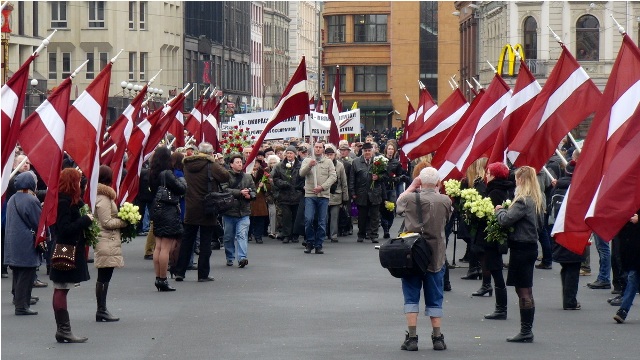
RIGA—The day is a festive one despite the gray and low sky. Young pretty girls have bunches of roses which they soon distribute to elderly and solemn gentlemen arriving, row upon row in an interminable procession. Numerous national flags are held in a heraldic and staid way by young men forming a kind of double guard of honor.
Posted in Antisemitism & Bias, Celebrations of Fascism, Collaborators Glorified, Events, Human Rights, Latvia, News & Views, Opinion, Politics of Memory, Riga's Waffen SS Marches, Roland Binet
Tagged Holocaust in Latvia, Holocaust in the Baltics
Comments Off on Will Intellectuals in Western Countries Continue their Silence on Latvia’s Glorification of Hitler’s Waffen SS?
Seventy Years Declaration Presented to European Parliament President at Strasbourg
On 14 March 2012 in Strasbourg, a delegation presented the Seventy Years Declaration to Martin Schulz, president of the European Parliament, who spoke about the imperative to guard the accurate memory of the Holocaust in European history and to remain vigilant against denial and renewed extremism.
The delegation included veteran German parliamentarian Gert Weisskirchen; European Parliament vice president Miguel Angel Martinez; Lithuanian MEP Justas Paleckis; and DefendingHistory.com editor Dovid Katz.
European Commission report on the presentation of 70YD
Text of the Seventy Years Declaration
Media Links
Posted in EU, It Pays to Defend History: Success Over the Years..., News & Views
Comments Off on Seventy Years Declaration Presented to European Parliament President at Strasbourg
1500 Honor the Waffen SS at Riga’s Liberty Monument; Event is Praised by Latvia’s President, Condemned by Council of Europe’s Commission on Racism
E Y E W I T N E S S R E P O R T / O P I N I O N
by Dovid Katz
RIGA—According to most estimates, there were around 1500 participants today in the city-center ceremony honoring the Waffen SS, about 1000 police, and about one hundred protesters who turned out in opposition to the event.
The ongoing campaign by some East European governments to repackage far-right ultranationalist politics and policies (with concomitant antisemitic, racist and Nazi-glorifying undertones) as a wholesome British-conservative-style “center right” has suffered a major blow. The battleground of ideas has in recent weeks shifted to the annual Waffen SS commemoration ceremony held at Liberty Monument, the symbolic heart of the capital of Latvia, with the blessing of some of the nation’s top leaders.
Posted in Antisemitism & Bias, Celebrations of Fascism, Collaborators Glorified, Dovid Katz, Events, Human Rights, Latvia, News & Views, Opinion, Politics of Memory, Racism, Riga's Waffen SS Marches, Symbology
Tagged Holocaust in Latvia, Holocaust in the Baltics
Comments Off on 1500 Honor the Waffen SS at Riga’s Liberty Monument; Event is Praised by Latvia’s President, Condemned by Council of Europe’s Commission on Racism
Saying No to “Double Genocide”
O P I N I O N
by Danny-Ben Moshe
This comment appeared today in the Jerusalem Post and is republished here with the author’s permission.
The Israel-South Africa Chamber of Commerce is hosting as guest of honor Lithuanian Foreign Minister Audronius Ažubalis at a gala dinner. Given the current Lithuanian government’s policies towards the Holocaust, it is a bizarre choice.
More than twenty years into their post-Soviet eras, Lithuania and other East European nations are understandably and appropriately seeking international acknowledgment for the suffering inflicted on them by the Soviet regime.
However, rather than commemorating this in its own right, Lithuania has led the campaign to tie this recognition in with the Holocaust, in a policy known as Double Genocide. By so doing, the recognition they seek for their own suffering under the Soviets ipso facto becomes a policy that distorts and downgrades the Holocaust, and undermines and threatens its memory.
Posted in 70 Years Declaration, Danny Ben-Moshe, Double Games, Double Genocide: The New Form of Holocaust Revisionism & Denial, History, News & Views, Opinion, Politics of Memory, South Africa
Comments Off on Saying No to “Double Genocide”
Over 1000 Neo-Nazis Fill Main Vilnius Boulevard on Lithuanian Independence Day
E Y E W I T N E S S R E P O R T
by Dovid Katz
Ignoring international pleas (including over two thousand signatures on an online petition) for the withdrawing of permits for this year’s neo-Nazi march, Vilnius authorities mounted a major police presence to keep order during today’s event in the heart of the Lithuanian capital.

This marcher’s handbag featured a designer swastika
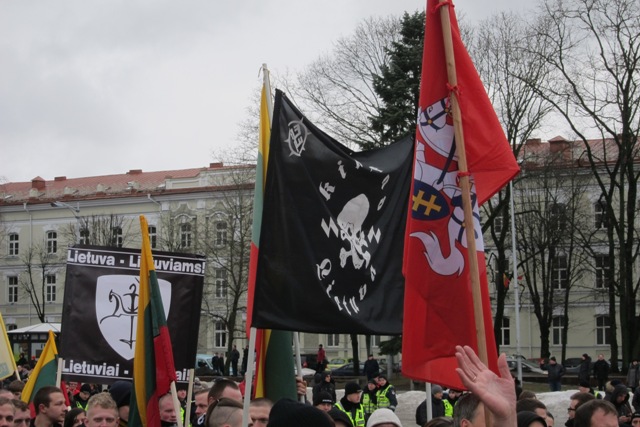
The modified SS skull and crossbones and the “Lithuanian swastika” (with added lines) were among the symbols featured in today’s march
Posted in Antisemitism & Bias, Celebrations of Fascism, Dovid Katz, Events, Human Rights, Neo-Nazi & Fascist Marches, News & Views, Swastikas in Lithuania, Vilnius, Vilnius Jewish Public Library
Comments Off on Over 1000 Neo-Nazis Fill Main Vilnius Boulevard on Lithuanian Independence Day
Once Again, Moral Abdication at the American Embassy in Vilnius?
C O M M E N T
In contrast to its potent and convincing public response to neo-Nazi events in the center of Vilnius in earlier years, the current leadership of the American embassy in the Lithuanian capital has followed a pattern disturbing to many Americans, of failing to even mention what America’s values are in commenting in official communications on both a neo-Nazi march and a pro-tolerance march, both scheduled for tomorrow, Lithuania’s independence day.
Posted in Antisemitism & Bias, Celebrations of Fascism, Events, Foreign Ministries: Holocaust Politics Abuse?, Free Speech & Democracy, Human Rights, News & Views, Opinion, Politics of Memory, The OSCE, United States, US State Department
Comments Off on Once Again, Moral Abdication at the American Embassy in Vilnius?
Seventy Years Declaration in European Languages
◊
THE TEXT
Early history and coverage of the Seventy Years Declaration (Jan-Feb 2012)
Presentation at European Parliament (March 2012)
The documentary film Rewriting History now available free online; launched in Australia (Sept 2012) and in the United States (April 2013)
The film Defending Holocaust History (Spring 2013)
The SYD website
Defending History section on the Seventy Years Declaration
Historians’ mentions: Dan Stone; Gareth Pritchard & Desislava Ganeheva
Posted in 70 Years Declaration, Collaborators Glorified, Double Genocide: The New Form of Holocaust Revisionism & Denial, It Pays to Defend History: Success Over the Years..., Lithuania, Litvak Affairs, News & Views
Comments Off on Seventy Years Declaration in European Languages
Holocaust Survivors Picket TA ‘Gala’ Where South African Bigwigs Honor Lithuanian Right-Wing Politician
Kovno Ghetto Survivor and Resistance Hero Joe Melamed, 87, Leads March 5th 2012 Picket Line Against “Sellout Gala” at the Tel Aviv Dan Panorama
MORE IMAGES
Lithuanian Foreign Minister and Brothers Zingeris are Greeted by Protesting Holocaust Survivors
A FIRST-TIME PARTNERSHIP BETWEEN LEYVIK HOUSE YIDDISH CULTURE CENTER, THE SIMON WIESENTHAL CENTER ISRAEL OFFICE AND THE ASSOCIATION OF LITHUANIAN JEWS IN ISRAEL
Report on YNET. The Times of Israel. 15min.lt. Itongadol.com. Agencia Judia. Forverts (Yiddish Forward). Background. More.
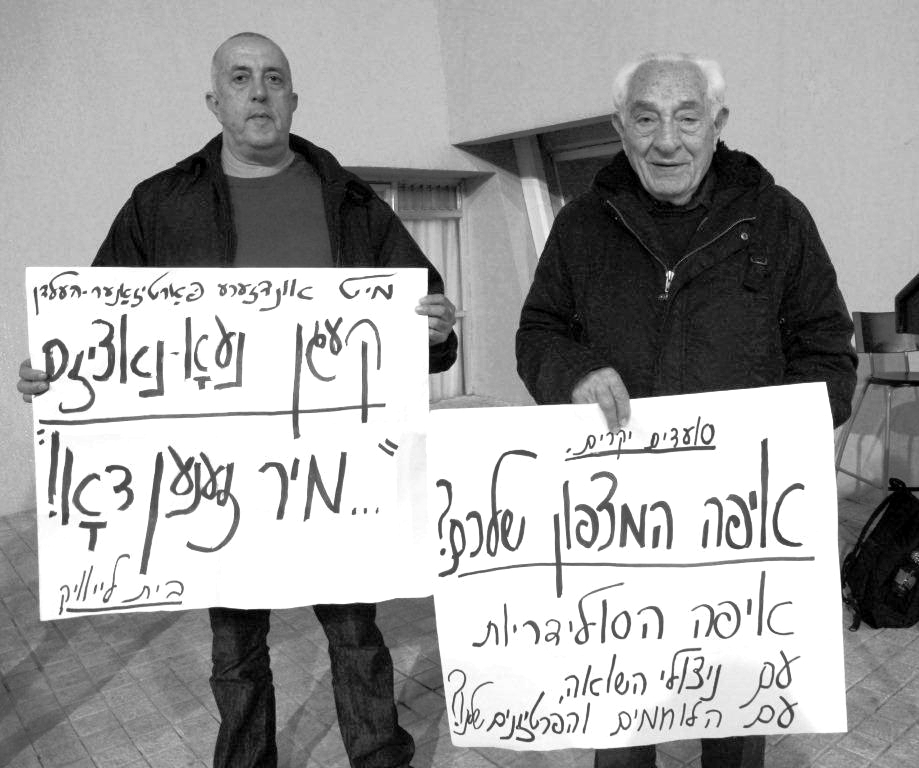
Holocaust survivors Shlomo Cheskov (left, from Shavl/Šiauliai), and Joseph Melamed (from Kovno/Kaunas) at the Tel Aviv demonstration. Mr. Cheskov’s sign says (in Yiddish) “With our partisan heroes, against neo-Nazism. We are here!” Mr. Melamed’s (in Hebrew) addressed to the South African businessmen diners at the gala dinner: “Dear Diners! Where is your conscience? Your solidarity with Holocaust survivors and resistance fighters and partisans?” Photo: Bella Bryks-Klein.
Posted in A 21st Century Campaign Against Lithuanian Holocaust Survivors?, Boxes, Israel, Joseph Melamed, Kaunas, Lithuania, Litvak Affairs, News & Views, South Africa, Yiddish Affairs
Tagged Audronius Azubalis, Efraim Zuroff, Holocaust in Lithuania, Holocaust Survivors demonstrate againstAzubalis, Israel-Lita, Joseph Melamed, Lithuanian-Jewish relations
Comments Off on Holocaust Survivors Picket TA ‘Gala’ Where South African Bigwigs Honor Lithuanian Right-Wing Politician
Lithuanian Holocaust Survivors Protest Tel Aviv “Gala”
Kovno Ghetto Survivor and Resistance Hero Joe Melamed, 87, Leads March 5th 2012 Picket Line Against “Sellout Gala” at the Tel Aviv Dan Panorama
Lithuanian Foreign Minister and Brothers Zingeris are Greeted by Protesting Holocaust Survivors
A FIRST-TIME PARTNERSHIP BETWEEN LEYVIK HOUSE YIDDISH CULTURE CENTER, THE SIMON WIESENTHAL CENTER ISRAEL OFFICE AND THE ASSOCIATION OF LITHUANIAN JEWS IN ISRAEL
Posted in A 21st Century Campaign Against Lithuanian Holocaust Survivors?, Efraim Zuroff, Israel, Litvak Affairs, News & Views, Politics of Memory, South Africa
Comments Off on Lithuanian Holocaust Survivors Protest Tel Aviv “Gala”
Images from a Survivor Demonstration at the Dan Panorama in Tel Aviv
Most counts put at eighteen the number of participants in a small, polite but determined picket line outside the Dan Panorama Hotel in Tel Aviv this evening. The protesters, Holocaust survivors from Lithuania and their supporters, sported signs in English, Hebrew and Yiddish taking to task the government-manipulated gala evening being held inside the hotel by “Yisrael Lita” at which the Lithuanian foreign minister, a determined opponent of accurate Holocaust comemmoration, was “guest of honor.”
Posted in Events, Israel, Joseph Melamed, Litvak Affairs, News & Views, Politics of Memory
Tagged Audronius Azubalis, Holocaust in Lithuania, Holocaust survivors protest Lithuanian government, Joseph Melamed, Lithuanian-Jewish affairs
Comments Off on Images from a Survivor Demonstration at the Dan Panorama in Tel Aviv
Monica Lowenberg in Dialogue with Latvia’s Ambassador to the UK
D E B A T E
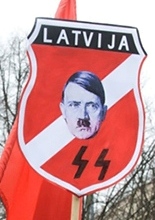
From the 2009 Waffen SS march in Riga. Photo Ilmars Znotins.
Monica Lowenberg is the creator of the international petition against this year’s Waffen SS march scheduled for 16 March 2012 in the heart of Riga, Latvia’s capital city. The petition has to date attracted some six thousand signatures from every part of the planet.
Its author approached the Latvian ambassador to the UK for support.
Below is his letter of 1 March (as PDF here). It is followed by the text of Monica Lowenberg’s 5 March reply, supplied to DefendingHistory.com for publication.
I: The Latvian Ambassador to Monica Lowenberg (1 March 2012)
Posted in Celebrations of Fascism, Collaborators Glorified, Events, Free Speech & Democracy, History, Latvia, Monica Lowenberg, Neo-Nazi & Fascist Marches, News & Views, Opinion, Politics of Memory, Riga's Waffen SS Marches, United Kingdom
Comments Off on Monica Lowenberg in Dialogue with Latvia’s Ambassador to the UK
March 11th: A Grand Opportunity for the Lithuanian Human Rights Community — and the People of Vilnius
O P I N I O N
by Dovid Katz
When three of us from the DefendingHistory.com community headed out from Vilnius on February 16th to confront the neo-Nazi march in central Kaunas, we were sure we would be joined by dozens, or more, true lovers of Lithuania — folks who cannot remain silent that perverted political leadership allows today’s neo-Nazis to achieve free reign in the center of a great city in the middle of the nation’s cherished independence day. Folks who cannot let the glorification of stylized swastikas (including the “Lithuanian swastika“), and white armbands (celebrating the LAF Holocaust perpetrators of 1941) go unchallenged in the country with the largest rate of murder of its civilian Jewish population in all Holocaust-era Europe. Folks who want to send at least some modicum of support to today’s minorities. And a message to the world that the neo-Nazis do not represent Lithuanian society.
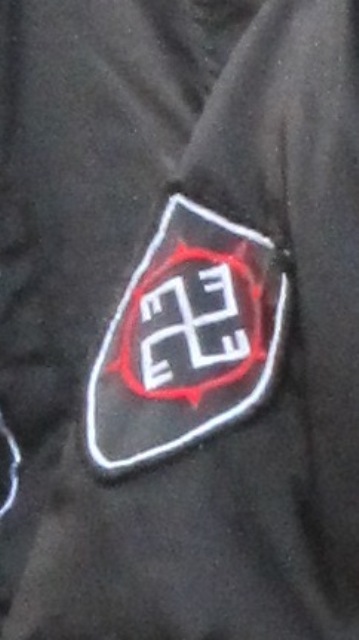

It was a shock to find in Kaunas on February 16th, that the somewhat quixotic DefendingHistory.com threesome would find itself the only visible anti-Nazi presence during the march and the rally that followed.
Posted in Celebrations of Fascism, Dovid Katz, Free Speech & Democracy, Human Rights, Media Watch, Neo-Nazi & Fascist Marches, News & Views, Opinion, Vilnius, Vilnius Jewish Public Library
Tagged Antisemitism in Lithuania, Efraim Zuroff, Genocide Research Center, International Commission for the Evaluation of the Crimes of the Nazi and Soviet Occupation Regimes in Lithuania, LAF (Lithuanian Activist Front), Lithuania, March 11th 2012, Milan Chersonski, neo-fascists in Lithuania, neo-Nazi marches in Vilnius, neo-Nazis in Lithuania, Olga Zabludoff, Vilnius Jewish Public Library, Vilnius Yiddish Institute
Comments Off on March 11th: A Grand Opportunity for the Lithuanian Human Rights Community — and the People of Vilnius
The Posthumous Remaking of a Holocaust Perpetrator in Lithuania: Why is Jonas Noreika a National Hero?
O P I N I O N
by Evaldas Balčiūnas
Who was Jonas Noreika?
Jonas Noreika (1910-1947), also known by his nom de guerre, General Vėtra, has been named by the current Lithuanian government as “an important member of the resistance” and an object of every sort of heroic commemoration.
In 1997 he was posthumously awarded the Order of the Cross of Vytis, First Degree. The same year a memorial plaque was placed on the facade of the Lithuanian Academy of Sciences Library in Vilnius.

Library of the Academy of Sciences in Vilnius. The red arrow marks the Noreika plaque.
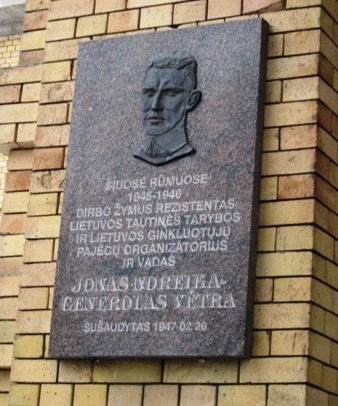
Noreika plaque in central Vilnius
Posted in Collaborators Glorified, Debates on the Postwar "Forest Brothers", Dr. Arūnas Bubnys and State Holocaust Revisionism in Lithuania, Evaldas Balčiūnas, Exotic Jewish Tourism, History, Lithuania, News & Views, Opinion, Plungyán (Plungė), Politics of Memory, State Glorification of Holocaust Collaborator J. Noreika, Symbology, Vilnius's Genocide Center and the Genocide Museum it Manages
Tagged Evaldas Balciunas, General Vetka, Generolo Vetro gatve, Genocide Center, Glorification of War Criminals in Eastern Europe, Holocaust in Lithuania, Holocaust Obfuscation, Jonas Noreika, LIETUVOS MOKSLU AKAKEMIJOS VRUBLEVSKIU BIBLIOTEKA, Lithuanian Academy of Sciences Library, streets named for Holocaust perpetrators, Vilnius
Comments Off on The Posthumous Remaking of a Holocaust Perpetrator in Lithuania: Why is Jonas Noreika a National Hero?
March 11th is Not a Day to Glorify the Perpetrators
O P I N I O N
by Olga Zabludoff
When I learned that the municipality of Vilnius had again issued permits for a neo-Nazi march on Lithuania’s March 11th Independence Day, I was disturbed for more than one reason. Why would the government, which has been purporting its wish for reconciliation with its small Lithuanian Jewish community and Jews everywhere, sanction the resurrection of a Holocaust image? Why would the government, which has been purporting its wish to better its tarnished image with worldwide Jewry, accept and endorse the display of the LAF white armbands imprinted with the flaming swastika?
Most survivors of the Lithuanian Holocaust are more traumatized by memories of the white-armbanded Lithuanian Activist Front than by memories of Hitler’s Aryan henchmen. It was the local LAF murderers who began to butcher Jews who had been their neighbors — this even before their German Nazi masters/commanders came upon the scene. It was the LAF who unleashed the Holocaust in Lithuania. It was then that their slogan was born: “Lithuania for Lithuanians!” (Lietuva Lietuviams).
Posted in Antisemitism & Bias, Celebrations of Fascism, Collaborators Glorified, Free Speech & Democracy, Neo-Nazi & Fascist Marches, News & Views, Olga Zabludoff, Opinion, Swastikas in Lithuania, Vilnius
Comments Off on March 11th is Not a Day to Glorify the Perpetrators
Latvian President, Blasting Critics of March 16th ‘Waffen SS Parade, says it’s ‘Crazy to Think Them War Criminals’
In an escalation of high level pro-Nazi rhetoric in Riga, the nation’s president, Andris Bērziņš, said today that the international community needs to have it explained.
Have what explained? Why those who served in Nazi Germany’s Latvian Waffen SS divisions are honored in the country’s capital on March 16th each year.
The president of Latvia went on to say that “It’s crazy to think they’re war criminals.”
Posted in Antisemitism & Bias, Celebrations of Fascism, Collaborators Glorified, Latvia, Neo-Nazi & Fascist Marches, News & Views, Riga's Waffen SS Marches
Comments Off on Latvian President, Blasting Critics of March 16th ‘Waffen SS Parade, says it’s ‘Crazy to Think Them War Criminals’
Zingeris Statement on Planned March 11th Neo-Nazi March Fails to Mention — the Neo-Nazi March
C O M M E N T
In response to the international petition created by Olga Zabludoff asking the Lithuanian government to rescind permits for the March 11th neo-Nazi march in the center of the capital city Vilnius on the nation’s independence day, Lithuanian embassies in various countries yesterday sent their “Jewish lists” a statement dated 24 February 2012 signed by right-wing Jewish MP Emanuelis Zingeris.
The problem is that Mr. Zingeris’s eloquent statement, calling his countrymen to unity, justice and all lofty things on the nation’s independence day, does not mention with one word the actual neo-Nazi march that is the issue at hand.
It is a striking contrast with the unvarnished words from the heart of a simple Jewish resident of Vilnius about the same neo-Nazi march which DefendingHistory.com released, also yesterday, on YouTube.
Posted in Antisemitism & Bias, Celebrations of Fascism, Double Games, Events, Human Rights, Neo-Nazi & Fascist Marches, News & Views, Opinion, Vilnius
Comments Off on Zingeris Statement on Planned March 11th Neo-Nazi March Fails to Mention — the Neo-Nazi March
Lithuanian Radio Panel Discussion on the Seventy Years Declaration
The Seventy Years Declaration, released on 20 January 2012, was the subject of a 31 January 2012 Žinių radijas (News Radio) station panel discussion including one of the Lithuanian signatories of the declaration, Social Democratic MP Vytenis Andriukaitis, himself a signatory of the Lithuanian Declaration of Independence. MP Andriukaitis was attacked by the foreign minister for signing.
MP Andriukaitis’s response won international support, and there is reference in the panel discussion to the support from British human rights champion MP Denis MacShane for all eight Lithuanian parliamentarians who signed the Seventy Years Declaration.
Posted in "Red-Brown Commission", 70 Years Declaration, Bold Citizens Speak Out, Denis MacShane, Double Genocide: The New Form of Holocaust Revisionism & Denial, History, Holocaust Policies of Mr. Ronaldas Račinskas and the State-Sponsored "International Commission" (ICECNSORL), News & Views, Opinion, Politics of Memory, Vytenis Andriukaitis
Comments Off on Lithuanian Radio Panel Discussion on the Seventy Years Declaration
Stop the Neo-Nazi Movement in Hungary!
O P I N I O N
by David Surjányi
Dozens of people marching on the streets with flags in their hands and badges on their chest.
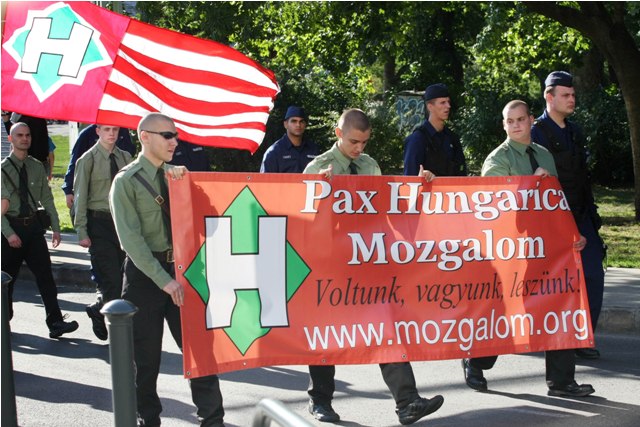
When they reach their destination a strange looking person steps on the podium and starts to speak. His speech is saturated with hate. He demands a “Jew-free” country. He blames the Roma people for the problems of our society.
And this is not 1944. It is 2012. Here in Hungary.
Posted in Antisemitism & Bias, Collaborators Glorified, Human Rights, Hungary, Neo-Nazi & Fascist Marches, News & Views, Opinion, Politics of Memory, Racism
Comments Off on Stop the Neo-Nazi Movement in Hungary!