Rewriting History: New Documentary Film on the Shocking New Holocaust Revisionism in Eastern Europe
REVIEWS OF REWRITING HISTORY
Film’s website ◊ Sign the Seventy Years Declaration ◊ Donate HERE

REVIEWS OF REWRITING HISTORY
Film’s website ◊ Sign the Seventy Years Declaration ◊ Donate HERE
The following news report appeared today in For LGBT Equality:
On 24 April 2013 Vilnius authorities appealed to the Supreme Administrative Court of Lithuania, indicating that, despite the judgment by the first instance court, the municipal authorities have the right to propose a location for a public assembly other than that demanded by the organizers. “The law does not provide an organizer with the right to choose the location for a gathering unconditionally,” the municipality claims in its statement.
Some people interested in military history have perhaps kept in mind a picture of the German Army during World War II – the Wehrmacht – as having been an army not essentially different from other belligerent armies, although, admittedly, it acted brutally and, sometimes, at the limit of what would have been deemed acceptable in times of war.
The new SYD-dedicated website www.SeventyYearsDeclaration.org was launched today.
The website marks a new phase in the international effort to halt the progress of the East European far right’s “Double Genocide” campaign across Europe and beyond. For more background on the Seventy Years Declaration (SYD) see the dedicated page, European languages page, and section in Defending History.
BACKGROUND:
SYD in European languages.
Early history and coverage (Jan-Feb 2012), including the eight bold Lithuanian parliamentarians (all social democrats) who signed the SYD.
Presentation at European Parliament (March 2012).
The documentary film Rewriting History launched in Australia (Sept 2012) and in the United States (April 2013).
The film Defending Holocaust History (Spring 2013).
Defending History section on the Seventy Years Declaration.
.LGL released the following statement in For LGBT Equality earlier today
The Lithuanian Gay League (LGL) today partially won its appeal against the decision of the Vilnius City Municipality to disallow the upcoming Baltic Pride march to be held on Gedimino Prospect, the main street of Vilnius. The Vilnius Regional Administrative Court ruled that the decision of the municipality was not legal.
The organizers of Baltic Pride and the municipality must now restart the process of negotiating the location for the Baltic Pride march.
Years ago, when I first started doubting the veracity of certain propaganda intended to diminish the culpability of local forces in the Holocaust, I interviewed an elderly woman who was an eye-witness to what happened in late June of 1941 in Rokiškis (in Yiddish: Rákishok) in northern (or northeastern) Lithuania.

Obeliai (Abel) 1942: Is curiosity or concern sparked by this “celebration of 1941 partisans” coming from the apex of Nazi rule in Lithuania (1942, when the local Jews were already all murdered)? It seems not. This photo is of the 1942 Nazi-era memorial torn down by the Soviets, and just replaced by a new one, commemorating the same pro-Nazi “partisans” …
She told me how a bunch of young men turned savage, rounded up Jewish men, stuck them in what amounted to a pig sty surrounded by barbed wire in the center of town, and then tortured and humiliated them until they murdered them. She said this gang of savages went by the name of Savisaugos batalionas, which is Lithuanian for self-defense battalion. Were they led by Germans? No, she said, there hadn’t been a single German to be seen.
Dear Ed,
I could hardly believe it when I was told that you were participating in the Sutzkever Translation Prize competition as a judge. The Ed Hirsch whose work I’ve read and admired for years—the Ed Hirsch I’ve admired for years—wouldn’t allow himself to be used in a way that will help the Neo-Nazi forces in Lithuania remove the stain of antisemitism from its persecution of individuals who served as Jewish partisans during the Holocaust years.
Dear Mr. Hirsch
As a fellow poet and human being, I implore you to withdraw as a judge in a competition that will be part of a series of events misrepresenting things, in effect for the benefit of certain elements in the Lithuanian government. Alternatively, as suggested by colleagues, a simple requirement that each of the wrongfully defamed Jewish Holocaust Survivors who joined the anti-Nazi resistance be issued a full and public apology would bring the matter to a rapid close.
I am writing to you because it has come to my attention that you are to be the judge in the Avrom Sutzkever Poetry Translation Prize. Many years ago I came across a book of Sutzkever and have used several lines from his poems in a book of mine on bereavement. I was deeply touched by his work and wanted to share it with others.
Riga, 1943: Latvian soldiers proudly march with a Latvian flag and a Nazi flag. Some of the men were conscripted into the Waffen SS, but a number were volunteers.

◊

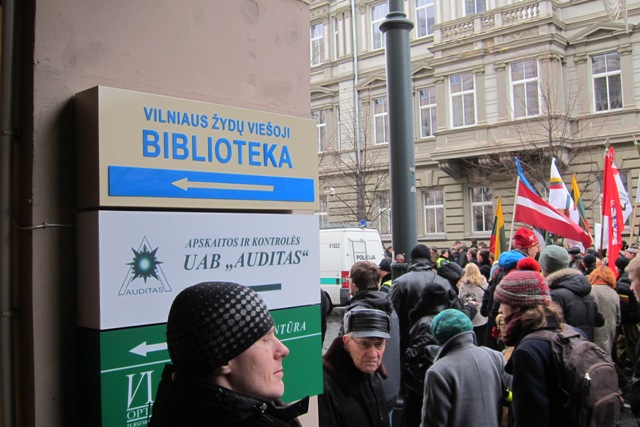
Officially speaking, the annual neo-Nazi march on Lithuania’s independence day earlier this month, complete with swastikas, sieg heils and white power jackets, had been “moved” by the municipality from Vilnius’s central boulevard, Gedimino, to the rather less prestigious location across the river in Shnípishok (Šnipiškės), and the move was confirmed by the courts. But it was all a fiction. On the day, the police facilitated the neo-Nazis’ march up Gedimino as usual without the slightest hint of disapproval, let alone transfer to one of the bridges leading across the river. See our report, and the eyewitness accounts by Anna Shepherd and Geoff Vasil.


A month has now elapsed since the online Lithuania Tribune took a defamatory press release as God’s-honest-truth news, in absence of the slightest attempt to obtain a quote from the victim, or indeed anyone with a contrasting view. The press release came not from a news agency, but the highly partisan executive director of the “Red-Brown Commission” (the full and rather Orwellian name of which is “The International Commission for the Evaluation of the Crimes of the Nazi and Soviet Occupation Regimes in Lithuania”). The Commission is highly controversial to say the least, and resignations to date (all on principle) from its associated bodies include Dr. Yitzhak Arad, Sir Martin Gilbert (London), Prof. Gershon Greenberg (Washington, DC), Prof. Konrad Kwiet (Sydney) and Prof. Dov Levin (Jerusalem). Moreover, while putting forward an educational image to donors, it is in fact the ultranationalist political engine of a sizable part of the Double Genocide movement in Eastern Europe today, and this dubious role has been brought to light repeatedly. Major statements on the Commission’s activities came in 2012 from its former member Yitzhak Arad, and from the world’s last active association of Holocaust survivors from Lithuania.
Žagarė (known in Yiddish as Zháger), Lithuania, always brings a warm feeling. It is a small, multicultural town. While Jews long accounted for half the population, unfortunately they are only a memory now. Germans, Latvians, Roma and Lithuanians continue to live here. There was room enough for everyone up until 1941.
I had the opportunity today to visit Žagarė to honor those who sought to insure that Žagarė would continue to have enough space for everyone. I traveled to a ceremony to honor Edvardas Levinskas (1893-1975), Terese Levinskienė (1903-1949) and Lilija Vilandaitė (1900-1948), posthumous recipients of the Righteous Among the Nations, or Righteous Gentile, award, conferred by Yad Vashem in Jerusalem.
Compiled by Geoff Vasil
The Lithuanian publication Atgimimas carries an interview with an anonymous defector from Julius Panka’s Union of Lithuanian Nationalist Youth, who claims he got out and didn’t march this year because many of the people in the organization are, despite claims by right-wing politician sponsors and Panka, “real Nazis.” The young man interviewed was afraid to use his real name. Republished on Lithuanian delfi.lt news site.

One of the last photos of Dr. Marina Solodkin, who came to protest the Waffen SS march in Riga on March 16th 2013, shortly before her sudden death in her hotel room. Photo by Juris Kaža.

Marina Solodkin (1952 — 2013)
Dr. Marina Solodkin, 60, a Moscow native and former member of the Israeli Knesset, died in her hotel room, of an apparent heart attack or stroke, in Riga, the capital of Latvia, on March 16th. She had come to join activities to protest this year’s Waffen SS march earlier that day. [UPDATE: See now reports in Arutz Sheva, Haaretz, Jerusalem Post, Jewish Press, JTA, The Times of Israel, YNet; a brief biography appears on the Israeli Foreign Ministry’s website.]
A screen-capture of Dr. Solodkin’s final Facebook posting, from Israel on March 15th before setting off for Riga, appears below. It translates: