


- April 2010: The Wiesenthal Center’s Dr. Efraim Zuroff comments (in the Guardian) on the American ambassador’s assurance that “The United States and Lithuania are partners in the fight against antisemitism and in efforts to address the legacy of the Holocaust” bereft of any mention of the “slight problems,” e.g. state-sanctioned neo-Nazi marches on independence day, attempted prosecution of Holocaust survivors, glorification of Nazi perpetrators, disturbing comments by top officials and a general decline into the acceptability of antisemitism.
- Continue reading
News & Views
The Disquieting 2010-2012 Record of the American Embassy in Vilnius, Lithuania
Posted in "Red-Brown Commission", Double Games, Foreign Ministries: Holocaust Politics Abuse?, Human Rights, LGBTQ Equal Rights, News & Views, Politics of Memory, The Great SLS About-Face, United States, US State Department
Tagged Ambassador Anne Derse, Efraim Zuroff, Geoff Vasil, Holocaust in Lithuania, Jonathan M. Berger, Lithuania, Marc Tracy, Markas Zingeris, United States embassy in Vilnius
Comments Off on The Disquieting 2010-2012 Record of the American Embassy in Vilnius, Lithuania
Lithuanian President’s Decree on “Red-Brown Commission” is Re-issued with “New Sentence”
Baltic News Service (BNS) has just released yet more convoluted news on the renewal of the “red-brown commission” by, it appears, yet another revised presidential decree. Full text of the BNS report follows below.
Posted in "Red-Brown Commission", Double Games, Double Genocide: The New Form of Holocaust Revisionism & Denial, News & Views, Opinion, Politics of Memory, Yad Vashem and Lithuania
Comments Off on Lithuanian President’s Decree on “Red-Brown Commission” is Re-issued with “New Sentence”
Yivo and the Lithuanian Government: Box coverage to 16 October 2012
New York: Yivo’s Lithuanian Circus—Blow to Holocaust Survivors and their Families—Coming to Town on Tuesday
Milan Chersonski (Vilnius)
Allan Nadler (Drew University)
Faye Ran (New York)
Efraim Zuroff (Jerusalem)

From surrendering books to surrendering history: “sad and mad” Yivo saga continues. When it all started…
Posted in "Jewish" Events as Cover?, In the Era of Yivo's 100th, News & Views, Politics of Memory
Tagged Dr. Jonathan Brent
Comments Off on Yivo and the Lithuanian Government: Box coverage to 16 October 2012
Former Director of Yivo Speaks Out on Current Policies Concerning Lithuania
The comments on Dr. Efraim Zuroff’s 14 Oct. 2012 op-ed in The Times of Israel on Yivo’s current policies regarding Lithuanian issues include one (dated 15 Oct.) from Yivo’s former director, Professor Allan Nadler of Drew University. His comment:
Posted in "Jewish" Events as Cover?, In the Era of Yivo's 100th, News & Views, Politics of Memory
Tagged Dr. Jonathan Brent (Yivo)
Comments Off on Former Director of Yivo Speaks Out on Current Policies Concerning Lithuania
US Documentary Film Maker Releases Correspondence with Yad Vashem on Alliance with Lithuanian “Red-Brown Commission”
The American documentary film maker Richard Bloom, who has produced a number of documentaries on the Holocaust, today released for publication his recent correspondence with Yad Vashem. He said his decision was taken after he failed to receive substantive replies to his recent queries about Yad Vashem rejoining the Lithuanian government’s “red-brown commission.”
Posted in "Red-Brown Commission", Arts, Film, News & Views, Opinion, Politics of Memory, Yad Vashem and Lithuania
Tagged International Commission for the Evaluation of the Crimes of the Nazi and Soviet Occupation Regimes in Lithuania, Richard Bloom, The Litvak Connection, Yad Vashem
Comments Off on US Documentary Film Maker Releases Correspondence with Yad Vashem on Alliance with Lithuanian “Red-Brown Commission”
Major New History Paper on the Ukrainian Waffen SS
A major new paper on the history and nationalist mythology of the Ukrainian Waffen SS, by Dr. Per Anders Rudling of Lund University, Sweden, has appeared in the Journal of Slavic Military Studies. Its title is “‘They Defended Ukraine’: The 14. Waffen-Grenadier-Division der SS (Galizische Nr. 1) Revisited.”
The abstract reads as follows:
Posted in Canada, History, News & Views, Sweden, Ukraine
Comments Off on Major New History Paper on the Ukrainian Waffen SS
Simon Wiesenthal Center Laments Yivo’s Betrayals of Jewish Causes for the Sake of Lithuanian State PR
O P I N I O N
by Efraim Zuroff
reprinted with the author’s permission from today’s Times of Israel
This week, one of the more shameful events in Lithuanian-Jewish relations since the Baltic republic regained independence in 1991 will be hosted in New York by the once-venerable Yivo Institute. Under the heading “Reclaiming the Jewish Narrative in Lithuania Today,” the Yiddish research institute will host Markas Zingeris, whom it describes as a “Lithuanian-Jewish poet and writer,” to speak about relations between Jews and Lithuanians since the fall of Communism.
Posted in "Jewish" Events as Cover?, Collaborators Glorified, Double Games, Efraim Zuroff, Events, Human Rights, Identity Theft of Litvak Heritage, In the Era of Yivo's 100th, Lithuania, Litvak Affairs, News & Views, Opinion, The Great SLS About-Face, United States, US State Department, Yiddish Affairs
Tagged Dr. Jonathan Brent, Efraim Zuroff, Holocaust in Lithuania, International Commission for the Evaluation of the Crimes of the Nazi and Soviet Regimes, Markas Zingeris, Yivo, Yivo and Lithuania
Comments Off on Simon Wiesenthal Center Laments Yivo’s Betrayals of Jewish Causes for the Sake of Lithuanian State PR
Ukrainian Ultranationalists Sponsor Lecture Tour Across North American Universities
O P I N I O N
by Per Anders Rudling
Last week, a Canada-wide lecture tour by Ruslan Zabily was announced. He is the former director of the Center for the Study of the Liberation Movement and the current director of the Lonsky Street Prison National Memorial Museum (for short: the Lonsky Museum) in Lviv, Ukraine.
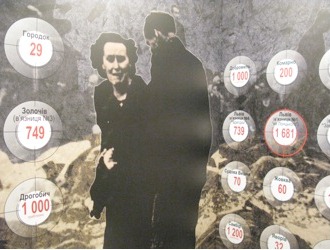
AT THE LONSKY MUSEUM: JEWISH HOLOCAUST VICTIMS PHOTOSHOPPED OUT. A woman has just recognized a loved one among the victims of the NKVD killings in 1941. In the background of the original photo one also sees groups of Jewish victims of the massacre which followed within days of the NKVD murders (Jews were forced to carry and rebury these victims). Thousands of Jews were killed as Soviet crimes were blamed on them and used to incite antisemitic violence and murder. In this photoshopped version on display at the Lonsky Museum, the nationalists’ Jewish civilian victims are literally covered by the circular insertions of Soviet crime statistics, implicitly ethniziced as Ukrainian suffering.
◊
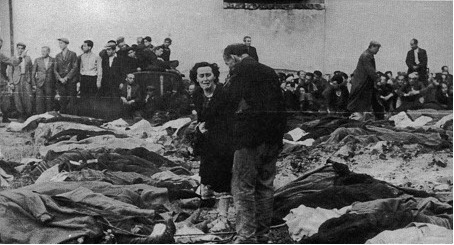
The original image, before photoshopping at the Lonsky…
The lecture tour includes some of the most prestigious universities in Canada — the universities of Alberta, Toronto, Manitoba, Saskatchewan, and Ottawa — as well as Harvard University’s Ukrainian Studies Institute in the United States. The lectures in Alberta and Toronto are facilitated by the Canadian Institute of Ukrainian Studies; the Peter Jacyk Program for the Study of Ukraine; the Centre for European, Russian and Eurasian Studies; the Harvard Institute of Ukrainian Studies and its Chair of Ukrainian Studies.
Posted in Antisemitism & Bias, Bandera, Canada, Collaborators Glorified, Events, Free Speech & Democracy, Museums, News & Views, Opinion, Per Anders Rudling, Politics of Memory, Ukraine
Tagged Askold Lozynskyj, Harvard University Ukrainian Studies Institute, Lonsky Museum in Lviv (Ukraine), Per Anders Rudling, Ruslan Zabily, Stepan Bandera, Ukrainian ultranationalism in Cnada
Comments Off on Ukrainian Ultranationalists Sponsor Lecture Tour Across North American Universities
Efraim Zuroff Comments on Facebook on Next Tuesday’s Zingeris Event at Yivo in New York City
Efraim Zuroff, the Holocaust historian, Nazi-hunter and author, today posted the following message on his Facebook page. It is reproduced here with the permission of Dr. Zuroff, who is director of the Simon Wiesenthal Center Israel office and its Operation Last Chance. For more on the alleged US embassy (Vilnius) blackballing of Dr. Zuroff from an international 2011 summer program in Vilnius see here. Background to the Yivo event: see Milan Chersonski’s article.

-
This is a call for action to those in the NYC area. This coming Tuesday, October 16 at 7 PM, YIVO is hosting an evening at the Center for Jewish History at 15 West 16th St. entitled “Reclaiming The Jewish Narrative in Lithuania Today.” The problem is that the featured guests are all supporters of the Lithuanian government’s efforts to promote the canard of equivalency between Communist and Nazi crimes and are minimizing the huge role of Lithuanians in the mass murder of Lithuanian Jews. Anyone able to go and confront Markas Zingeris, the Lithuanian PM’s advisor on genocide, and former US ambassador to Lithuania Anne Derse whose embassy blackballed my participation in a seminar on Lithuanian Jewish history at the request of the Lithuanian authorities, will be doing a big mitzva!!!
Posted in "Jewish" Events as Cover?, Double Genocide: The New Form of Holocaust Revisionism & Denial, Efraim Zuroff, Events, Free Speech & Democracy, Litvak Affairs, News & Views, Opinion, Politics of Memory
Tagged Anne Derse, Center for Jewish History, Efraim Zuroff, Markas Zingeris, Yivo, Yivo Lithuania
Comments Off on Efraim Zuroff Comments on Facebook on Next Tuesday’s Zingeris Event at Yivo in New York City
Summary Coverage on Monument in Bauska to Honor Waffen SS (updated to 12 Oct 2012)
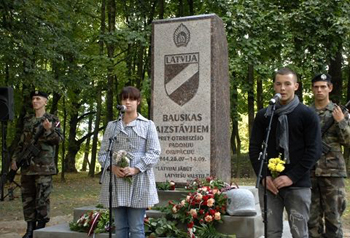
REPORT. HEAD OF JEWISH COMMUNITIES ISSUES PROTEST. SWC COMMENTS. FATE OF EFFORTS TO ERECT A MEMORIAL TO THE TOWN’S ANNIHILATED JEWISH POPULATION.
SEE ALSO:
LATVIA SECTION
MONICA LOWENBERG’S INTERNATIONAL PETITION & BLOG ON THE WAFFEN SS PARADES IN RIGA; MAINSTREAM UK LINKS WITH LATVIAN FAR RIGHT
Posted in Collaborators Glorified, Latvia, News & Views
Comments Off on Summary Coverage on Monument in Bauska to Honor Waffen SS (updated to 12 Oct 2012)
Canadian Missile Lands in Sweden
The following is the letter dated 5 October signed by a number of leading figures of Ukrainian nationalist groups in Canada and sent to the vice-chancellor of Lund University in Sweden complaining about the opinions voiced by postdoctoral fellow Per Anders Rudling, a prominent young historian. [Updates: Dr. Rudling’s DefendingHistory.com article on the subject is here; an open letter from scholars supporting him is here.]
Posted in Canada, Documents, News & Views, Per Anders Rudling, Politics of Memory, Sweden, Ukraine
Tagged Per Anders Rudling
Comments Off on Canadian Missile Lands in Sweden
Is this Really What You Want To Do, Mr. Executive Director of Yivo?
O P I N I O N
by Milan Chersonski
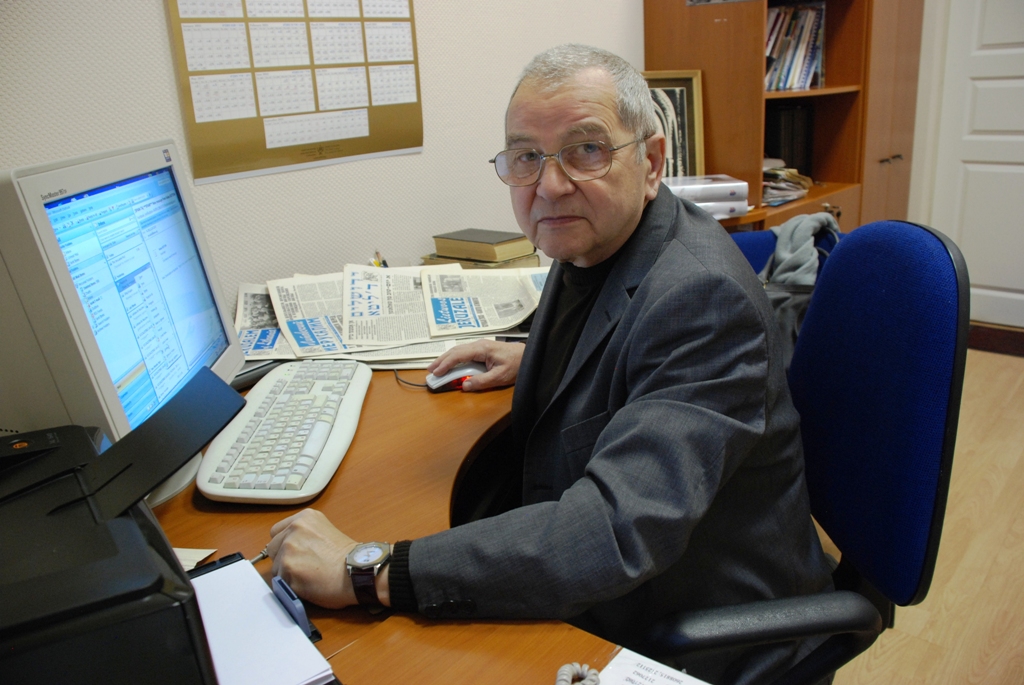 Milan Chersonski (Chersonskij), longtime editor (1999-2011) of Jerusalem of Lithuania, quadrilingual (English-Lithuanian-Russian-Yiddish) newspaper of the Jewish Community of Lithuania, was previously (1979-1999) director of the Yiddish Folk Theater of Lithuania, which in Soviet times was the USSR’s only Yiddish amateur theater company. The views he expresses in DefendingHistory are his own. This is an authorized English version (updated by the author) by Ludmilla Makedonskaya (Los Angeles). Russian original.
Photo: Milan Chersonski at this desk at the Jewish Community of Lithuania (image © 2012 Jurgita Kunigiškytė). Milan Chersonski section.
Dear Mr. Jonathan Brent,
A little over a year ago, on 12 September 2011, I wrote my first open letter to you. I wrote that it is inappropriate to hold an event commemorating the Jews of Vilna who were victims of genocide together with the minister of foreign affairs of the Republic of Lithuania Audronis Ažubalis on the premises of Yivo. If you did not then find time to read my letter, you can find it now online.
Posted in "Jewish" Events as Cover?, A 21st Century Campaign Against Lithuanian Holocaust Survivors?, Bold Citizens Speak Out, Double Games, In the Era of Yivo's 100th, Litvak Affairs, Milan Chersonski (1937-2021), News & Views, Opinion, Yiddish Affairs
Tagged Anbassador Anne E. Derse, Anne Derse + Lithuania + Jewish issues, Emanuelis Zingeris, Jerusalem of Lithuania, Jewish Community of Lithuania, Jonathan Brent, Markas Zingeris, Milan Chersonski, YIVO + far right Lithuanian politics, Yivo + Jonathan Brent + Zingeris + Anne Derse, YIVO Fall 2012 program of events, YIVO lecture series at the CJH
Comments Off on Is this Really What You Want To Do, Mr. Executive Director of Yivo?
Samples of the Work of a Holocaust-Twisting, Antisemitic, Homophobic Envelope Designer
The following are among the envelopes designed by Antanas Šakalys who continues to be honored by his (other) works being exhibited at both Vilnius University and the Central Post Office in the Lithuanian capital. Details and further links.
These samples are categorized as follows:
1. Holocaust Distortion/Inversion (blaming of victims, honoring of perpetrators, defamation of historians).
2. Antisemitism.
3. Homophobia and Assault on Equal Rights.
4. Defamation of Lithuanian personalities who call for tolerance.
◊
Holocaust Distortion/Inversion (blaming of victims, honoring of perpetrators, defamation of historians)
Posted in Antisemitism & Bias, Bloomington-Borns Program Manipulated?, Collaborators Glorified, Documents, Human Rights, LGBTQ Equal Rights, Lithuania, News & Views, Politics of Memory, Russian Speakers' Personal Status
Comments Off on Samples of the Work of a Holocaust-Twisting, Antisemitic, Homophobic Envelope Designer
Updates on the Šakalys Scandal: Central Post Office Website Still Features Biased Envelope-Maker
As of today, both Vilnius University and the Central Post Office are still featuring the “historic envelope art” of designer Antanas Šakalys, though neither of the prestigious venues publicly includes any samples of his antisemitic, Holocaust-distorting and homophobic output.
Posted in Antisemitism & Bias, Bloomington-Borns Program Manipulated?, LGBTQ Equal Rights, News & Views
Comments Off on Updates on the Šakalys Scandal: Central Post Office Website Still Features Biased Envelope-Maker
Lithuanian Translation of the 25 September 2012 Letter from Congressmen Sherman, Wachman, Berman to the Prime Minister of Lithuania
The following is a translation into Lithuanian of the letter signed by US congressmen Brad Sherman, Henry Wachman and Howard Berman on 25 September 2012. English original is here. Published Russian translation. Both translations were provided by Jacob Piliansky (Vilnius).
- JAV Kongresas
- Vašingtonas
- Rugsėjo 25, 2012
Gerbiamasis, Ministre Pirmininke Kubiliau
Posted in Collaborators Glorified, Lithuania, News & Views, Politics of Memory, September 23rd Commemorations, United States
Comments Off on Lithuanian Translation of the 25 September 2012 Letter from Congressmen Sherman, Wachman, Berman to the Prime Minister of Lithuania
Antisemitic Campaign Advertisements in Lithuanian Parliamentary Elections
A number of antisemitic and fascist-sympathizing ads have recently appeared in the course of the campaign for the Lithuanian parliamentary elections to be held in two rounds on 14 and 28 October 2012.
UPDATE: JTA
It does not help that public swastikas were legalized in Lithuania in 2010. That year a group of ambassadors in Vilnius got toegether to write a letter to the nation’s leaders on various Jewish and Holocaust issues, including the swastika issue. The United Nations Human Rights Committee finally commented this year on the attempted rehabilitation of the swastika.
One parliamentary candidate’s campaign uses a photo of him sporting a swastika-decorated tie. Another is a vulgar caricature of a Jew getting money from the state and threatening to take more (a reference to this year’s restitution bill providing communal compensation for confiscated property). A third expresses the wish for a “Third Republic” state with a Nazi-like logo.
Posted in Antisemitism & Bias, News & Views, Swastikas in Lithuania
Comments Off on Antisemitic Campaign Advertisements in Lithuanian Parliamentary Elections
Dr. Per Anders Rudling’s Email to Colleagues of 3 October 2012 Concerning the Zabily Speaking Tour In North America
The following is the text of the email which Dr. Per Anders Rudling circulated to colleagues today on the subject of Ruslan Zabily’s planned North American lecture tour, including engagements at top universities and a meeting with the prime minister of Canada.
3 October 2012 16:03:03 CEST Dear Colleagues,
Posted in Bandera, Canada, Documents, Museums, News & Views, Opinion, Per Anders Rudling, Politics of Memory, Sweden
Tagged Per Anders Rudling
Comments Off on Dr. Per Anders Rudling’s Email to Colleagues of 3 October 2012 Concerning the Zabily Speaking Tour In North America
A “New” Postcard, Featuring Antisemitic Distortion of the 1941 Lietukis Garage Massacre, Comes to Light as Vilnius University Calls the Envelope-Maker “Humanistic”
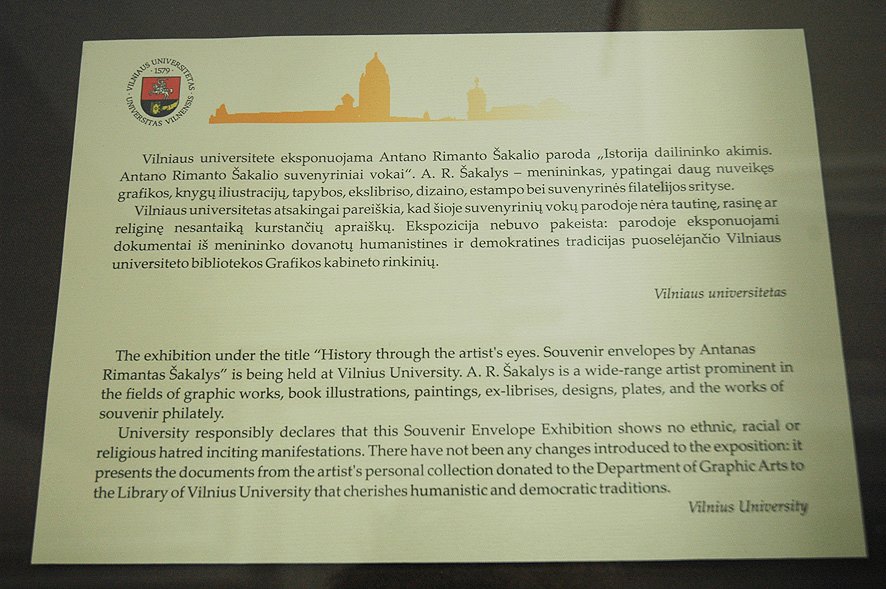
Just as Vilnius University put up a sign in Lithuanan and English, defending as “humanistic” its exhibition of a collection of envelopes by the antisemitic and homophobic designer Antanas Šakalys, the VU employee who had first provided the offensive images to DefendingHistory, which we published on 21 September 2012, provided another, at 2PM today, to coincide with the time of the scheduled gala opening of the exhibition, cancelled after our article and the 25 Septenber Delfi.lt report by Eglė Samoškaitė. The 2PM slot was then symbolically taken up at the university by a group of nine dauntless protesters against the glorification of an antisemitic and homophobic designer.
Ironically the envelope released today, a production of the same designer, also refers to “humanism”…
Posted in Antisemitism & Bias, Collaborators Glorified, Double Genocide: The New Form of Holocaust Revisionism & Denial, News & Views, Politics of Memory, Symbology
Comments Off on A “New” Postcard, Featuring Antisemitic Distortion of the 1941 Lietukis Garage Massacre, Comes to Light as Vilnius University Calls the Envelope-Maker “Humanistic”
Vilnius University Calls Antisemitic, Racist, Homophobic Artist “Humanistic” as 9 Young Lithuanians Protest; Yiddish Institute, US Backers, Bloomington-Borns — All Silent
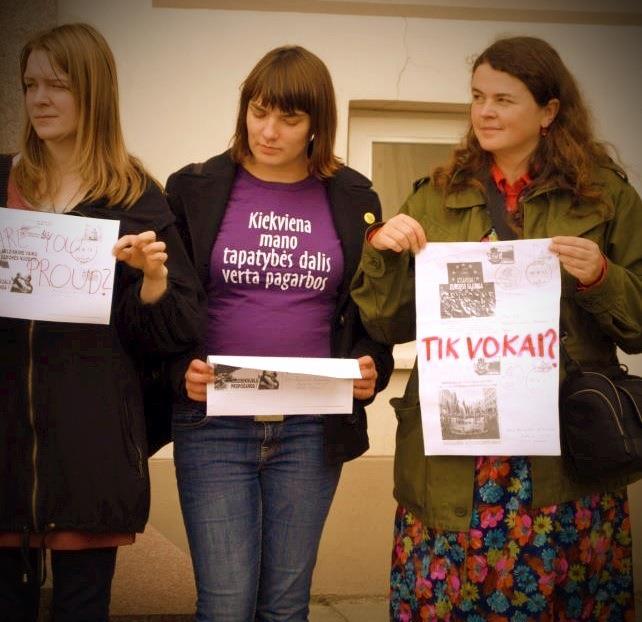
Left to right: Sigita Rukšėnaitė, Anna Shepherd, Fiokla Kiure. Sign at right asks: “Just Envelopes?”
A dedicated Facebook page provides facts and photos on today’s dignified and courageous demonstration by a small group of young Lithuanian human rights advocates against Vilnius University’s proceeding with an exhibition of an envelope designer whose work features flagrant antisemitic, homophobic and racist material (larger selection here).
Fiokla Kiure’s images of the event are available here; a small selection follows this article.
BACKGROUND:
Earlier report (21 Sept)
Delfi.lt report by Eglė Samoškaitė (25 Sept) [English here]
A dozen samples of the envelope maker’s works
Revelation of an additional “humanistic” envelope by the same designer (27 Sept)
For years this artist’s antisemitic envelopes were on sale at the Main Post Office; the Jewish community’s newspaper exposed them in the June 2008 issue of Jerusalem of Lithuania.
Posted in Antisemitism & Bias, Bloomington-Borns Program Manipulated?, LGBTQ Equal Rights, Lithuania, News & Views, Opinion, Racism, Richard Maullin, Russian Speakers' Personal Status, Vilnius Yiddish Institute, Yiddish Affairs
Tagged Anna Shepherd, Antanas Sakalys, Antisemitism in Lithuania, Dan Opatoshu, Daniel Berg, Fairbank Maslin, FM3, homophobia in Lithuania, Richard Maullin, Tina Lunson, Vilnius University, Vilnius University Library, Vilnius Yiddish Institute, Vilnius Yiddish Summer Program
Comments Off on Vilnius University Calls Antisemitic, Racist, Homophobic Artist “Humanistic” as 9 Young Lithuanians Protest; Yiddish Institute, US Backers, Bloomington-Borns — All Silent
Yad Vashem Sinking Deeper in Lithuanian “Commission” Morass with Political Campaign for Compensation from Russia
The polite fiction that the renewed Lithuanian state sponsored “Red-Brown Commission” will advance Holocaust research and research on Soviet crimes strictly at the academic and educational levels took a big hit today, before even its first meetings.
A BNS report released today confirms that the Commission, officially known as The International Commission for the Evaluation of the Crimes of the Nazi and Soviet Occupation Regimes in Lithuania, is one of the bodies that will be involved with demanding compensation from Russia for Soviet crimes against Lithuania.
Posted in "Red-Brown Commission", Double Games, Israel, News & Views, Politics of Memory, Yad Vashem and Lithuania
Comments Off on Yad Vashem Sinking Deeper in Lithuanian “Commission” Morass with Political Campaign for Compensation from Russia