The Seventy Years Declaration
on the Anniversary of the Final Solution Conference at Wannsee


Andrius Navickas, a religious studies expert and editor-in-chief of the Bernardinai.lt website, published a rather strange editorial at the end of 2011 taken from a speech he gave over Lithuanian Radio.
The campaign to distort World War II history in the direction of East European far-right models and to glorify local Nazi collaborators and perpetrators continues apace.
Bernardinai.lt, usually a bastion of tolerance and resistance against racism and ultranationalism, today published without comment a press release from the Lithuanian Ministry of Defense verbatim, about yesterday’s ministry activities honoring the Nazi-collaborating Lithuanian Activist Front (LAF), on the occasion of an anniversary of the killing of some of its leaders and members by Soviet forces.
The Vilna Ghetto memoir of Rozka Korczak-Marlé (1921–1988) is unfortunately completely unknown to Lithuanians today. I have therefore decided to translate the book into Lithuanian (from the Russian edition that Korczak herself edited), and have published two samples, here and here, on Anarchija.lt.
Suspense is growing in the Lithuanian capital, Vilnius, concerning the verdict in the free speech trial of the flamboyant, controversial young left-wing politician, Algirdas Paleckis. The court’s ruling will be read from the bench next Wednesday 14 December 2011 at 2 PM at the First District Court at Laisves 79, Vilnius. The charge carries a possible one-year prison sentence if Mr. Paleckis is found guilty. A press release was received today from the Lithuania Without Nazism organization (not to be confused with the ‘secret’ internet group ‘Lithuania Without Neo-Nazism’, that some believe to be a manipulated group, somewhat sophomoric, or both).
◊
Not for the first time, two fine historians have published in the same year their very different syntheses for the wider public, on the same topic, and based largely o known published sources, both having long proven their mettle as master researchers in previous publications rooted in archives and primary documents. On this occasion the resulting contrast is unusually startling. One of these books, Alexander Prusin’s The Lands Between, is a meticulously balanced and historically authoritative, but conventional and somewhat lackluster history that will appeal to lecturers looking for a solid textbook on twentieth-century East European history and, of course, history buffs ever fascinated by the Second World War.
Timothy Snyder’s Bloodlands, by contrast, is the work of a literary master who has what it takes to write a thriller. Deservedly, his book has captured the imagination of vast numbers of readers and pundits alike. It is also the work of a humanistic thinker who does not beat around the bush and has – very justifiably – made willful state mass murder his topic, leading him to grapple with murder en masse, a forever captivating topic, all the more so within the Hitler–Stalin complex of issues that continue to fascinate, daunt and rebound potently in today’s geopolitics.
Yet Snyder’s Bloodlands suffers from some cardinal biases that are all the more regrettable in such a masterly and popular work. First, though, it is prudent to briefly cover the book’s scope and at least a few of its highly consequential virtues.
◊
Such historical issues as Stalin’s policies of mass murder and activities of the Organization of Ukrainian Nationalists (OUN) and the Ukrainian Insurgent Army (UPA), attract a great deal of the media coverage in contemporary Ukraine. However, the media reporting on these issues is often politically biased, and it even involves a self-imposed censorship concerning the involvement of the OUN and the UPA in Nazi genocide.
Although not seeking to deny the Holocaust, the ultimate consequence of the movement to redefine genocide is the equalization of National Socialist and Soviet crimes. The characterization of Soviet crimes as genocide is a misrepresentation that hinders authentic remembrance of the Holocaust in Lithuania by helping to obscure the extent and nature of Lithuanian complicity in the killings of the local Jewish population.
The idea that the crimes of Hitler and successive Soviet regimes are in fact equal has been a growing force behind public discourse on the Holocaust since the formulation of the national Holocaust and Genocide Education Program at the sixth meeting of The International Commission for the Evaluation of the Crimes of the Nazi and Soviet Occupation Regimes in Lithuania in June 2002.
A Genocide Museum on ground zero of the Holocaust in Eastern Europe that does not mention the Holocaust,
Or
One that, more than a year after being exposed in this journal in the summer of 2010, and a confluence of international pressures, has added, in October 2011, a single solitary cell in the basement, unannounced on the main floor, that distorts the Lithuanian Holocaust and actually glorifies (as ‘rebels’) the local killers who unleashed the Holocaust in the country, while failing to mention their Holocaust role in an exhibit on the Holocaust?
You decide. . .
The 2010 anthology Strasti za Banderoju (Bandera Passion, alternate translations include Bandera Ecstasy or Bandera-mania), edited by Tarik Syril Amar, Ihor Balyns’kyi and Iaroslav Hrytsak, assembles key contributions to three debates conducted in the years 2009-2010 around the person of Stepan Bandera, leader of the main wing of the Organization of Ukrainian Nationalists (OUN).
The first debate, staged on an Internet platform in L’viv in 2009, was occasioned by Bandera’s 100th birthday and the 50th anniversary of his assassination. It was followed in 2010 by another round triggered by then-Ukrainian president Viktor Iushchenko’s decision to convey upon Bandera the title Hero of Ukraine. The editors divided that second round into two parts: the debate conducted in Ukraine and the debate conducted in North America.
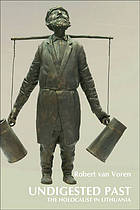 A few friends asked me if I could attend a book presentation in Kaunas, since they couldn’t make it. The book is called Undigested Past: The Holocaust in Lithuania by Robert van Voren. It was published in English first as part of a series by the Rodopi publishing house on Eastern Europe. I’d never heard of van Voren, but people told me he was known for his books on psychiatric abuses in the Soviet Union. The poster for the event proclaimed boldly in Lithuanian that the conference’s official language would be English, which made me smirk, but an English-language version of the poster became available on the morning of the event.
The governing establishments in Eastern European states sometimes produce red-brown symbols as part of the wider campaign to give the notion of red-brown equality an aura of official sanctioned status. The effects are obvious: People are being desensitized to the swastika, Soviet symbols are ‘artistically’ (i.e. via political kitsch) recombinated into the new Dual Equal Evil symbols making the revisionist history ‘true’. Severe pain is caused to families of Holocaust Survivors and anti-Nazi Soviet war veterans alike. The continued silence of the European Union, the OSCE and NATO encourages the drift toward the far right, which includes clean-up of the image of Nazi collaborators in elite circles, and glorification of Nazi symbols in more uncouth environments.
According to a recent report on Delfi.lt, Lithuanian MP Gintaras Songaila, who has expressed support for the neo-Nazi marches through central Vilnius on Lithuania’s Independence Day, has recently begun disseminating a brochure to his fellow Lithuanian parliamentarians about alleged Polish atrocities against Lithuanians from before and during World War II. The brochure is based on a book by Algimantas Liekis called Black Pages in Lithuanian History.
Iurii Andrukhovych complains in an article published in Gazeta Wyborcza about the sorry state of Polish-Ukrainian relations. He correctly informs readers that in the last ten years Polish-Ukrainian relations, in particular concerning contentious World War II questions, have not improved at all and “if something has changed then perhaps only for the worse”. Yet Andrukhovych’s solution to the problem would be to republish Paweł Smoleński’s collections of essays Pochówek dla rezuna (“Burial of a Butcher”) which, like Andrukhovych in his article, looks for solutions in the revision of stereotypes while ignoring the actual historical causes of current problems.
David Silberman was born in Latvia in 1934. As a Jew of young age when the war came upon his country of birth, he was fated to die.1 Because, when the Germans conquered Latvia in June and July 1941, spontaneous as well as induced pogroms developed in different parts of the country with thousands of Jewish victims. Then, as early as July and August 1941 ― in bloody actions by Einsatzgruppe A as well as by autonomous Latvian self-proclaimed guardians ― the Jews began systematically to be killed, even long before the decision of the “Endlösung” (Final Solution) of the “Jewish problem” had finally been taken in Berlin.2
♦
♦
16 Dec 2010; 20 Jan 2011; 28 April 2011; 3 May 2011; 5 May 2011
O P I N I O N
by Dovid Katz
There is actually a larger issue, and a constructive lesson, that emerges from Alexander Gogun’s reply to Grzegorz Rossoliński-Liebe’s critique of an earlier article co-authored by Gogun, that had appeared on a Ukrainian nationalist website that tends to glorify various Nazi-collaborationist nationalist groups and underplay or ignore their participation in genocide. Tellingly, that issue does not even relate to differences of opinion on any one point of fact, interpretation or analysis. Historians and academics will naturally disagree and from time to time and hasten to correct each other on this or that detail.
In a letter to the editor of today’s edition of the mainstream daily Vakaro žinios (Evening News), three organizations, including the mainstream Sąjūdis, write to complain that the state has not done enough in 2011 to commemorate the 1941 fascist collaborators (including the Lithuanian Activist Front or LAF ‘white-armbanders’), who unleashed the Lithuanian Holocaust, killing Jewish neighbors in dozens of locations before the Germans ever arrived. Many were then recruited for the Germans’ organized killing squads. The organizations signing the letter clearly regard them as national heroes and ‘insurgents’.
The letter to the editor is available online (English translation here).
An emotional review[1] written by the PhD candidate Grzegorz Rossoliński-Liebe and published in this journal, is devoted to a popular scientific article written by me in collaboration with Olexandr Vovk. Our text about the presence of Jews in the UPA (Ukrainian Insurgent Army) was written seven years ago and published more than six years ago by the Moscow Jewish magazine Korni (“Roots”)[2]. It was later reproduced on an amateur history website about Ukrainian nationalism.