


OPINION | POLITICS OF MEMORY | BELGIUM | LITHUANIA
◊
by Roland Binet (De Panne, Belgium)
◊
In chapter five of his major book on the Holocaust in Lithuania published last year, Professor Saulius Sužiedėlis discusses theatrical productions that Jakob Gens had proposed to introduce into the Vilna Ghetto at the end of 1941. Here are some quotes: “Kruk reacted with disgust (…) Members of the Bund announced a boycott and leaflets were distributed stating “You don’t make theater in a graveyard”.
I do not share the opinion that theatre should not have been played in the ghettos. On the contrary, to me, the sometimes vivid cultural life in the ghettos under Nazi and collaborators’ rule, in all its hues and colors, had undoubtedly been a bonding link, a source of some kind of normalcy and hope for the persecuted Jews, and a necessary psychological rampart against fear, boredom, stress, anguish, that all inhabitants of these hells on earth had to go through during days, weeks, months, sometimes years, perpetually living in the mortal fear for one’s life perhaps extinguished from one moment to the next or after a lengthy walk to a killing pit, naked, alone, forlorn.
After the initial awe that greeted the end of the war and the news slowly seeping into consciousness that there had been death factories erected by the Nazis in Poland where millions of Jews had been slaughtered, and that in the former Soviet republics that there had been Nazi mobile units of different types but of the same lethal determination to erase all Jewish lives, the peoples of Europe began to realize the scope of the annihilation of the European Jews. That is the people of Western Europe. In the former and the new Soviet republics, a veil of silence had been draped upon the fate of the Jews during the war. Yes, in the Soviet telling there had been Jewish victims of the war, but they had not perished as Jews but as Soviet citizens. And, thinking otherwise was tantamount to a crime under Stalin.
One would think that such an inhuman endeavor as erasing a whole stratum of peoples – in this case, chiefly, the Jews of Europe – would have made it imperative, primordial and compelling to all nations of Europe to dearly preserve sacred the memory of the victims, the sacred memory of places, terrains, ravines, forests, where thousands – sometimes hundreds of thousands – of Jews had been killed in the most barbaric fashion by a nation that may have boasted of the most illustrious names in sciences, philosophy, medicine, literature and poetry, classical and opera music, a nation that in its collective enthusiasm had adored a madman they called their Führer.
Then, after the war and the knowledge of the abominable crimes carried out by the Germans in his name, that nation had in a collective endearing ensemble exclaimed “Wir haben es nicht gewusst!” A nation that had nurtured in its collective bosom ordinary men, fathers, uncles, sons, who had suddenly and very professionally become murderers primarily of Jews, but also of other peoples declared enemies by their beloved Führer. Some of the murderers had even reveled in the slaughters and mental and physical torture they had inflected on innocent civilians, Jews and others from other nations. And, they too, the murderers, when later brought to account or to trial had exclaimed “Ich habe es nicht gewusst” or as in the case of Eichmann “Ich führte Befehle aus”. In his excellent book in French “Einsatzgruppen,” Michaël Prazan quotes a member of the Einsatzkommando 4a, Kurt Werner, who had been active in Babi Yar: “You cannot imagine the nerves you had to have, below [in the ravine], to do that awful job.” Should we have felt pity or sympathy for such creatures, normal German citizens turned military who – according to various historians – could at any time have refused that kind of “job” without sanction?
Let me take two exemplary cases in point of political decisions pertaining to sacred places that smack of utter neglect and contempt for the Jewish victims of the Holocaust and the duty of memory, one in Belgium, the other relating to more recent events in Lithuania.
Belgium: During the war: 70,000 Jews were living in Belgium, a third of them perhaps as Belgian citizens when the country was invaded by Germany on May 10, 1940. After the Nazis’ victory, the country came under military rule. The Belgian king remained in the country but the government had fled and taken refuge in London. Belgium was administered by the Wehrmacht military power and on the administrative level there had been a collegium of “general administrators” from different ministries ruling Belgium in the absence of the legal ministers. Of course, representatives of the SD and RSHA came to Belgium and after a certain period of relative quiet, measures against the Jews were taken as in neighboring countries. Then, starting in 1942 the arrests began and later the deportations to Auschwitz-Birkenau.
In Belgium, the arrests of Jews were mostly carried out during the night, by Nazis, sometimes with the help of the local police (Antwerp, Liège, etc.), sometimes also with the help of local collaborators, Flames (Flemings) and Walloons. All arrested Jews were then brought to a Sammelpunkt, i.e. the Dossin Kazerne (barracks) in Mechelen, a city situated between Brussels and Antwerp, convenient as most Jews had lived in one or the other of these two important cities. There have been no photos taken of roundups of Jews (there is one existing picture but without much to see, it is of a truck and some people around it), and there has only been one photo of the interior courtyard of the Dossin Kazerne. “Between July 1942 and September 1944, 25,482 Jews and 352 Gypsies were assembled and transported to Auschwitz-Birkenau, in 26 transports. 1,395 survived” (source: “De Nazi Moord Fabrieken” by Ton Roozeboom – de Lantaarn B.V., 2017).
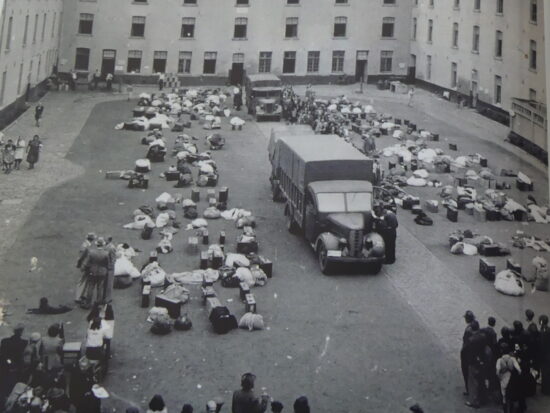
Interior courtyard of the Dossin Kazerne during World War II
In Belgium, and more importantly in Flanders, the spirit of Kafka is still present. The Dossin Kazerne was actually used as military barracks till 1976, the buildings falling into disrepair over the years. Finally, the city of Mechelen had toyed with the idea of having the Dossin Kazerne broken up. In the end, a wonderful idea was brought forth: the site where more than 25,000 Jews and Gypsies spent their last days in Belgium was transformed into a complex of apartments.
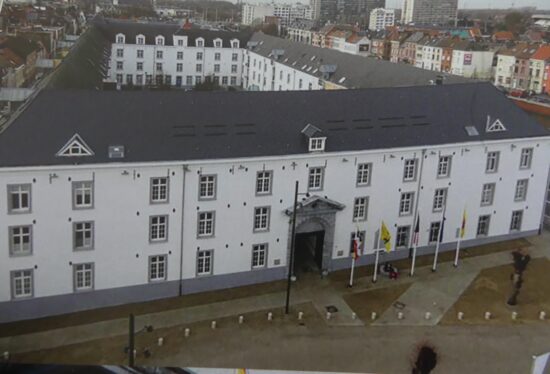
The new housing development at the Dossin Kazerne
The front of the building was preserved as an introductory part of a museum to the slain Jews built in fact on the other side of the street (source: De Kampen by Annemie Reyntjens, Borgerhoff & Lamberigts). Two pictures, from Ton Roozeboom’s book illustrate the schizoid legacy of that memory of the Holocaust in Belgium. It also illustrates that popular French expression “Loin des yeux, loin du cœur”: Far from sight, far from the heart.
◊
Is it better on the other side of the former Iron Curtain?
On the one hand, in some countries beyond the old Iron Curtain where there had been heavy collaboration with the Nazis a hero-cult has developed around well-known collaborators still honored nowadays by statues, plaques, street names and prudish albeit not too unfavorable mentions even in serious and well-researched history books.
Lithuania: The latest odious cases in point in Lithuania also seem to prove that adage “Loin des yeux, loin du cœur”. There too, in Lithuania, as has been the case with the Dossin Kazerne in Mechelen, the mere idea of building a national convention center out of a Soviet building in the middle of the Old Vilna Jewish Cemetery, or the feared destruction of the remnants of the last Jewish partisan fort of the Vilna Ghetto’s Jewish resistance due to the arrival of a German NATO unit which will quarter its troops in that area, strikes me as a form of political amnesia that – frankly – reeks of a certain hue of antisemitism and a basic lack of respect towards the Jewish victims of the war.
It seems that in present Lithuania, you “make theatre in a graveyard”.
How can we reconcile the idea that Lithuania alongside other countries mainly from beyond the Iron Curtain, strongly supports the idea of erecting a monument to the victims of Communism and Nazism together in Brussels, near the headquarters of the European Commission while simultaneously trying to erase some of the remaining traces of Jewish life or Jewish war memory back home in Eastern Europe?
This I call “schizoid” and it is a sickness of the mind. Of the political mind.