


DOCUMENTS | OLD VILNA JEWISH CEMETERY AT PIRAMÓNT: SAGA OF 2015-2026 | EARLIER OPPOSITION TO CONVENTION CENTER PROJECT | COMMENT BY ANDRIUS KULIKAUSKAS, SID LEIMAN, JULIUS NORWILLA, DOVID KATZ | 2023-2024 “WORKING GROUP” ON VILNA CEMETERY | LIST OF MEMBERS | MOUNTING OPPOSITION TO “COMPROMISE’ MUSEUM PROJECT” | THE USCPAHA | THE CPJCE | THE AJC | THE CER | THE GWF | CEMETERIES & MASS GRAVES | CHRISTIAN-JEWISH RELATIONS | HUMAN RIGHTS
◊
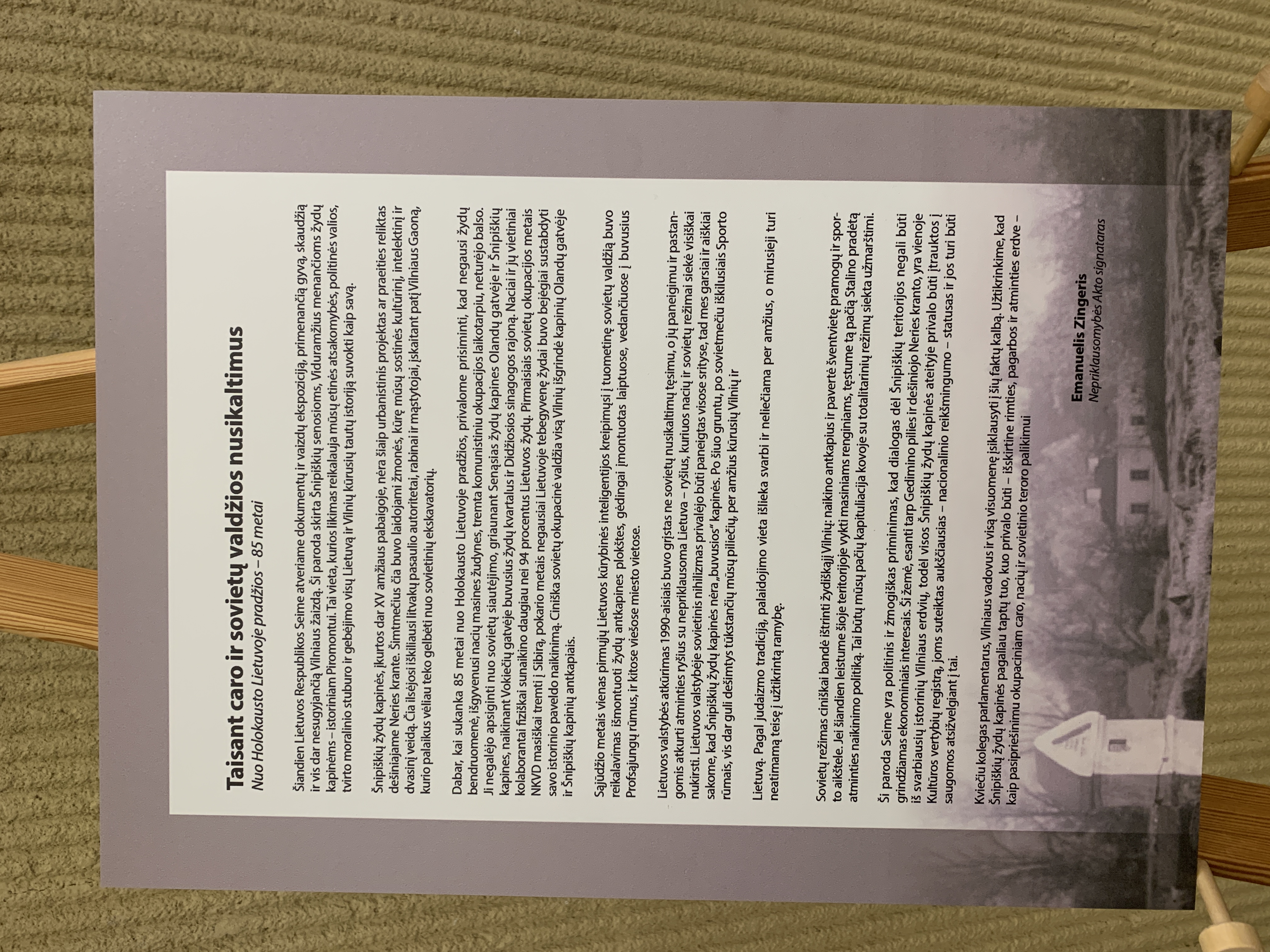
Editor’s note: The following is an English translation of the 3rd of the 18 exhibits featured in the current Seimas exhibition “The Jewish Cemetery in Šnipiškės, Vilnius” in the Stained Glass Gallery of the Seimas, Lithuania’s Parliament (The original Lithuanian panel is online). The exhibition, running from 17 to 24 September, is being presented under the auspices of Member of Parliament Emanuelis Zingeris whose own statement appears here (Lithunian original).The exhibition was prepared by Artūras Imbrasas together with the association Gerbkime kapines (“Respect Cemeteries”). The creative team also includesd the association’s chair, Rūta Bloštein, as well as Arkadij Kurliandčik, Andrius Kulikauskas and Edmundas Kulikauskas. The original Lithuanian statement posted at the exhibition is available online.
◊
Redressing the Crimes of Tsarist and Soviet Rule
85 Years Since the Beginning of the Holocaust in Lithuania
Today, in the Seimas of the Republic of Lithuania, we open an exhibition of documents and images recalling a living, painful wound in Vilnius that has yet to heal. The exhibition is dedicated to the old Jewish cemetery in Šnipiškės, dating back to the Middle Ages — historic Piramónt. The fate of this place demands our ethical responsibility, political will, moral resolve and an ability to regard the history of all the peoples who built Lithuania and Vilnius as our own.
The Šnipiškės Jewish Cemetery, established as early as the end of the 15th century, is not merely an urban site or a relic of the past on the right bank of the Neris. For centuries, people who shaped the cultural, intellectual and spiritual character of our capital were buried here. Among those who rested here were some of the foremost authorities, rabbis and thinkers of the Litvak world, including the Vilna Gaon himself, whose remains later had to be rescued from Soviet excavators.
Now, as we mark 85 years since the beginning of the Holocaust in Lithuania, we must remember that the small Jewish community that survived the Nazi mass killings had no voice under the subsequent Communist occupation and deportations. It could not defend itself against the Soviet campaign of destruction: the demolition of the Old Jewish Cemetery on Olandų Street and the Šnipiškės cemetery, the destruction of the Jewish quarters on Vokiečių Street and the area around the Great Synagogue.
The Nazis and their local collaborators physically annihilated more than 94 percent of Lithuania’s Jews. During the first years of Soviet occupation, the NKVD carried out mass deportations to Siberia, and in the postwar years the few Jews who remained in Lithuania were powerless to prevent the destruction of their historic heritage. The cynical Soviet occupation authorities paved Vilnius with gravestones taken from the Olandų Street and Šnipiškės cemeteries.
During the years of Sąjūdis, one of the first appeals by members of Lithuania’s creative intelligentsia to the Soviet authorities of the day called for the removal of Jewish gravestones that had been shamefully incorporated into the steps leading to the former Trade Union Palace and into other public places around the city.
The restoration of the Lithuanian state in 1990 was founded not on the continuation of Soviet crimes, but on their repudiation and on efforts to restore the bonds of memory with independent Lithuania — bonds that the Nazi and Soviet regimes had sought to sever completely. In the restored Lithuanian state, Soviet nihilism had to be rejected in every sphere. That is why we say loudly and clearly that the Šnipiškės Jewish Cemetery is not a “former” cemetery. Beneath this ground, beneath the Sports Palace erected during the Soviet era, still lie tens of thousands of our fellow citizens who, over the centuries, helped build Vilnius and Lithuania.
According to Jewish tradition, a burial place remains sacred and inviolable for all time, and the dead have an inalienable right to rest undisturbed.
The Soviet regime cynically sought to erase Jewish Vilnius: it destroyed gravestones and turned a sacred site into a place for entertainment and sports. If we were to permit mass events to take place on this territory today, we would be continuing the same policy of destroying memory begun under Stalin. It would amount to our own capitulation in the struggle against the oblivion sought by totalitarian regimes.
This exhibition in the Seimas is both a political and a human reminder that the dialogue over the future of Šnipiškės cannot be driven by economic interests. This land, situated between Gediminas Castle and the right bank of the Neris, occupies one of Vilnius’s most important historic spaces. The entire Šnipiškės Jewish Cemetery must therefore be entered in the Register of Cultural Properties, granted the highest status — that of national significance — and protected accordingly.
I call on my fellow parliamentarians, the leaders of Vilnius and the public as a whole to listen to what these facts tell us. Let us ensure that the Šnipiškės Jewish Cemetery at last becomes what it must be: an exceptional place of solemnity, respect and remembrance — a repudiation of the legacy of occupation and of tsarist, Nazi and Soviet terror.