


DOCUMENTS | OLD VILNA JEWISH CEMETERY AT PIRAMÓNT: SAGA OF 2015-2026 | EARLIER OPPOSITION TO CONVENTION CENTER PROJECT | COMMENT BY ANDRIUS KULIKAUSKAS, SID LEIMAN, JULIUS NORWILLA, DOVID KATZ | 2023-2024 “WORKING GROUP” ON VILNA CEMETERY | LIST OF MEMBERS | MOUNTING OPPOSITION TO “COMPROMISE’ MUSEUM PROJECT” | THE USCPAHA | THE CPJCE | THE AJC | THE CER | THE GWF | CEMETERIES & MASS GRAVES | CHRISTIAN-JEWISH RELATIONS | HUMAN RIGHTS
◊
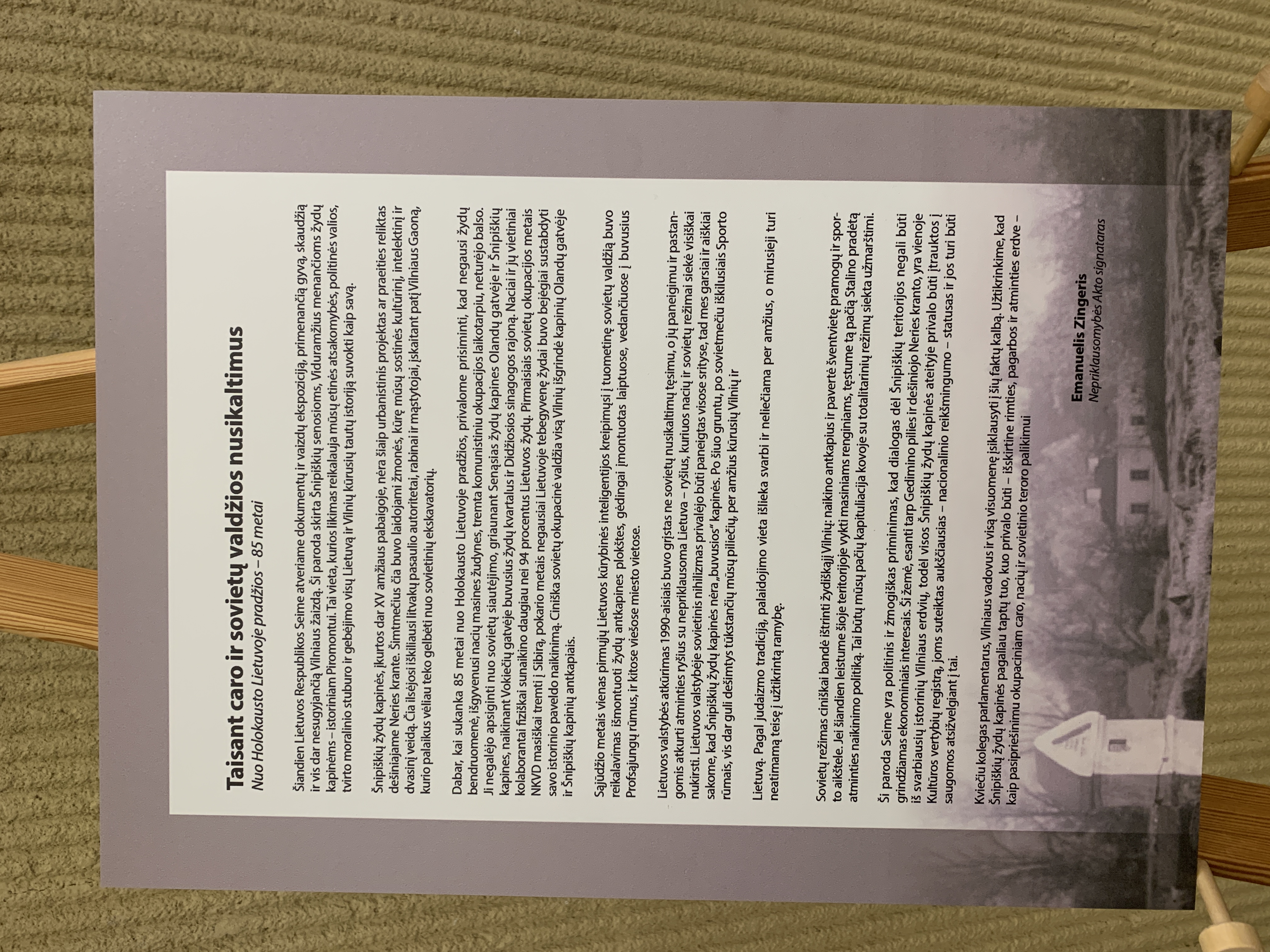
Editor’s note: The following is an English translation of the 3rd of the 18 exhibits featured in the current Seimas exhibition “The Jewish Cemetery in Šnipiškės, Vilnius” in the Stained Glass Gallery of the Seimas, Lithuania’s Parliament (The original Lithuanian panel is online). The exhibition, running from 17 to 24 September, is being presented under the auspices of Member of Parliament Emanuelis Zingeris whose own statement appears here (Lithuanian original).The exhibition was prepared by Artūras Imbrasas together with the association Gerbkime kapines (“Respect Cemeteries”). The creative team also includesd the association’s chair, Rūta Bloštein, as well as Arkadij Kurliandčik, Andrius Kulikauskas and Edmundas Kulikauskas.
◊
Redressing the Crimes of Tsarist and Soviet Rule
85 Years Since the Beginning of the Holocaust in Lithuania
Today, in the Seimas of the Republic of Lithuania, we open an exhibition of documents and images recalling a living, painful wound in Vilnius that has yet to heal. The exhibition is dedicated to the old Jewish cemetery in Šnipiškės, dating back to the Middle Ages — historic Piramónt. The fate of this place demands our ethical responsibility, political will, moral resolve and an ability to regard the history of all the peoples who built Lithuania and Vilnius as our own.