


OPINION | OLD VILNA JEWISH CEMETERY AT PIRAMÓNT: 2015-2025 | EARLIER OPPOSITION | 2023-2024 “WORKING GROUP” ON VILNA CEMETERY | LIST OF MEMBERS | MOUNTING OPPOSITION TO NEW “MUSEUM PROJECT” | USCPAHA (UNITED STATES COMMISSION FOR THE PRESERVATION OF AMERICA’S HERITAGE ABROAD) | THE CPJCE (COMMITTEE FOR THE PRESERVATION OF JEWISH CEMETERIES IN EUROPE) | THE AJC (AMERICAN JEWISH COMMITTEE) | THE CER (CONFERENCE OF EUROPEAN RABBIS) | THE GWF (GOOD WILL FOUNDATION) | CEMETERIES & MASS GRAVES | HUMAN RIGHTS
Undoing a Soviet Wrong: Preserving the Šnipiškės Jewish Cemetery
by Rabbi Sholom Ber Krinsky
March 11, 2026
Thirty-six years ago today, Lithuania captured the world’s attention. In the face of the Soviet Union—an empire that former U.S. President Ronald Reagan famously called the “evil empire” for its ruthless disregard for morality and human dignity—the people of this small nation chose courage over fear, leading to the dissolution of the Soviet Union.
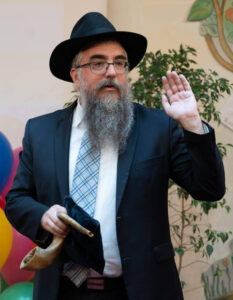
Vilnius’s Rabbi Sholom Ber Krinsky, the city’s only resident rabbi for 32 years
In January 1991, unarmed citizens stood before Soviet tanks in the center of Vilnius. Some gave their lives for freedom, facing unimaginable danger for the cause of dignity and self-determination. They did not know how the story would end—but they knew they could no longer live under the degrading brutality and soulless power of the Soviet system. They stood up—and they prevailed.
History has shown again and again that empires ultimately collapse when they lose their moral and spiritual compass. When conscience disappears, even the largest armies and the most formidable arsenals eventually become irrelevant.
Today, Lithuania stands proud as a democratic, forward-looking European nation. Yet it now faces a profound moral question: how should it treat the historic Šnipiškės Jewish Cemetery, a sacred site scarred by the callousness of the Soviet regime?
For centuries, Vilnius was one of the great centers of Jewish learning and life in Europe. Generations of Jews lived, prayed, studied, and built their families here. Many of the most revered spiritual luminaries of Lithuanian Jewry were laid to rest in this cemetery.
Judaism is unequivocal on this matter. A cemetery is a sacred place, known as a Bais Hachayim—literally, a “House of the Living.” It is a place that must be respected and honored in every possible way. Above all, it must be left untouched and undisturbed, preserving the dignity of those who rest there for eternity.
The answer cannot be to repurpose the site.
The “Sport Palace” building on top of the cemetery should not be used—period. It should not become a convention center. It should not become a museum.
It should not be used to memorialize a Lithuanian freedom movement. Lithuania’s freedom movement should be commemorated in a way that repudiates Soviet brutality, not in a place that embodies it. To celebrate the struggle for freedom by making use of a site that stands as a stark example of Soviet remorselessness would contradict the very values that inspired that struggle in the first place.
It should not even become a Jewish memorial complex.
The cemetery should remain exactly what it was before the Soviets attempted to erase it: a Jewish cemetery that properly honors and respects those interred there, and preserves the memory of the generations who lived in this city for so long.
Preserving this sacred cemetery is not without cost. Its central location in a rapidly developing European capital makes it attractive for investment. The Soviet-era building atop it is an eyesore. Yet moral clarity demands courage over convenience. Protecting this site—and removing the Soviet structure from this land—is not just preservation; it is a profoundly anti-Soviet act, a stand for conscience, justice, and respect for those who cannot speak for themselves.
For if decisions are guided only by considerations of convenience or economic gain, we risk repeating the very moral blindness that characterized Soviet rule.
Since 1994, it has been my honor to represent Chabad-Lubavitch in Lithuania and to help reconnect Lithuania’s Jewish community with the rich and storied heritage that once made this country world-renowned in the Jewish world.
During the Soviet era, Chabad emissaries were hunted, imprisoned, and sometimes killed for the “crime” of teaching Torah and preserving Jewish life. Many endured years of suffering in the gulags of Siberia simply for refusing to let the flame of Jewish faith and tradition be extinguished. Their devotion to spirituality and holiness represented the very antithesis of Soviet ideology—and that is precisely why they were persecuted.
Their courage reminds us of a timeless truth: spiritual conviction and moral clarity are stronger than any empire.
Lithuania now has the opportunity to take another step forward in its moral journey. By leaving the Šnipiškės Jewish Cemetery untouched while removing the Soviet era building and allowing those buried there to rest in peace, the nation honors both its own hard-won freedom from Soviet oppression and the generations of Jews who made Vilnius their home.
This moment is about far more than removing Soviet statues or symbols. It is about reversing, in whatever measure possible, the injustices left in the wake of war and occupation. It is about placing yet another nail in the coffin of the Soviet legacy.
Above all, it is about affirming that Lithuania stands firmly for justice, conscience, and human dignity.
◊
Rabbi Sholom Ber Krinsky and Mrs. Nechama Dina Krinsky and their family have been living full-time in Lithuania since 1994, representing Chabad-
◊
Editor’s note: Today, on modern democratic Lithuania’s celebration of the thirty-sixth anniversary of its historic March 11, 1990 declaration of independence, Rabbi Sholom Ber Krinsky, the resident Chabad rabbi, and the city’s only all-year-round rabbi for over three decades, issued the above statement to Lithuania’s leaders with copies to leaders of major Jewish organizations internationally. It concerns the fate of the old Vilna Jewish Cemetery, whose roots go back to the fifteenth century, and where major scholars and untold thousands still lie buried. This follows Rabbi Elchonon Baron’s unforgettable one-minute speech at the National Academy of Sciences in January (and many previous statements in recent years), the rabbinic edict of Rabbi Samuel Jacob Feffer in 2015, and the heartfelt protest of former chief rabbi Chaim Burshtein which led to his dismissal over a decade ago.
The powerful statements by all of modern Vilnius’s rabbis have been joined by worldwide condemnations of both major projects to desecrate and destroy Lithuania’s major Jewish cemetery (where many thousands still lie buried, despite Soviet pilfering of the stones). The first is a project to cite a convention center in the ruin of the old Soviet “sports palace” (index to protests), and the second is to make a “museum” out of the ruin (with macabre debates abounding, about what percentage would be dedicated to Lithuanian independence, and what percentage to Jewish memory; index to protests). In both cases, thousands would clap at events and flush lavatories surrounded by thousands of graves of citizens of Vilna who, because of the Holocaust, have no descendants in the city to fight for the dignity and honesty of preservation of the plots their families purchased in perpetuity.
Issues of human rights and equal rights loom large: this would not be happening to a cemetery of the country’s majority ethnicity and religion. In the opinion of this journal, the United States taxpayer supported “USCPAHA” has behaved disgracefully by colluding with each of the desecration projects and failing to take a minimally clear moral stand on the very issue for which it exists. Similarly, the record of the American Jewish Committee (AJC) and the London-based CPJCE will go down in history in shame.
Interested readers can follow the portion of the saga that got underway in 2015 in Defending History’s section on the subject. This journal has also been proud to carry a series of essays by the world’s leading scholar of the history of the Old Vilna Jewish Cemetery, New York’s Professor Shnayer (Sid) Leiman. Lithuanian scholars Andrius Kulikauskas and Julius Norvila (Norwilla) have spoken out forcefully.
Rabbi Krinsky, one of the first to sign Ruta Bloshtein’s petition in 2016 , has today issued a powerful statement that displays courage and deep moral clarity, and has all the more weight coming from the one rabbi who has actually lived in Vilnius and cared for daily Jewish religious needs uninterruptedly for thirty-two years.