


LITHUANIA | POLITICS OF MEMORY | BLAMING VICTIMS | GLORIFYING PERPETRATORS | LAST REMNANT OF JEWISH PARTISAN RESISTANCE IN THE FORESTS OF LITHUANIA | HISTORY
◊
OPINION
◊
by Roland Binet (De Panne, Belgium)
◊
- “Soviet rule has disappeared. The Jews are left behind as fair game.”
- Entry of July 7, 1941. From Surviving the Holocaust: Kovno Ghetto Diary, by Avraham Tory.
◊
In the late sixties while working in a small company in Brussels my Jewish boss who had been “geschmuggelt’’ out of the ghetto in Lvov (former Lemberg, now Lviv, Ukraine) in a truck, before it was liquidated in 1942, had repeatedly told me that after his escape he had repeatedly tried to join with partisan groups in the area, mostly Polish or Ukrainian. Had they known that he was Jewish, he would have been killed outright. His luck was that he could pass himself off as a Pole as he spoke the language well. He had been fifteen years old at the time. I remembered these words recently on the occasion of the scandal that has erupted these past months regarding the Jewish Partisan Fort in the Rūdninkai Forest (Yiddish; Rudnitsker vald) which is now in danger of being erased due to the presence in that zone of the new German NATO Panzer Brigade (Litauenbrigade).
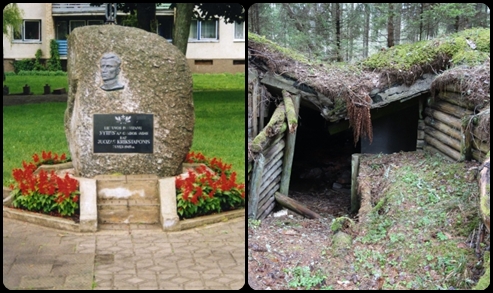
EFFECTS OF THE LITHUANIAN GOVERNMENT’S ‘MAGIC WAND’? Left: Public monument to Holocaust collaborator Juozas Krikštaponis (photo: Seimas). Right: One of the collapsing bunkers at Lithuania’s only relic of the Jewish anti-Nazi resistance that sits next door to Germany’s new Panzer brigade and may soon disappear (photo: DefendingHistory.com).
In a recent article in Der Spiegel journalist Solveig Grothe writes that after having inquired on that subject with Lithuanian authorities, the director of the Center for the Research of Genocide wrote her that “The Soviet partisans in Lithuania were from 1941 to 1945 part of the Soviet armed forces fighting against Nazi Germany. Their activities are considered hostile towards the sovereign Lithuanian State.” We could easily disregard such a blatant distortion of the historical truth related to the Jews who had survived extermination in their country but I know from my personal visit at the Genocide Museum that Lithuanian officialdom are far more interested in counting and weeping for the postwar Forest Brothers than for their former Jewish countrymen. Solveig Grothe had also noticed that difference in treatment when she visited that museum, now renamed Museum of the Occupations and the Fight for Freedom, having seen “only a small cell in the basement is allocated for the murder of the Jews.”
But worse was to come. In reply to queries from a number of journalists about the fate of the one surviving relic of Jewish anti-Nazi resistance, an official of the Department of Cultural Heritage under the ministry of Culture of Lithuania concluded his long answer stating that:
This object would also essentially meet the criteria of the Law on the Prohibition of Totalitarian and Authoritarian Regimes and Their ideologies, according to which it could potentially be removed as a public object promoting totalitarian and authoritarian regimes and their ideologies.
The ideology in question having been Soviet and the main argumentative point being that the surviving Jews had been part of Soviet partisan units. And here comes the crux of the whole schizoid and perverted demonstration by Lithuanian officialdom:
This anti-Nazi armed underground, inspired by Moscow as early as 1941, in Lithuania served the political interests of the USSR and operated as a force seeking to consolidate a new Soviet occupation (re-occupation), pursuing these aims through various means, including repressive and even criminal methods.
In order to try to counter such blatant deformation of the historical reality not only in Lithuania but in that country as part of a world then gripped by a world war, let me concentrate on two points:
(1) What was happening between 1941 and 1945 in a world at war of which Lithuania had been nolens volens a constitutive part as a country rapidly occupied by Nazi Germany but which opted thanks to appeals to the population by the LAF and the Provisional Government, as early as June 23, 1941, “to get rid of its Jewish population,” which it did as rapidly and in a masterly fashion, and,
(2) had the surviving Jews or those who had joined fighters’ units inside the ghettos had other choices than joining Soviet led or inspired armed partisans at a time and place where the Soviet Union, in those years in alliance with Great Britain and the United States and the other Allies, was the only force seriously fighting the Nazis in Eastern Europe?
‘Fania’s Fort’ in the Lithuanian forest.
The currently unfolding saga.
At the time of the invasion of the USSR by Nazi Germany, only Great Britain was still at war with Germany and a handful of armed units from Poland, the Netherlands, France, and Belgium. Great Britain could of course count not only on its inhabitants in the United Kingdom but also on armies from the Anzac countries, Canada, India and South Africa. After the cowardly attack on Pearl Harbor in December 1941, Hitler declared war on the United States on December 1941. Prior to that fateful decision, the United States had already signed a Lend-Lease agreement with the USSR in October 1941, paving the way for sending merchandise, material and other commodities to that country suffering from grave shortages. On January 1, 1942, the United Nations’ Declaration was signed in Washington, by which 26 allied countries engaged themselves to use all their resources to vanquish the powers of the Nazi Axis.
So, dear ladies and gentlemen of current Lithuanian officialdom, since the very first day of the year 1942, the USSR was allied to Great Britain, the United States and 24 other countries at war with Nazi Germany. But, in Lithuania, the surviving Jews remained fair game. Some joined partisan units. What are the rules and customs of war as defined by The Hague Convention of 1899 and its Annex dated October 18, 1907? The First Article of the Annex stipulates that the rules, customs and duties of war apply not only to the armies but also to militias and volunteers’ corpses on condition to have someone responsible as a leader, to bear distinctive and at distance recognizable signs, to bear weapons openly, and to conform during operations to the laws and customs of war. Non-Communist and Communist-ruled partisans in Lithuania as in other countries were in fact allied to the United States, the United Kingdom and 24 other signatory nations of the United Nations’ Declaration. They fought a legally founded war against the aggressor of their country – Nazi Germany – as well as persons or units that collaborated in the war on the side of the Germans. The anti-Nazi partisans comprised Lithuanians, Latvians, Belarusians, Russians and others; Jews were a distinct minority.
What of the surviving Jews in Lithuania? Under the Soviet occupation of their country, some of them had rejoiced or been part of the Nomenklatura, some had suffered at the hands of the Soviet regime, some unfortunate ones had been deported to Siberia on June 14, 1941. But, on June 22, 1941, the world for and around the Jews had crashed, brutally, in a fateful and irremediable way in de facto genocide. By 1942-1943, almost none of them had survived.
What were the few surviving Jews to do? Even when they had the luck to survive the killings they remained fair game only fit for slave labor and being murdered. In the adjacent Poland known for its rabid antisemitism, Hillel Seidman could write in his Diary of the Warsaw Ghetto:
It is a fact that although near 450,000 Jews have already been exterminated in Warsaw, not one single Jew has been hidden by a Pole…
In his Bloodlands, Timothy Snyder confirms the absence and silence of the Poles:
The commanders of the Interior Army (Armia Krajowa) from Warsaw had strategic preoccupations that dissuaded them to give weapons to the Jews (…) Despite these reservations, the Interior Army gave a few pistols to the Jewish Combat Organization in December 1942.
In his Kovno Ghetto Diary, Avraham Tory alluded to the practical difficulties the surviving Jews living by themselves in the forest experienced.
The forest camp of the Jewish refugees from Vilna has not yet been recognized by the central bodies of Soviet partisans. To achieve this, the camp must prove itself for an extended period of time by its ability and willingness to fight the enemy. This particular forest camp is, for the time being, merely a candidate to join the family of partisan camps in the forest.
In her remarkable diary A Partisan from Vilna, Rachel Margolis has written eloquently about the difficulties the surviving Jews who wanted to join partisans’ forces in the forests experienced, even from so-called Soviet fighters:
So, a bunch of Jews lounging about with nothing to do but beg for handouts. They are cowards. The Germans are doing the right thing to kill you.
Or when she and other survivors learned what had happened in a village to some surviving Jews, tricked by peasants and killed by them in the most odious manners.
In his monumental work The Holocaust in the Soviet Union, Yitzhak Arad concurs as to the Armia Krajowa for the Vilna zone:
FPO made contact with “Armia Krajowa,” the Polish underground in Vilnius and conducted negotiations concerning help in obtaining weapons. Following several weeks of talks, weapons were denied and ties with the Poles were severed.
He estimates that “between 600 and 700 people, almost all of them youths, left the Vilna Ghetto for the forests.” According to him, in Kovno there had not been successful endeavors to join partisan units in the forests, with the exception of about 160 people by mid-April 1944 (Karen Sutton mentions the figure of 300-400).
In her classic work The Massacre of the Jews of Lithuania, Karen Sutton also wrote about the Jewish partisans’ groups and the difficulties they encountered:
…conditions among the non-Jewish Lithuanian masses were adverse to Jews who wished to go into hiding. In 1941-1942, no organized anti-Nazi underground groups or even social-political cells as yet existed. The masses had no sense of solidarity or national cohesion with the Jewish community (…) Yitzhak Arad, himself a partisan, who researched and wrote about the Jewish resistance in the forests of Lithuania, recounted numerous difficulties including being shot at by Lithuanian or Polish nationalist units operating in the same vicinity (…) Many Jews who reached the forests were not accepted into partisan units. These non-combatants attempted to survive by setting up “family camps”. Unfortunately, nearly all inhabitants of these camps died from exposure or related causes or were murdered by Germans or local Lithuanians.
In Crisis, War and the Holocaust in Lithuania, Saulius Sužiedėlis devotes a large part of chapter five (“Survival, Destruction, Struggle”) to the different Jewish partisan groups, the difficulties they encountered in forming themselves, the debates and practical issues, and after they went to the forests, the obstacles they found on their way there and while living there within mainly Soviet-led partisan units. He also evokes the fact that anti-Nazi armed groups chiefly in eastern Lithuania were not the only armed groups, because deserters, bandits, Vlasovite collaborationist units, POWs and AWOL German soldiers, had formed in bands roaming the countryside and sometimes terrorizing the farmers and village inhabitants. It would perhaps be adequate to borrow one of the quotes he cites as a conclusion on the chapter of the partisans. It is from a book by James Glass (Jewish Resistance):
Partisan violence never produced indiscriminate consequences; it focused on specific ends. German violence, on the other hand, destroyed anything in its way.
As we have seen, a leading official Lithuanian Department of Cultural Heritage had depicted the Jewish anti-Nazi partisans as “having used criminal methods”. Well, this photo speaks for itself.
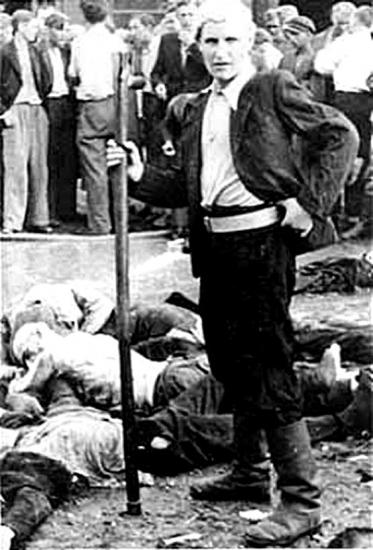
Here we have a Lithuanian man who at the Lietukis garage, in Kaunas, on June 27, 1941 – several days after the invasion of the country by Germany – helped kill dozens of unarmed, civilian innocent Jewish men who were walking about in town.
But, for the Jews who got lucky enough to escape from such monsters and who found refuge in whatever anti-Nazi unit likeable to accept them, the Lithuanian rewriters of history have the gall to insult and besmirch their sacred memory, qualifying them as akin to murderers and depriving them of one of the only remaining physical links attesting of their heroic fight in the face of such overwhelming adverse criminal and genocidal odds.
What unwholesome minds are capable of generating such propaganda, thinking that with their magic wand (and endless state funding), they can transform the local Hitlerist perpetrators of genocide into victims and heroes, at the same time trying to turn Jewish survivors of that genocide into criminals and enemies of the state. What a classic example of rewriting history by inverting the moral values now, 85 years after the greatest tragedy Lithuania had ever known. The nearly complete annihilation of the Jews of Lithuania.
◊
RELATED: