


MUSEUMS | BOOKS | LITVAK AFFAIRS | EVENTS | ANTISEMITISM
◊
OPINION
◊
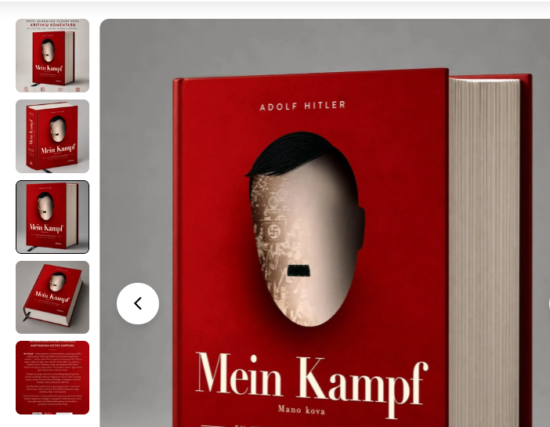
From the publisher’s website
VILNIUS—A 3 Dec. 2026 symposium (archived page) on the new Lithuanian edition of Hitler’s Mein Kampf will be starring Genocide Center director Dr. A. Bubnys, who wrote the introduction and, according to the publisher, oversaw the translation’s historical accuracy. His international notoriety includes his triumphant posing with posters of Holocaust collaborators J. Noreika and K. Škirpa (see coverage in Der Spiegel).
Participants identified as representatives of local Jewish community organizations or Holocaust survivors’ families? None. Is this a macabre replay of the lamentable January 2025 event at the same “Jewish museum”? Is bogus Jewish legitimacy (“the kosher stamp”) supposed to be conferred by holding the event in the Samuel Bak Museum premises at the “Vilna Gaon” museum? Was the great artist informed or consulted? The descendants of the Gaon?
The question for modern, beautiful, democratic Vilnius: When will Lithuania’s stunning capital have an intellectually free Jewish museum, at liberty to express (or even include) mainstream Western Holocaust scholarship and independent Jewish perspectives? Or will it remain a vehicle for the Double Genocide and Holocaust revisionism promoted by East European ultranationalists and the far right? For the endless contortionism to avoid the simple history of the LAF massacres of thousands of Lithuanian Jews in June 1941 before the arrival of German forces?
Does this event risk lending supposed Jewish institutional legitimacy to historical revisionists while leaving independent Jewish perspectives omitted and unrepresented? Is the discussion going to serve “in real life” as a promotional platform for the publisher and local supporters of a revival of readership for Mein Kampf in a sparkling new Lithuanian edition? The publisher advertises the 800-page hardback at €129, with a club-member price of €74.48, displayed as a 42% discount, and €2.97 in credit toward a future purchase for logged-in purchasers. Dispatch is expected around 10 December. In good time for Christmas and New Year’s gifts.
The beloved names of Samuel Bak and the Gaon of Vilna cannot shield the museum’s programming decisions from criticism. Not least when bold Lithuanian politicians and scholars have publicly questioned and critiqued the new Lithuanian edition of Hitler’s screed, advertised as a critical edition with historical annotations. They include Culture Minister Lukas Alsys, philosopher Gintautas Mažeikis, and educators Dr. Algis Bitautas and Algirdas Davidavičius. There has also been spirited public opposition from Gercas Žakas, head of Kaunas’s Jewish community, and the Israeli Embassy in Lithuania. To its great credit, the Lithuanian Publishers’ Association issued a statement noting that “at a time of rising antisemitism and hate speech, it is particularly important to assess the consequences of commercially distributing such a publication” which goes on to “support calls for the publisher to reconsider its decision to translate and distribute this book.”
In addition to these, what about including in the Dec. 3 event the elected head of the Vilnius Jewish Community and the city’s one resident rabbi in the discussion? Representatives of Yad Vashem and the U.S. Holocaust Memorial Museum? Or just move the event to the Genocide Center or the “Red-Brown Commission” and be done with it? Would they not be more expected institutional hosts for this event as now framed? Or is it “convenient” for them to have this in one of the supposedly “Jewish places” in town?
It is our firm conviction that the horde of state-sponsored Holocaust topic operatives are harming rather then enabling the healing processes of genuine reconciliation rooted in open, unfettered dialogue respecting also non state-institution approved perspectives, including those of the victims and survivors, their families, current Jewish communities, and the Western and Jewish traditions of tried-and-tested Holocaust scholarship.
Will the event explore the choice of author for the Lithuanian edition’s introduction and his record of honoring Holocaust collaborators? And will it address the implications of holding the event at the Samuel Bak Museum, part of the Vilna Gaon Museum of Jewish History? These questions become more pressing when the announced lineup identifies no representatives of local Jewish community organizations or Holocaust survivors’ families, and no scholars representing mainstream Western historiography, while including the publisher and two contributors to the new book on sale.
Last but not least, there is further material here for students of sophistry and doublespeak in their incarnation as Holocaust obfuscation in Eastern Europe. The very title of the 3 December discussion is: “Mein Kampf in Lithuania — scholarly edition or commerce?” Does framing the issue as “academic versus commercial” risk obscuring more compelling questions? Although the announcement raises concerns about antisemitism, will the discussion seriously examine whether the very publication and its astute promotion could serve antisemitic purposes at this juncture in history, with dispatch scheduled for the Christmas gift season? In a country where around 96% of the Jewish population was massacred, and where a powerful elite engages in complex acrobatics in a doomed effort to fix history.
Where — and when — will a coherent opposing position receive an equally substantial hearing here in Vilnius?