


According to historians, the largest slaughter of people in a single day in the history of the Baltic states occurred on the 29th of October 1941, when between nine and ten thousand Jews were gruesomely killed at the ‘Ninth Fort’ near Kaunas (Kovno), Lithuania, under Nazi German command. Highly motivated local forces carried out most of the killing and the associated humiliation and degradation of the victims. To mark the occasion there is a commemoration ceremony at the site held each year at midday on the last Sunday in October. This year it was held today, under a bright sun that warmed the clear chill of late fall in Lithuania.
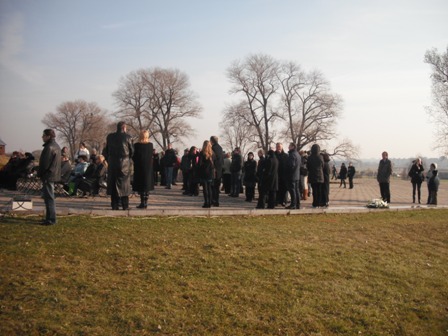 Organized by the Jewish Community of Kaunas, and addressed by its leader, Gercas (Hershl) Žakas, this year’s event drew just over a hundred people, filling less than half the paved plaza near the memorial dais. Survivors present expressed concern for the future status of Ninth Fort remembrance here, and Holocaust commemoration more generally. The concern echoes various factors, including the gradual disappearance of survivors and witnesses, the shrinking of the vestigial Jewish community, and the shifting political trends.
 Švenčioneliai, interwar Poland’s Nowo-Święciany). Such is the custom every year on the first Sunday in October, to remember the eight thousand Jewish civilians murdered there after a gruesome ten days of imprisonment, deprivation of basic human needs, and torture, in makeshift barracks here at the site, in October 1941. The eight thousand Jews were marched (with the lame and the old transported on wagons) from their hometowns in the area to the site on September 27th. They were all shot over a two-day period on the 7th and 8th of October 1941.